
Written by Md Rakib Hassan — Income Tax Practitioner with 10+ years of tax compliance and audit experience across Bangladesh and the UK. Former accounts manager at a UK chartered accounting firm managing 1,000+ clients, with direct experience resolving multi-year tax audit disputes with HMRC and the NBR. Currently Finance Controller at a UK-based multinational tech group.
Withholding tax Bangladesh — known locally as Utse Kor or উৎসে কর — is the mechanism through which the National Board of Revenue (NBR) collects income tax at the point of payment rather than at the end of the year. It is the single most broadly applicable tax obligation in Bangladesh, touching virtually every company, bank, hospital, NGO, and government body that makes payments to third parties.
Failure to correctly apply withholding tax Bangladesh obligations is one of the most common triggers for NBR audit proceedings. This guide, built on the authoritative TDS guidelines published by Tax Zone-2, Chittagong, explains every critical dimension of the system — who must deduct, which sections apply, what penalties follow non-compliance, and how to file through eTDS.
What Is Withholding Tax Bangladesh?
Withholding tax Bangladesh is a system of tax collection at source. When a designated entity makes a payment — for goods, services, rent, salary, dividends, royalties, or dozens of other categories — it is legally required to deduct a specified percentage of tax from that payment before it reaches the recipient.
The deducted amount is then deposited to the government treasury on behalf of the recipient. For the recipient, it represents a prepayment of income tax — either fully final or adjustable against their annual liability.
This system serves two purposes: it provides the government with a steady, real-time revenue stream rather than waiting for year-end assessments, and it dramatically reduces the scope for income under-reporting.
Who Must Deduct Withholding Tax in Bangladesh?
Not every person or entity making a payment must deduct tax. Withholding tax Bangladesh obligations apply to designated withholding entities. Under the Income Tax Act 2023, the following are required to withhold tax at source:
- Any company (including foreign companies operating in Bangladesh)
- Any firm or association of persons
- Any trust or fund
- Public-Private Partnerships (PPP)
- Any foreign contractor, foreign enterprise, or association established outside Bangladesh
- Any hospital, clinic, or diagnostic centre
- Any e-commerce platform with annual turnover exceeding BDT 1 crore
- Hotels, community centres, and transport agencies with annual turnover exceeding BDT 1 crore
- Any person engaged in the production and supply of tobacco leaves (other than farmers)
This list is comprehensive and deliberately broad. A start-up company from its first payment to a vendor, a diagnostic centre paying a pathologist, a hotel paying a cleaning company — all are withholding entities under withholding tax Bangladesh law.
Section-Wise Withholding Tax Rates — Key Categories
The rates under withholding tax Bangladesh are specified across Chapters 1, 2, and 3 of Part 7 of the Income Tax Act 2023, further detailed through the TDS Rules 2024 and their subsequent SRO amendments.
Salary (Section 86)
TDS on salary income is deducted at the average rate based on the employee’s estimated yearly taxable salary. There is no flat rate — the employer must calculate the full-year tax liability, divide by 12, and deduct monthly.
Workers’ Participation Fund — WPPF (Section 88)
Rate: 10% Deducted at the time of payment from the WPPF fund to employees.
Contractors and Suppliers (Section 89)
The most widely applicable withholding tax Bangladesh category. Key rates:
- General goods supply / manufacturing / packaging: 5%
- Tobacco and cigarette supply: 10%
- Import supply (netting formula): B – A where B = applicable TDS on sale, A = AIT paid at import
- Agricultural commodities (rice, wheat, potato, onion, garlic, pulses, cotton, yarn etc.): 0.5% (reduced from 1% in FY 2025–26)
- Books (to non-government entities): 3%
- Export-oriented garment sub-contracts: 1% (reduced from 5% in FY 2025–26)
Service Payments (Section 90)
- Advisory/consultancy fees — Individual: 15% | Company/firm: 7.5%
- Professional fees — Individual: 15% | Company/firm: 7.5%
- Technical service fee: 10%
- Event management, manpower, catering, courier, packing (gross bill): 2%
- Internet service: 5% (reduced from 10% in FY 2025–26)
- Mobile financial services agent/channel partners: 10%
Rent (Sections 109 & 110)
Rate: 10% on all property rents and convention hall/conference centre rents (doubled from 5% in FY 2025–26)
Dividends (Section 117)
- Company to company: 20%
- Individual with TIN: 10%
- Individual without TIN: 15%
Interest on Bank Deposits (Section 102)
- Companies: 20%
- Other than companies: 10%
- Public universities, ICAB, ICMAB, ICSB, approved funds: 10%
Non-Residents (Section 119)
Withholding tax Bangladesh on payments to non-residents is uniformly higher, reflecting the absence of domestic tax compliance mechanisms:
- Advisory or consultancy — Individual: 20% | Others: 10%
- Professional/technical services — Individual: 20% | Others: 10%
- Management services, legal services, commission: 20%
- Royalty, licence fees, intangibles: 20%
- Dividends to company/fund/trust: 20% | Others: 30%
- Artist, singer, player: 30%
- Salary/remuneration: 30%
- Contract or sub-contract: 7.5%
- Advertisement making or digital marketing: 15%
- Air/water transport: 7.5%
- Any other payment: 20%
Deposit Deadlines — A Critical Component of Withholding Tax Bangladesh
Correctly calculating the deduction is only half the obligation. Withholding tax Bangladesh compliance requires depositing the withheld amount to the government treasury within strictly defined deadlines under the TDS Rules 2024:
| Period | Deadline |
|---|---|
| July to May — any deduction | Within 2 weeks (14 days) following the end of the deduction month |
| 1st–20th June | Within 7 days from the date of deduction |
| 21st–28th June | Next day after deduction |
| 29th–30th June | Same day as deduction |
The June rules are particularly stringent because the government closes its books for the financial year on 30 June. Any withholding tax Bangladesh deposit that misses the June deadlines directly impacts annual compliance statistics and can trigger immediate audit enquiry.
Monthly Withholding Tax Return — Section 177
Every withholding entity must file a Monthly Withholding Tax Return (WHTR) under Section 177 of the Income Tax Act 2023 by the 15th of the following month.
The return must be filed with the relevant DCT circle (based on the taxpayer’s registered address) and must include:
- Details of all payments made subject to withholding tax
- Amount deducted in each TDS category
- Treasury challan references for deposits made
- Salary payment details (specifically in the April WHTR)
If the 15th falls on a public holiday or weekly holiday, the next working day becomes the filing deadline. An extended deadline of up to 15 additional days may be granted by the Additional Commissioner in appropriate cases.
Who must file: The filing obligation covers companies, firms, banking institutions, private hospitals, clinics, diagnostic centres, NGOs (excluding those with MPO-funded schools only), and all other entities with withholding obligations.
Consequences of Non-Compliance — Penalties Under the Income Tax Act 2023
Withholding tax Bangladesh non-compliance carries serious consequences. These are not administrative slaps — they include financial penalties, criminal liability, and reputational damage that takes years to recover from.
Failure to Deduct or Deposit — Section 143
Where a withholding entity fails to deduct or collect tax, deposits less than required, or fails to deposit deducted amounts, the following consequences apply:
The payer becomes a defaulting taxpayer (খেলাপি করদাতা):
- Liable for the full undeducted/undeposited amount
- Penalty of up to BDT 10 lakh under any provision of the Act
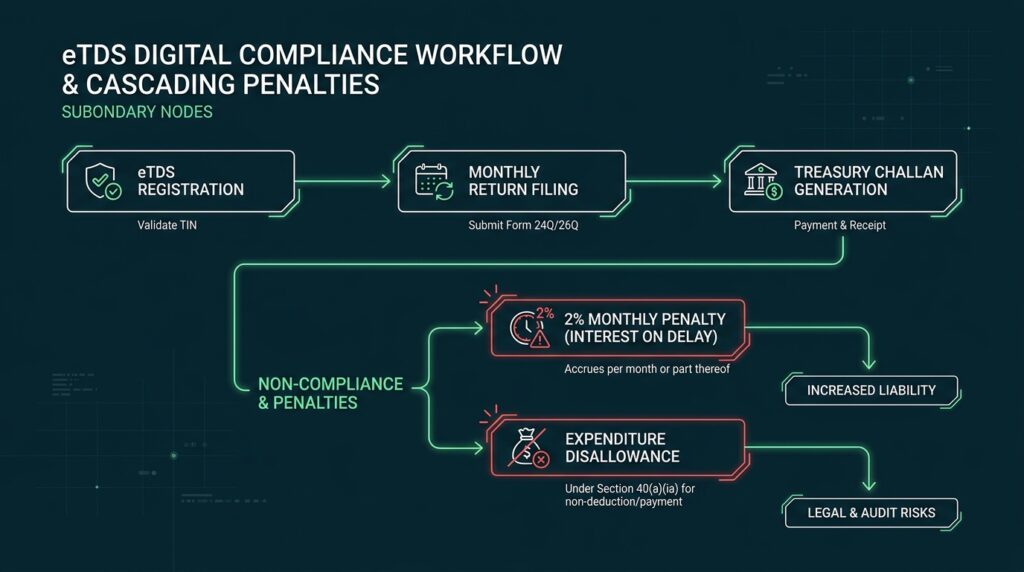
- 2% additional tax per month on the shortfall
- Up to 1 year imprisonment under Section 311 or fine under Section 315
Additional Interest on Late Deposit — Section 143(3)
Where tax was deducted but not deposited, 2% per 6 months interest is calculated from the due deposit date to the actual date of deposit, for a maximum period of 24 months.
Disallowance of Expenditure — Section 55
Where any payment is made without deducting the required withholding tax Bangladesh, the entire payment is disallowed as a business expense. This means the cost hits both the tax account (the disallowed expense increases taxable profit) and the balance sheet (a potential liability for the undeducted amount remains).
Failure to File Monthly Return — Section 266(2)
If a withholding entity does not file the Section 177 monthly return, the penalty is:
- The higher of 10% of the applicable tax or BDT 5,000
- Continuing failure: additional BDT 1,000 per month for each continuing month
Advance Tax — Section 155
Advance income tax under withholding tax Bangladesh framework is payable by companies in four equal instalments:
| Due Date | Instalment |
|---|---|
| 15 September | 25% of estimated annual liability |
| 15 December | 25% |
| 15 March | 25% |
| 15 June | 25% |
Where advance tax is underpaid, interest accrues on the difference between what was paid and what should have been paid. This interest cannot be waived.
Filing Through eTDS — Digital Compliance
The NBR has mandated that all withholding tax Bangladesh deductions, returns, and deposits must now be processed through the eTDS Environment portal at www.etds.gov.bd, established under S.R.O. 351-Law/Income Tax/2022 dated 06/12/2022.
Every withholding entity must:
- Register on the eTDS portal
- File all withholding tax returns electronically
- Generate challan through the portal
- Deposit via online banking or in-person at designated banks
The eTDS system is integrated with the NBR’s central tax database, meaning any mismatch between your eTDS filing and your counterparty’s tax account is flagged automatically. This has significantly increased the audit detection rate for withholding tax Bangladesh shortfalls.
Important account codes for Tax Zone-2, Chittagong:
| Circle | Organisation Code |
|---|---|
| Circle-23 (Company) | 1110217302617 |
| Circle-24 (Company) | 1110217302618 |
| Circle-25 (Company) | 1110217302619 |
| Circle-29 (Company) | 1110217302620 |
| Circle-30 (Company) | 1110217302634 |
| Circle-35 (Company) | 1110217302629 |
Economic Code: For company taxpayers — 1111301 | For non-company taxpayers — 1111101
Grossing Up — When Deduction Was Missed
Where a withholding tax Bangladesh entity pays an amount without deducting tax, Section 141 requires the tax to be calculated through grossing up:
Tax Payable = (100 × Amount Paid) ÷ (100 – Rate)
Example: Paid BDT 85,000 net to a consultant without deducting 15% TDS.
Tax = (100 × 85,000) ÷ (100 – 15) = 8,500,000 ÷ 85 = BDT 100,000 (gross), so tax owed = BDT 15,000.
Without grossing up, you would incorrectly calculate tax as 85,000 × 15% = BDT 12,750 — an understatement that creates residual liability.
Key Compliance Checklist for Withholding Tax Bangladesh
- [ ] Confirm your entity type is on the withholding entity list (mandatory)
- [ ] Map every payment category to the correct TDS section and rate
- [ ] Verify PSR status for all payees before applying standard rates
- [ ] Register on eTDS portal (www.etds.gov.bd) if not already done
- [ ] Set up treasury deposits before the 14th of each month (July–May)
- [ ] Respect June’s tightened deadlines (7-day, next-day, same-day rules)
- [ ] File Section 177 WHTR by 15th of every month
- [ ] Maintain TDS certificates (Section 145) for all payees
- [ ] Apply 50% surcharge where PSR is absent or payment is not by bank transfer
- [ ] Use grossing-up formula where deduction was missed
Conclusion
Withholding tax Bangladesh is the most operationally intensive tax obligation any business faces — because it recurs every month, applies to almost every payment, and is enforced through both financial penalties and criminal provisions. The system is not going to become simpler; with eTDS now mandatory and cross-referencing built into the NBR’s audit algorithms, errors are increasingly detectable.
The Finance Zone-2 Chittagong guidelines that form the basis of this blog represent the most authoritative ground-level guidance available to compliance professionals in Bangladesh. Every finance team should have a working copy.
Disclaimer: This guide is for informational purposes based on the Income Tax Act 2023, TDS Rules 2024, and TDS guidelines published by Tax Zone-2, Chittagong (2023). Always verify current rates and procedures via the NBR or a registered Income Tax Practitioner before filing.
Leave a Reply
You must be logged in to post a comment.