Written by Md Rakib Hassan — Income Tax Practitioner with 10+ years of tax compliance and audit experience across Bangladesh and the UK. Former accounts manager at a UK chartered accounting firm managing 1,000+ clients, with direct experience resolving multi-year tax audit disputes with HMRC and the NBR. Currently Finance Controller at a UK-based multinational tech group.
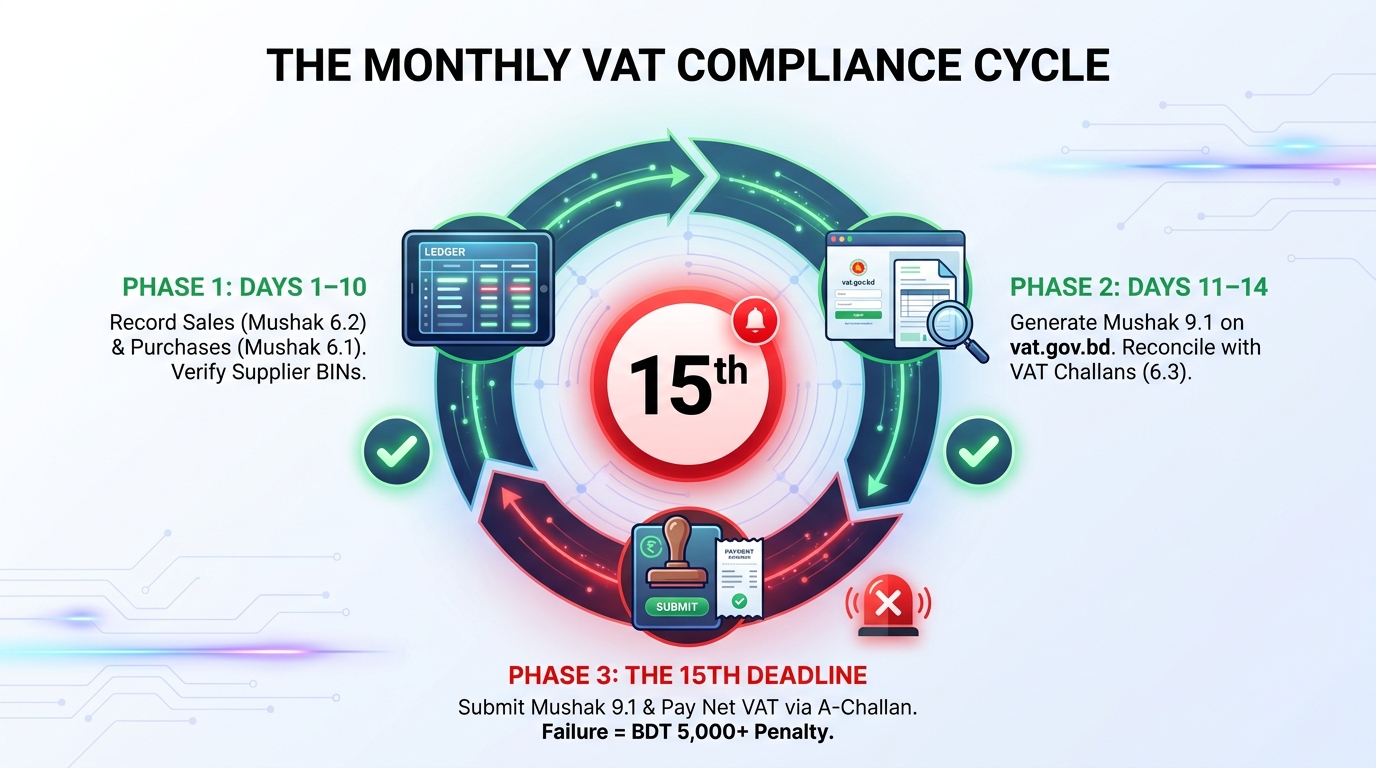
Every VAT-registered business in Bangladesh carries one non-negotiable monthly obligation: filing its VAT return. Under the VAT and Supplementary Duty Act 2012, this is not optional, not seasonal, and not something that can be skipped during quiet months. If your business holds a Business Identification Number (BIN), a VAT return — formally the Mushak 9.1 form — must be submitted to the National Board of Revenue (NBR) by the 15th of every month, every month, without exception.
In 2026, the entire VAT return submission process has moved online through the NBR’s VAT Online portal at vat.gov.bd. Understanding how vat bd regulations work, what the VAT return submission form requires, and how to navigate the online system correctly is not just a compliance matter — it is a direct protection against penalties, interest charges, BIN suspension, and the NBR audit triggers that arise from mismatched filing records.
This guide covers everything: what a VAT return is, who must file it, how to complete and submit the Mushak 9.1 vat return submission form online, the penalties for getting it wrong, and the professional practices that keep vat bd compliance clean and audit-proof.
What Is a VAT Return in Bangladesh?
A VAT return is the formal monthly declaration that a VAT-registered business submits to the NBR, reporting:
- Total value of taxable supplies (sales) during the tax period — the Output VAT
- Total VAT collected from customers on those supplies
- Total value of taxable purchases during the tax period — generating Input VAT
- Input VAT credits claimed against purchases
- Net VAT payable to the government (Output VAT minus Input VAT)
- Supplementary Duty (SD), if applicable to the business’s goods or services
- Closing balance carried forward to the next period
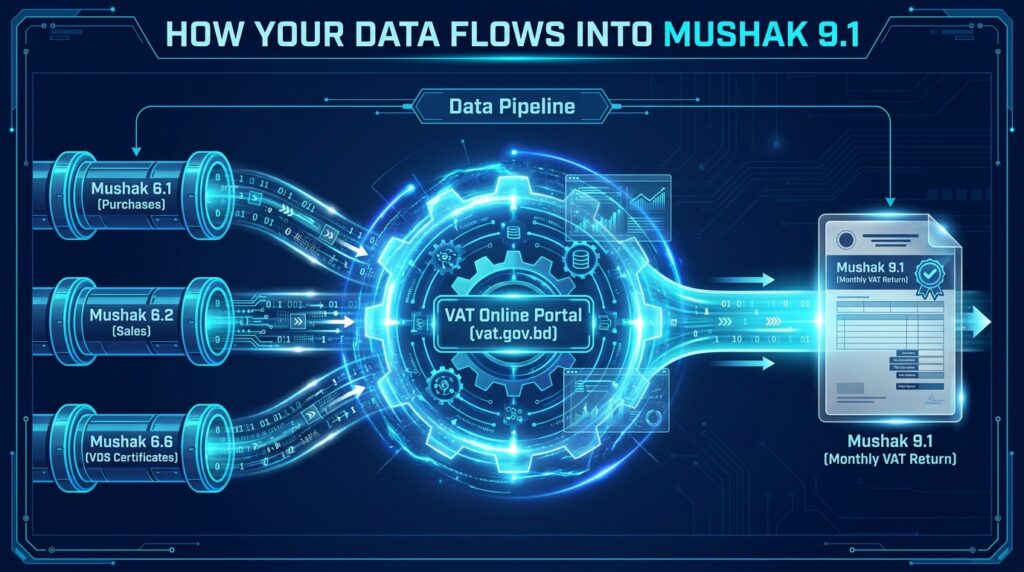
The VAT return in Bangladesh is submitted on the official VAT return submission form known as Mushak 9.1 — the standard monthly return under the VAT and Supplementary Duty Act 2012. Every part of the vat return process — from invoice recording to Mushak form generation to payment — is governed by this Act and administered by the NBR.
VAT was first introduced in Bangladesh in 1991 and underwent a landmark overhaul when the VAT and Supplementary Duty Act 2012 came into force in July 2019. The new Act introduced the Integrated VAT Administration System (IVAS), automated Mushak forms, and the vat online bd portal that now manages the complete digital VAT return cycle.
Who Must File a VAT Return in Bangladesh?
Any business or entity that has obtained a BIN (Business Identification Number) from the NBR is legally required to file a monthly VAT return. This includes:
- Manufacturers producing taxable goods
- Importers bringing taxable goods into Bangladesh
- Exporters (zero-rated, but still required to file a VAT return)
- Service providers supplying taxable services (standard rate: 15%, or sector-specific reduced rates)
- Traders and retailers with annual turnover exceeding BDT 80 lakh (BDT 8 million)
- Turnover tax registrants with annual turnover between BDT 30 lakh and BDT 80 lakh
- Government and semi-government entities that make taxable purchases and withhold VAT at source (VAT Deducted at Source — VDS)
- All companies — private limited, public limited — that are VAT-registered
Critical rule: Even if a business has zero transactions during a particular month — no sales, no purchases, zero VAT liability — a nil VAT return (Mushak 9.1 with all zeros) must still be filed by the 15th of the following month. Failure to file a nil return when required attracts the same penalties as failure to file a return with tax due.
VAT Rates in Bangladesh: What You Are Filing For
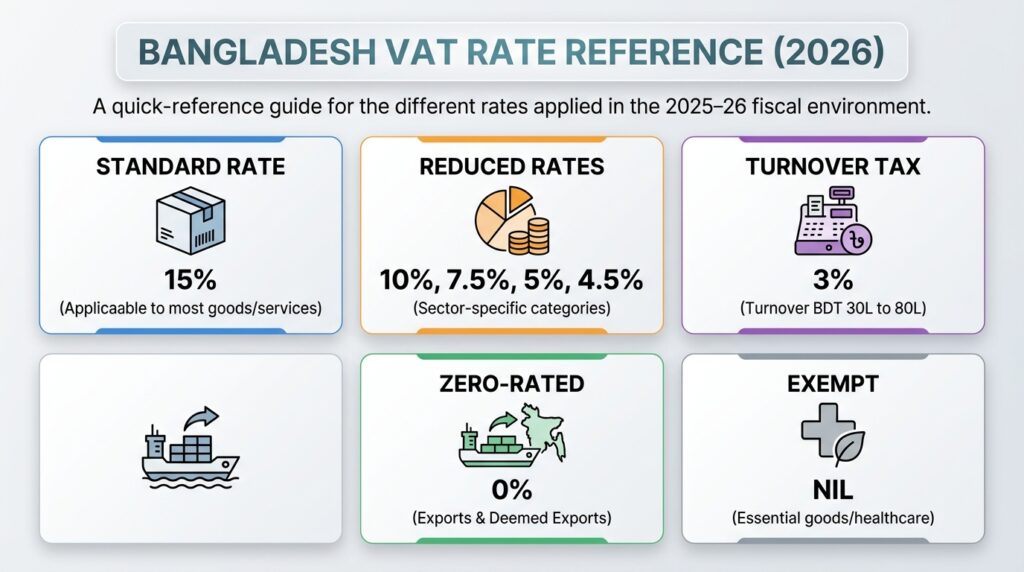
Understanding the rate structure is essential for completing an accurate VAT return. Bangladesh’s vat bd rate system under the VAT and Supplementary Duty Act 2012:
| Rate | Category |
|---|---|
| 15% | Standard rate — applicable to most goods and services |
| 10% | Selected services (e.g., certain construction services) |
| 7.5% | Selected services (e.g., certain transportation, audit/accounting services) |
| 5% | Selected goods and services |
| 4.5% | Specific reduced rate categories |
| 3% | Turnover tax — businesses with turnover BDT 30L to 80L |
| 0% | Exports (zero-rated — eligible for input VAT credit) |
| Exempt | Essential goods (rice, vegetables, basic healthcare, etc.) — no input credit |
The correct VAT rate for each supply must be applied on every Mushak 6.3 tax invoice issued, and accurately declared on each monthly VAT return submission form. Using the wrong rate is one of the most common audit triggers in Bangladesh VAT compliance.
The VAT Return Submission Form: Mushak 9.1 Explained
The VAT return submission form — Mushak 9.1 — is a multi-part document that comprehensively records every taxable activity during the month. Understanding its structure prevents the data entry errors that cause mismatches with other Mushak records.
Key Sections of Mushak 9.1
Part 1 — Taxable Supplies (Output VAT) Records all sales and supplies made during the month, categorised by rate:
- Standard-rated supplies (15%)
- Reduced-rate supplies
- Zero-rated exports
- Deemed exports
- Exempt supplies
For each category, the form requires: quantity, value, applicable VAT rate, and VAT amount collected. These figures must match your Mushak 6.2 (Sales Register) for the month.
Part 2 — Taxable Purchases (Input VAT) Records all purchases on which input VAT is claimed:
- Local purchases (with valid Mushak 6.3 tax invoices)
- Imports (with customs documentation)
Input VAT credit can only be claimed against purchases with valid, legally compliant Mushak 6.3 invoices. Invalid, unregistered, or unverifiable invoices — particularly from suppliers whose BIN cannot be verified — are a leading cause of VAT audit triggers in Bangladesh.
Part 3 — VAT Calculation The system automatically calculates:
- Total Output VAT (from Part 1)
- Total Input VAT (from Part 2)
- Net VAT Payable = Output VAT − Input VAT
- Closing balance carried forward or refund position
Part 4 — Supplementary Duty (SD) Applicable only to businesses dealing in SD-subject goods (tobacco, luxury items, certain beverages). Reported separately from VAT.
Part 5 — Declaration The authorised signatory declares that all information in the VAT return submission form is complete, true, and accurate. Any false declaration is subject to penal action under the VAT and Supplementary Duty Act 2012.
VAT Online BD: How to File Your VAT Return at vat.gov.bd
The vat online bd portal at vat.gov.bd is the NBR’s official digital platform for all VAT-registered business activities in Bangladesh — BIN registration, Mushak form management, VAT return submission, and payment.
Here is the complete step-by-step process for filing your VAT return online:
Step 1: Prepare Your Monthly Records
Before logging into vat online bd, compile the following data for the month:
- Mushak 6.3 sales invoices: Every tax invoice issued to customers, with BIN, value, and VAT amount. Total these by rate category.
- Mushak 6.2 Sales Register: The consolidated list of all sales transactions for the month.
- Mushak 6.1 Purchase Register: All purchases from registered suppliers with valid BIN and Mushak 6.3 invoices.
- Mushak 6.5 Stock Transfer records: If applicable (for multi-branch or manufacturing operations).
- Mushak 6.6 VDS certificates: VAT Deducted at Source certificates received from customers who withheld VAT.
- Mushak 6.7/6.8 Credit/Debit Notes: Any sales returns or purchase adjustments during the month.
- Previous month’s closing balance: From your last VAT return.
Professional tip: Maintaining a monthly VAT-readiness file throughout the month — not just in the days before the 15th deadline — is the single most effective practice for clean, penalty-free vat return submission. Many NBR audit issues trace directly to rushed last-minute entries.
Step 2: Log Into the VAT Online BD Portal
Navigate to vat.gov.bd and log in using your BIN and password. If you are a new user, create an account using your BIN number and the contact details registered with the NBR. OTP verification via mobile and email is required for account activation.
Step 3: Navigate to Return Filing
From your dashboard, select “Return” or “Mushak 9.1” from the main menu. Select the tax period — the month and year for which you are filing.
Step 4: Complete the Mushak 9.1 VAT Return Submission Form
Work through each section of the VAT return submission form systematically:
- Enter your taxable supply totals by category (standard-rated, reduced-rate, export, exempt)
- Enter input VAT claims from verified purchase invoices
- Record VDS certificates received (which reduce your net payable)
- Enter any carry-forward balance from the previous month’s VAT return
- Review the system-calculated net VAT payable
Cross-reference discipline: Before proceeding, verify that the sales figures in your Mushak 9.1 VAT return submission form match the totals in your Mushak 6.2 Sales Register for the month. Similarly, input VAT claims must match your Mushak 6.1 Purchase Register. These are the two most common mismatch points that trigger NBR queries.
Step 5: Attach Supporting Documents (If Required)
The vat online bd portal has an attachments facility. Upload any required supporting documents — typically relevant for businesses with complex supply structures, export claims, or SD payments.
Step 6: Review and Submit
Carefully review all figures before final submission. Once submitted, a VAT return cannot be easily amended — any corrections require a separate amended return filing process through the NBR.
Click Submit to file the VAT return for the period.
Step 7: Pay Net VAT Due
If your Mushak 9.1 shows a net VAT payable, payment must be made by the 15th of the month — the same deadline as the return itself. Payment options through vat online bd and the wider NBR payment system include:
- A-Challan (ibas.finance.gov.bd/acs): Generate a challan online and pay via internet banking, bKash, Rocket, or Nagad
- NBR-Sonali Bank e-payment portal (nbrepayment.gov.bd): Direct payment using bank cards or mobile financial services
- Bank branch challan: For those preferring in-person payment, though increasingly discouraged in the digital-first compliance environment
Keep the payment challan as proof — it is required for reconciliation with your VAT return records and for NBR audit defence.
VAT Return Deadline and Penalty Structure
| Event | Deadline / Rate |
|---|---|
| Monthly VAT return submission | 15th of the following month |
| Monthly VAT payment | 15th of the following month |
| Late filing penalty | BDT 5,000 or more (per return) |
| Late payment interest | 2% per month on unpaid VAT |
| BIN suspension | After consecutive missed filings |
| NBR VAT audit trigger | Mismatch between VAT return and income tax return |
Real professional insight: The 15th-of-month deadline for VAT return submission is the most consistently enforced deadline in Bangladesh’s tax system. The NBR’s digital monitoring system automatically flags BINs that miss the deadline, generating penalty notices with minimal human intervention. Missing even one month’s VAT return — even a nil return — initiates a compliance record that makes future audit selection more likely.
VAT BD: The Input Tax Credit System
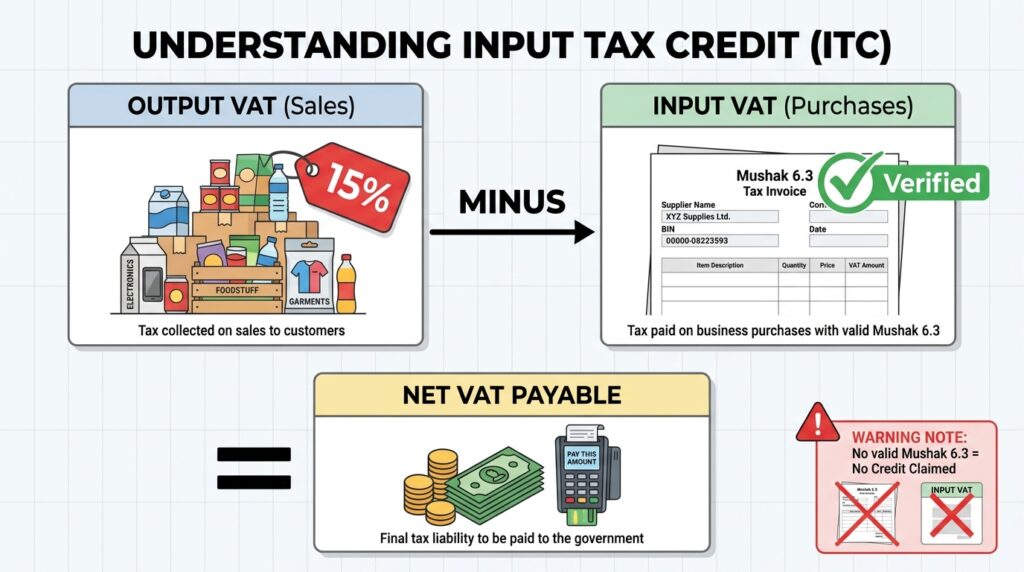
The most powerful tool in the vat bd compliance framework is the Input Tax Credit (ITC) mechanism — the core principle that distinguishes VAT from a simple sales tax.
How Input Tax Credit works:
When your business buys goods or services from a VAT-registered supplier, you pay VAT on those purchases. This VAT you paid is your Input VAT. When you sell to your customers, you charge VAT — this is your Output VAT. In your monthly VAT return, you subtract Input VAT from Output VAT. You only remit the difference to the government.
Example (BDT):
| Transaction | Amount | VAT @ 15% |
|---|---|---|
| Purchases (Input) | 5,00,000 | 75,000 (Input VAT) |
| Sales (Output) | 8,00,000 | 1,20,000 (Output VAT) |
| Net VAT Payable | 45,000 |
This mechanism prevents “tax on tax” — each business in the supply chain only pays VAT on the value it adds, not on the full price of goods.
Critical ITC rules for your VAT return:
- Input VAT can only be claimed against purchases backed by valid Mushak 6.3 tax invoices from registered suppliers
- The supplier’s BIN on the invoice must be verifiable and active
- Purchases from unregistered suppliers or with irregular invoices do not qualify for ITC
- If your Input VAT exceeds Output VAT (a credit position), the excess can be carried forward to the next month’s VAT return; cash refunds require a formal NBR application and approval process
Common VAT Return Mistakes That Trigger NBR Audits
From my professional experience dealing with NBR VAT compliance across diverse industries in Bangladesh:
Mismatch between VAT return revenue and income tax return revenue. The NBR cross-matches the total taxable supplies declared across your twelve monthly VAT returns against the revenue declared in your annual income tax return. Discrepancies are automatically flagged. If the difference is material and unexplained, an audit is initiated.
Claiming ITC on invalid invoices. Purchasing from suppliers without a valid, current BIN — or accepting invoices where the BIN cannot be verified on vat.gov.bd — and then claiming ITC on those purchases is one of the highest-risk practices in vat bd compliance. Always verify supplier BINs before processing invoices.
Incorrect VAT rate application. Applying 15% where a reduced rate applies, or vice versa, produces incorrect VAT return figures that are detectable during sector-specific audits.
Filing nil returns when transactions occurred. Some businesses mistakenly file nil VAT returns for months where they had actual transactions but did not maintain proper records. When those transactions later surface through TDS records or banking data, the inconsistency creates serious legal exposure.
Missing the 15th deadline. Late VAT return submission is the single most common VAT compliance failure in Bangladesh. Set calendar reminders for the 10th of every month — giving five days buffer before the 15th deadline.
Not keeping VAT records for five years. Under the VAT and Supplementary Duty Act 2012, all VAT records — invoices, registers, VAT return submissions, payment challans — must be retained for a minimum of five years. NBR audit selection can cover up to five previous tax periods.
The Mushak Forms Ecosystem: Understanding the Full VAT Compliance Picture
Your monthly VAT return (Mushak 9.1) sits at the centre of a broader ecosystem of Mushak forms that must all be consistent. Here is the complete picture:
| Mushak Form | Description | Link to VAT Return |
|---|---|---|
| Mushak 2.1 | VAT registration application form | Foundation of BIN |
| Mushak 2.3 | VAT registration certificate (BIN) | Your authority to charge VAT |
| Mushak 6.1 | Purchase Register | Feeds Input VAT into Mushak 9.1 |
| Mushak 6.2 | Sales Register | Feeds Output VAT into Mushak 9.1 |
| Mushak 6.3 | Tax Invoice (VAT Challan) | Supports both 6.1 and 6.2 entries |
| Mushak 6.4 | Input-output coefficient (manufacturing) | Used for production-based VAT calculation |
| Mushak 6.5 | Stock transfer document | Declared in VAT return |
| Mushak 6.6 | VDS Certificate | Reduces net payable in Mushak 9.1 |
| Mushak 6.7 | Credit Note (sales return) | Adjusts Output VAT in VAT return |
| Mushak 6.8 | Debit Note (purchase return) | Adjusts Input VAT in VAT return |
| Mushak 9.1 | Monthly VAT Return | The return itself |
| Mushak 18.6 | Adjustments and closing balances | Sub-form within Mushak 9.1 |
Every Mushak form in this chain must be consistent with every other. The NBR’s IVAS system cross-validates them automatically — which is why a discipline of accurate, timely record-keeping throughout the month is not administrative overhead, it is essential audit protection.
VAT Return for Exporters: Zero-Rating and Refunds
Exporters occupy a special position in Bangladesh’s vat bd framework:
- All exports are zero-rated — no VAT is charged on export sales
- However, exporters pay Input VAT on their purchases of goods and services used in export production
- This creates a net credit position on the monthly VAT return: Input VAT exceeds Output VAT
Exporters can either:
- Carry forward the Input VAT credit to offset future VAT payable months
- Apply to the NBR for a VAT refund — a formal process involving documentation of export sales, duty drawback certificates, and bank foreign exchange encashment certificates
VAT refund processing in Bangladesh has historically been slow. Most exporters prefer to carry the credit forward where their business structure permits.
Frequently Asked Questions
What is the VAT return deadline in Bangladesh? The monthly VAT return (Mushak 9.1) must be submitted by the 15th of the following month. For example, January’s VAT return is due by 15 February. VAT payment is also due on the same date.
What is the penalty for late VAT return filing? Late submission attracts a penalty of BDT 5,000 or more per missed return, plus 2% per month interest on any unpaid VAT amount. Consecutive missed returns can result in BIN suspension by the NBR.
Can I file a VAT return with zero transactions? Yes — and you must. A nil VAT return (Mushak 9.1 with all figures at zero) is required every month even if no business transactions occurred. Failure to file nil returns attracts the same penalties as missing a return with tax due.
Do I need to upload documents when filing online? The vat online bd portal has an attachments facility, but document uploads are not always mandatory for standard monthly returns. However, keep all Mushak forms, invoices, and registers available — the NBR may request them during audits or queries.
What is the VAT registration threshold in Bangladesh? Standard VAT registration (BIN) is required when annual taxable turnover exceeds BDT 80 lakh (BDT 8 million). Turnover tax enlistment applies for businesses with turnover between BDT 30 lakh and BDT 80 lakh (taxed at 3% instead of 15% VAT).
Where do I file my VAT return online in Bangladesh? All VAT return submissions are made through the NBR’s vat online bd portal at vat.gov.bd, using your BIN and registered account credentials.
Final Thoughts: Treat Your VAT Return as a Monthly Business Discipline
The VAT return is the most frequent formal compliance interaction your business has with the NBR — monthly, every month, for as long as your BIN is active. Unlike annual income tax returns, there is no room for letting it slide and catching up later. The penalties start from the day after the 15th, the audit triggers start from the day your VAT return figures diverge from your invoice records, and the BIN suspension risk starts from consecutive missed filings.
The vat online bd portal at vat.gov.bd has made the process genuinely accessible. The system is digital, the Mushak 9.1 VAT return submission form is structured to guide you through every section, and payment can be made in minutes via bKash or internet banking.
What makes the difference between stress-free monthly VAT return filing and last-minute scrambling is the discipline of maintaining your Mushak records throughout the month — not in the 48 hours before the 15th deadline. Build that discipline, and vat bd compliance becomes a routine rather than a crisis.
Need professional support with your monthly VAT return in Bangladesh — including Mushak 9.1 preparation, vat online bd submission, NBR audit response, or VAT registration? As a tax practitioner with direct NBR experience, I provide end-to-end VAT compliance services for businesses across Bangladesh and the UK. Get in touch.
Tags: vat return, vat return submission form, vat bd, vat online bd, mushak 9.1, vat return bangladesh, vat return filing bangladesh 2026, NBR VAT, vat.gov.bd, bin bangladesh, input tax credit bangladesh, mushak formsShare
Leave a Reply
You must be logged in to post a comment.