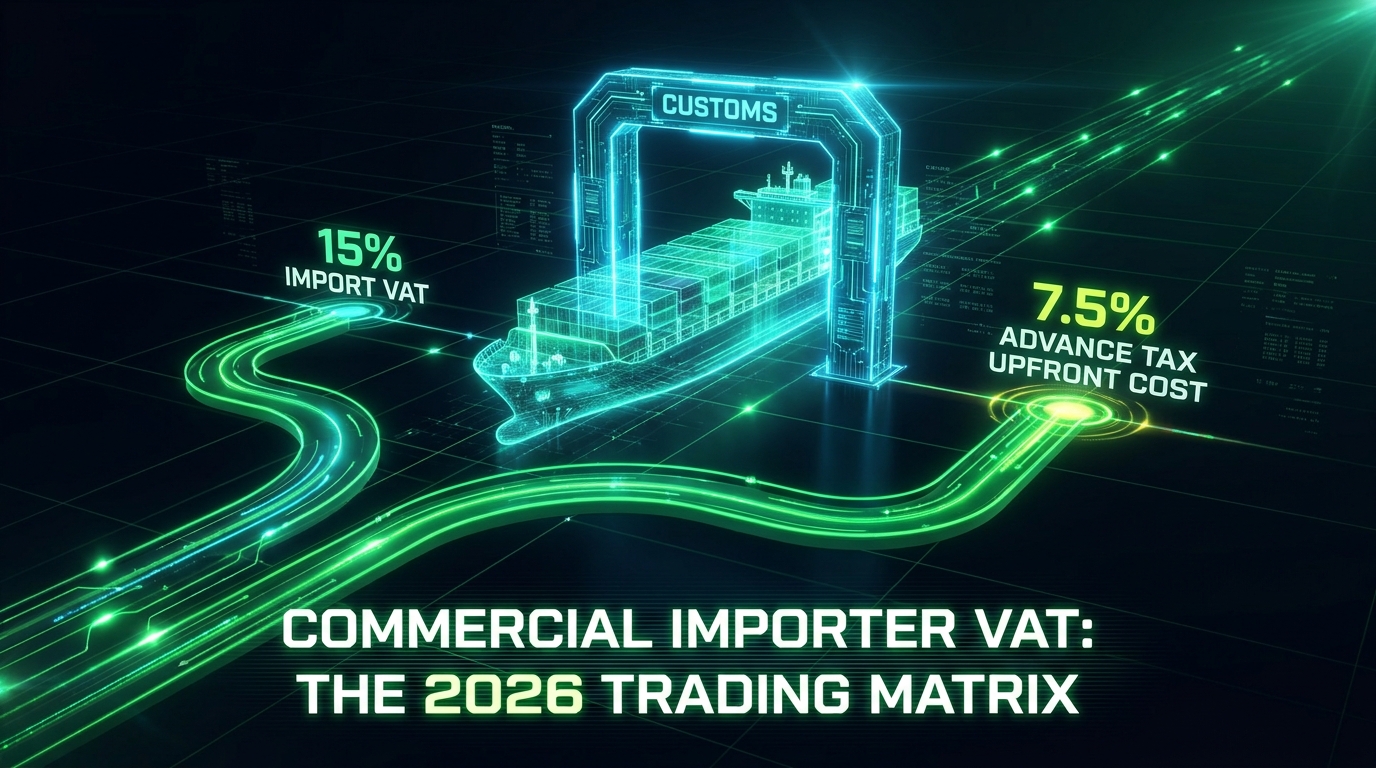
Commercial importers — businesses that import goods purely for resale rather than manufacturing — operate under a distinct VAT regime in Bangladesh. VAT on commercial importers Bangladesh is governed by both the customs stage and the local trading stage, and getting both right is essential.
What Is VAT on Commercial Importers Bangladesh?
A “commercial importer” under VAT law is one who imports finished goods (or near-finished) for resale, not for manufacturing into different products. The VAT on commercial importers Bangladesh framework charges:
- 15% VAT at the import stage (collected by customs)
- Advance Tax at the import stage (now 7.5% under Finance Ordinance 2025)
- 5% trading VAT on local supply
The 5% Trading Rate Explained
The 5% rate for commercial importers and traders is set out in the Third Schedule of the VAT & SD Act 2012. As per the 3rd schedule VAT rates are: For Traders @ 5%. Resource Portal
This 5% VAT on commercial importers Bangladesh rate is a truncated rate. The importer cannot claim full input rebate of the 15% paid at customs — they get partial credit, with the 5% effectively functioning as a final tax on the value added by the trader.
Advance Tax Changes for VAT on Commercial Importers Bangladesh
Finance Ordinance 2025 made a meaningful shift. The applicable advance tax rate for industrial raw material imports [is reduced] from 3% to 2%, and to increase the applicable advance tax rate from 5% to 7.5% for commercial importers. Vatabout
This 7.5% advance tax is creditable against final tax liability — but it does inflate the cashflow burden at import stage. VAT on commercial importers Bangladesh planning must now factor in this elevated upfront cost.
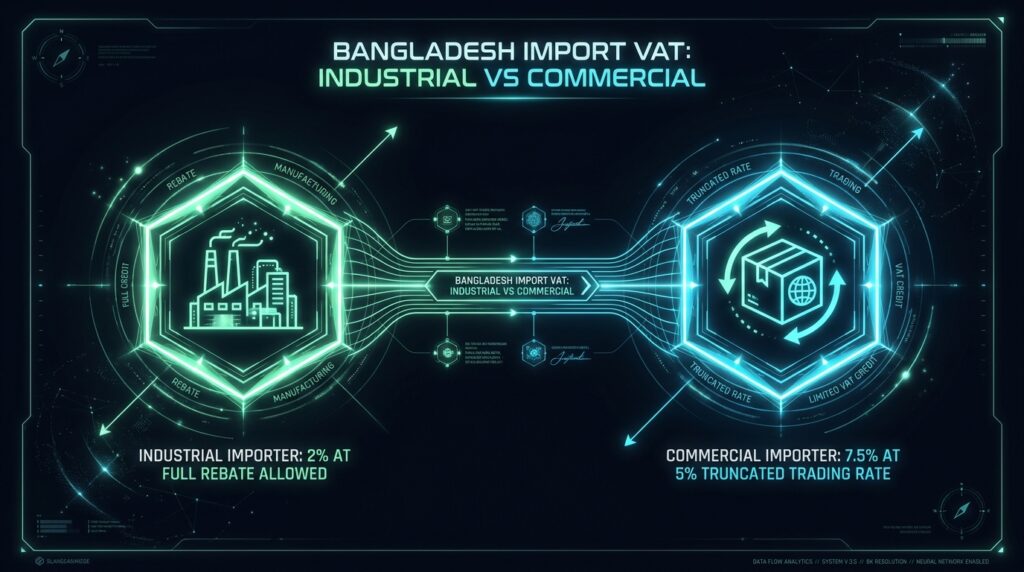
Industrial vs Commercial Importer Distinction
A critical distinction: industrial importers (importing raw materials for their own manufacturing) get input rebate, full standard rate treatment, and the lower 2% advance tax. Commercial importers (importing finished goods for resale) face the 5% trading rate and 7.5% advance tax.
Some businesses operate in both modes — importing some raw materials and some finished goods. VAT on commercial importers Bangladesh in mixed cases requires careful Bill of Entry classification and matching VAT treatment.
Compliance Workflow
For commercial importers, the typical monthly cycle:
- Import goods, pay 15% VAT plus 7.5% AT at customs
- Receive Bill of Entry and customs documentation
- Sell domestically, charging 5% trading VAT on Mushak 6.3
- File Mushak 9.1 monthly, claiming partial input adjustment
- Maintain Mushak 6.1, 6.2, 6.6 books
Common Errors in VAT on Commercial Importers Bangladesh
The recurring traps:
- Claiming full 15% input rebate when operating under 5% truncated trading — denied
- Misclassifying as industrial importer to access lower rates without actual manufacturing
- Advance tax not claimed as credit against final liability — lost cashflow
- Mushak 6.3 not issued to corporate buyers, triggering disputes
Strategic View
VAT on commercial importers Bangladesh is straightforward in structure but expensive in cashflow. Importers carry significant working capital tied up in customs payments before sales realisation. Planning import volumes against expected sales cycles is essential to avoid cash crunch.
The Bottom Line
The commercial importer regime is workable, but the 2025 advance tax hike has tightened margins. Importers should review their VAT on commercial importers Bangladesh treatment annually as rates and SROs change.
Written by Md Rakib Hassan — Income Tax Practitioner with 10+ years of tax compliance and audit experience across Bangladesh and the UK. Former accounts manager at a UK chartered accounting firm managing 1,000+ clients, with direct experience resolving multi-year tax audit disputes with HMRC and the NBR. Currently Finance Controller at a UK-based multinational tech group.
Need help with import VAT, customs duty, Income Tax, RJSC, or Accounting? We support commercial importers, traders, and distributors across Bangladesh and the UK.
Leave a Reply
You must be logged in to post a comment.