Written by Md Rakib Hassan — Income Tax Practitioner with 10+ years of tax compliance and audit experience across Bangladesh and the UK. Former accounts manager at a UK chartered accounting firm managing 1,000+ clients, with direct experience resolving multi-year tax audit disputes with HMRC and the NBR. Currently Finance Controller at a UK-based multinational tech group.
Importing goods into Bangladesh is not simply a matter of paying the invoice price. By the time your goods clear customs, you have paid Customs Duty, Regulatory Duty, Supplementary Duty, Value Added Tax, Advance Income Tax, and Advance Tax — each calculated on a different base, each building on the last. Understanding VAT at import stage Bangladesh is not optional; it is foundational to cost control, cash flow planning, and compliance with NBR regulations.
This guide explains every component in the correct sequence, with a fully worked numerical example so you can calculate the exact tax liability on any import.
📥 Download the Tax & VAT at Import Stage Calculation PDF
Resource credit: TaxBondhu — a Bangladesh tax education platform committed to making compliance knowledge accessible to all.
The Six Duties and Taxes on Imports
When goods enter Bangladesh, customs imposes up to six separate levies. Understanding each one is central to understanding VAT at import stage Bangladesh:
| Code | Full Name | Adjustable? |
|---|---|---|
| CD | Customs Duty | No — cannot be claimed back |
| RD | Regulatory Duty | No — cannot be claimed back |
| SD | Supplementary Duty | No — cannot be claimed back |
| VAT | Value Added Tax | Yes — rebate claimable |
| AIT | Advance Income Tax | Yes — rebate claimable |
| AT | Advance Tax | Yes — decreasing adjustment |
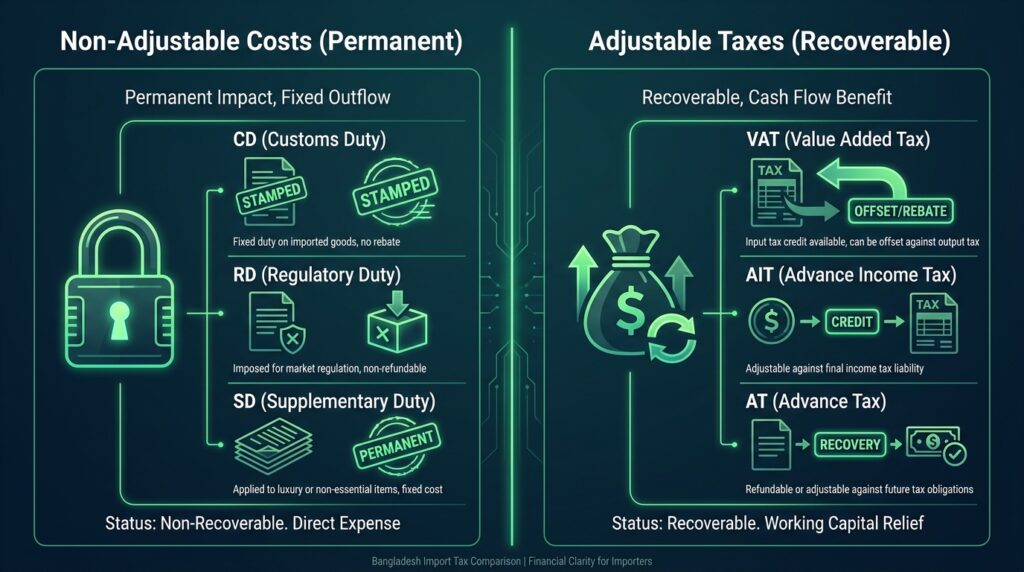
The critical distinction here is adjustability. CD, RD, and SD are sunk costs at the import stage — they increase your landed cost permanently. VAT paid at import becomes rebatable against your output VAT liability. AIT and AT are adjustable against your income tax liability or through the VAT return mechanism.
Step 1: Calculate the Assessable Value (AV)
Before any duty or tax can be calculated, you must establish the Assessable Value — the base on which almost everything else is computed.
The formula is:
Assessable Value = CIF Value + Landing Charge
Where:
- FOB = Free On Board price (factory gate price of goods)
- Freight = Cost of shipping from origin to Chittagong/Dhaka port
- C&F (CFR) = FOB + Freight
- Insurance = Typically 1% of C&F value
- CIF = C&F + Insurance
- Landing Charge = 1% of CIF
This layered build-up matters because the NBR assesses VAT at import stage Bangladesh on the full CIF plus landing charge — not the simple invoice value.
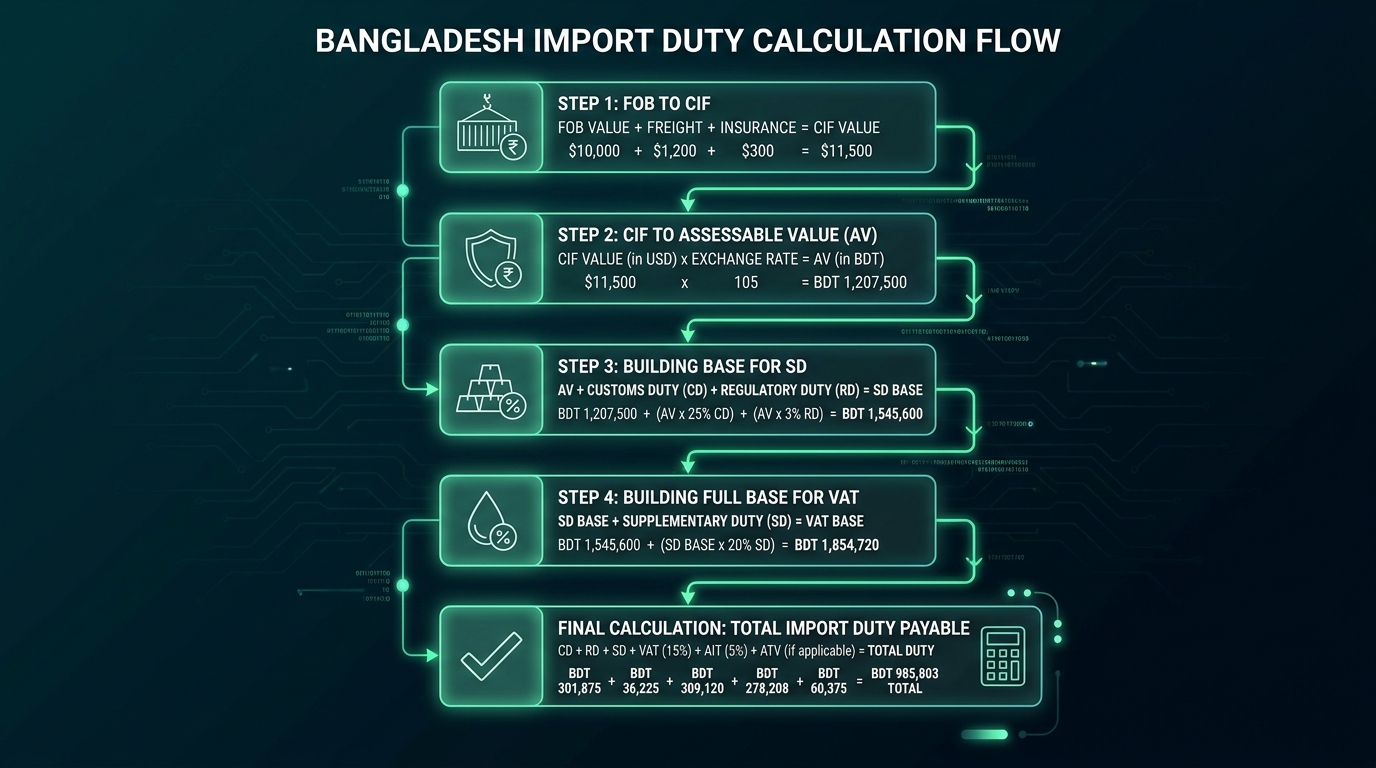
Worked Example: Full Import Duty Calculation
Let us take a practical scenario drawn directly from the TaxBondhu reference guide:
Scenario: An importer brings goods with a FOB value of USD 10,000. Exchange rate: 1 USD = 100 BDT. Applicable rates: CD 25%, RD 3%, SD 50%, VAT 15%, AIT 5%, AT 5%.
Step 1: Build the Assessable Value
| Component | Rate | USD | BDT |
|---|---|---|---|
| FOB | — | 10,000 | 1,000,000 |
| Freight | 20% of FOB | 2,000 | 200,000 |
| C&F Value | — | 12,000 | 1,200,000 |
| Insurance | 1% of C&F | 120 | 12,000 |
| CIF | — | 12,120 | 1,212,000 |
| Landing Charge | 1% of CIF | 121.20 | 12,120 |
| Assessable Value (AV) | — | 12,241.20 | 1,224,120 |
Step 2: Customs Duty (CD)
CD = AV × 25% = 1,224,120 × 25% = BDT 306,030
CD is a cost — not recoverable. It immediately increases your landed cost.
Step 3: Regulatory Duty (RD)
RD = AV × 3% = 1,224,120 × 3% = BDT 36,724
RD applies to goods where the statutory CD rate is 25%. Like CD, it is non-refundable and permanent.
Step 4: Supplementary Duty (SD)
SD = (AV + CD + RD) × 50% = (1,224,120 + 306,030 + 36,724) × 50% = 1,566,874 × 50% = BDT 783,437
SD is levied on the cumulative value including CD and RD. This cascading effect is why SD-liable imports carry a very high total tax burden. Note that SD is also non-adjustable.
Step 5: VAT at Import Stage Bangladesh
This is the core calculation. VAT at import stage Bangladesh is charged at 15% on the total of AV + CD + RD + SD:
VAT = (AV + CD + RD + SD) × 15% = (1,224,120 + 306,030 + 36,724 + 783,437) × 15% = 2,350,310 × 15% = BDT 352,547
This VAT is fully reclaimable as input tax rebate in your Mushak 9.1 return, provided you are a VAT-registered entity and the goods are used for taxable supplies.
Step 6: Advance Income Tax (AIT)
AIT = AV × 5% = 1,224,120 × 5% = BDT 61,206
AIT is collected by customs on behalf of the NBR and adjusted against the importer’s annual income tax liability. If you have TDS from importers under Section 89, the formula is: TDS = B − A, where B is the applicable TDS rate on sale price and A is AIT already paid at import.
Step 7: Advance Tax (AT)
AT = (AV + CD + RD + SD) × 5% = 2,350,310 × 5% = BDT 117,516
AT applies to the full duty-paid value and is adjustable via decreasing adjustment in your VAT return.
Final Total: All Duties and Taxes
| Duty/Tax | Amount (BDT) |
|---|---|
| CD | 306,030 |
| RD | 36,724 |
| SD | 783,437 |
| VAT | 352,547 |
| AIT | 61,206 |
| AT | 117,516 |
| Total | 1,657,460 |
On a BDT 1,000,000 FOB value, the total duties and taxes amount to BDT 1,657,460 — meaning the importer pays more in tax than the original cost of goods. This is why understanding VAT at import stage Bangladesh is so commercially critical.
Manufacturing (Supply) Stage VAT — The Difference
VAT at import stage Bangladesh follows different rules than manufacturing VAT.
At the manufacturing stage:
VAT-able Price = Input Cost + Value Addition
If SD is also applicable at manufacturing stage:
- Value for SD = Input Cost + Value Addition
- VAT-able Price = Value for SD + SD
This differs fundamentally from the import stage where SD is calculated on AV + CD + RD. Finance teams handling both import and production activities must maintain these two calculations separately.
The 3% AT Concession for Raw Material Importers
If you import raw materials for manufacturing, you may qualify for a reduced Advance Tax rate of 3% instead of 5%. To qualify, you must provide all four of the following to customs at the time of clearance:
- Attested copy of VAT-2.3 form (proof of manufacturer status)
- Attested copy of input-output coefficient form VAT-4.3
- Attested copy of industrial Import Registration Certificate (IRC)
- Certificate of VAT return submission for the last 12 months, issued by the VAT online system or Divisional Officer
Failure to produce all four documents means the full 5% AT applies. Given that AT is calculated on the post-SD duty-paid value, this 2% difference can be substantial on large volume imports.
What Is Adjustable and What Is Not — A Summary
From a cash flow planning perspective, this distinction is everything in VAT at import stage Bangladesh:
Non-Adjustable (Sunk Costs):
- Customs Duty (CD)
- Regulatory Duty (RD)
- Supplementary Duty (SD)
These three form the permanent cost base. They are never refunded or credited, and they become part of your product cost for VAT-able price calculation purposes.
Adjustable (Recoverable):
- VAT — rebated as input tax credit in Mushak 9.1
- AIT — offset against annual income tax liability under Section 89
- AT — decreasing adjustment in monthly VAT return
Managing VAT at import stage Bangladesh effectively means timing your import clearances with your VAT return cycles to maximise the cash flow benefit of input tax rebates.
Practical Implications for Finance Controllers
Having managed import-heavy businesses at a multinational level, here is what consistently causes problems:
1. Incorrect Assessable Value base: Many importers calculate VAT on CIF alone, omitting the 1% landing charge. This creates a discrepancy during audit.
2. SD-inclusive VAT base: Teams routinely forget that VAT is calculated on AV + CD + RD + SD. Omitting SD understates the VAT payable and creates a shortfall in the treasury deposit.
3. AIT vs TDS netting: For subsequent sales of imported goods, the AIT paid at customs must be netted against the applicable TDS rate on the sale price. Failing to apply this formula results in double taxation.
4. AT adjustability timing: AT is a decreasing adjustment — it must be claimed in the correct period’s Mushak 9.1 to avoid losing the benefit.
Conclusion
VAT at import stage Bangladesh is a multi-layered calculation with significant financial consequences at every step. Getting it right requires understanding not just the rates, but the sequence — which value each duty is applied to, and which taxes can be recovered. For any importer, manufacturer, or finance professional operating in Bangladesh, this calculation is core competency, not optional knowledge.
📥 Download the Tax & VAT at Import Stage Calculation PDF
Disclaimer: Rates used in examples are illustrative. Actual rates vary by HS Code and may be amended by NBR SROs during the financial year. Always verify with the current Customs Tariff Schedule before clearing goods.Share
Leave a Reply
You must be logged in to post a comment.