Written by Md Rakib Hassan — Income Tax Practitioner with 10+ years of tax compliance and audit experience across Bangladesh and the UK. Former Accounts Manager at a UK Chartered Accounting Firm managing 1,000+ clients. Currently Finance Controller at a UK-based multinational tech group.
Understanding UAE Corporate Tax: What Every Business Must Know in 2026
The United Arab Emirates — long regarded as a tax-free business destination — fundamentally changed its fiscal landscape when it introduced UAE corporate tax for the first time in the country’s history. For Bangladeshi entrepreneurs, finance professionals, and business owners with operations or ambitions in the Gulf region, understanding this regime is now a compliance necessity.
UAE corporate tax is a direct tax levied on the net income and profits of corporations and other business entities from their commercial activities conducted within the UAE. It came into effect for financial years commencing on or after 1 June 2023, and applies to taxable persons earning taxable income exceeding AED 375,000.
This guide draws on the UAE Corporate Tax Notes — Simplified Handwritten Notes prepared by CA Vimal Vinod, one of the most widely circulated study resources on this subject.
Why Did the UAE Introduce Corporate Tax?
For decades, the UAE operated without a federal corporate income tax, relying heavily on oil revenues to fund public expenditure. The introduction of UAE corporate tax was driven by three interconnected policy objectives:
Diversify Revenue Streams — With global energy markets becoming increasingly volatile, the UAE needed to reduce its reliance on oil income and build a more resilient and sustainable economic model for the long term.
Promote Economic Growth — A structured tax framework signals maturity to international investors and aligns the UAE with OECD global minimum tax standards, encouraging high-quality foreign direct investment and innovation.
Increase Government Revenue — Funding for world-class public services, infrastructure projects, and social development programmes requires a broadened revenue base beyond natural resources.
For Bangladeshi businesses with UAE subsidiaries, joint ventures, or branches, the arrival of UAE corporate tax means that profit repatriation planning, transfer pricing documentation, and group structure reviews are now essential activities.
The UAE Corporate Tax Structure: Three Categories of Business
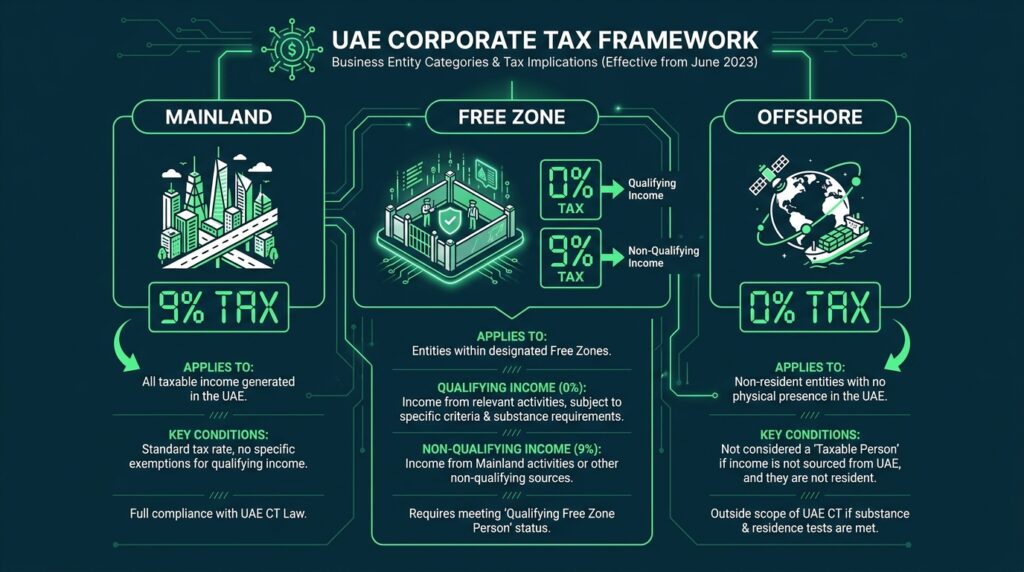
The UAE corporate tax framework divides business entities into three categories, each treated differently under the law.
Mainland Companies are incorporated and operating within the UAE mainland jurisdiction. They are fully subject to UAE corporate tax at the applicable rates. Taxable income means profit generated from commercial activities conducted within the UAE. Small businesses with income below AED 375,000 and qualifying public benefit entities can be exempt.
Free Zone Companies operate within one of the UAE’s designated free trade zones (DIFC, JAFZA, Abu Dhabi Global Market, and over 40 others). Their tax treatment depends on whether they qualify as a Qualifying Free Zone Person and on the nature of their income:
- Qualifying Income (from permitted activities within the free zone) → taxed at 0%
- Non-Qualifying Income (from activities outside the permitted list, or from mainland business) → taxed at 9%
To qualify as a Qualifying Free Zone Person, a company must conduct specific approved activities, maintain minimum share capital, and sustain physical presence within the free zone.
Offshore Companies are generally exempt from UAE corporate tax due to being registered outside the UAE and not conducting business within its territory. However, if an offshore company earns income from UAE-based activities that fall outside Free Zone Regulations, that income may become subject to the 9% corporate tax rate.
UAE Corporate Tax Rates — A Clear Breakdown
The UAE corporate tax rate structure is straightforward:
General Rate:
- Taxable income up to AED 375,000 → 0%
- Taxable income above AED 375,000 → 9%
Qualifying Free Zone Person:
- Qualifying income → 0%
- Non-qualifying income → 9%
This makes the UAE one of the most competitively taxed jurisdictions globally for business, sitting well below the UK’s 25% corporation tax rate and Bangladesh’s corporate tax rates of 22.5% to 45% depending on sector and listing status.
Implementation Date and Filing Requirements
UAE corporate tax became effective for financial years starting on or after 1 June 2023. Here is how this plays out in practice:
| Company | Financial Year Ends | First Year of UAE CT |
|---|---|---|
| W | 30 June 2023 | 1 Jul 2023 to 30 Jun 2024 |
| X | 30 Sept 2023 | 1 Oct 2023 to 30 Sept 2024 |
| Y | 31 Dec 2023 | 1 Jan 2024 to 31 Dec 2024 |
| Z | 31 March 2024 | 1 Apr 2024 to 31 March 2025 |
One annual UAE corporate tax return must be filed per financial year. The filing deadline is 9 months after the end of the financial year. For a company with a 31 December year-end, that means a filing deadline of 30 September the following year.
Who Is Exempt from UAE Corporate Tax?
The following categories of persons are fully exempt from UAE corporate tax:
- UAE Government entities
- UAE Government-controlled entities
- Persons engaged in non-extractive natural resource businesses in the UAE
- Qualifying Public Benefit Entities
- Qualifying Investment Funds (subject to conditions)
- Public or private pension and social security funds (subject to conditions)
- UAE juridical persons wholly owned and controlled by certain exempt entities — including subsidiaries of exempt entities engaged in specific activities listed in Article 4 of the Corporate Tax Law
Any entity seeking to rely on an exemption must formally apply for and receive confirmation from the Federal Tax Authority (FTA).
Exempt Income Under UAE Corporate Tax
Even where a taxable person is within the scope of UAE corporate tax, certain categories of income are exempt from the charge:
Dividends from UAE companies — Dividends received from any company incorporated or established in the UAE are exempt.
Participation Exemption — Dividends and other profit distributions received from foreign juridical persons are exempt under the participation exemption, provided the recipient holds a minimum ownership interest of 5% and has maintained that holding for at least 12 uninterrupted months.
Income from Foreign Establishment — Income earned from a foreign permanent establishment or branch is exempt from UAE CT (though an election not to apply this exemption is also available).
Non-Resident Income from International Transport — Income derived by a non-resident person from operating aircraft or ships in international transportation is exempt.
This participation exemption framework makes the UAE an attractive holding company location for Bangladeshi business groups with international operations — provided the structure is built with appropriate substance.
Deductible Expenses Under UAE Corporate Tax
For a business expense to be deductible against UAE corporate tax, it must satisfy all of the following conditions:
- The expense must be wholly and exclusively incurred for business purposes — only costs incurred solely to generate income from the taxable person’s business activities are deductible.
- The expense must be incurred in a reasonable and justifiable manner — uncommercially priced transactions between related parties will attract scrutiny.
- Capital expenditure is not deductible — the treatment of capital items follows their accounting classification under the applicable accounting standard.
- Expenses must not be related to exempt income — a cost incurred to generate exempt income (such as dividends from a UAE subsidiary) cannot reduce taxable income.
Non-Deductible Expenses — The following are explicitly excluded from deduction under UAE CT:
- Donations, grants, or gifts (unless made to a Qualifying Public Benefit Entity)
- Recoverable Input VAT
- Bribes or illegal payments
- Interest on derivatives used for hedging purposes
- Foreign exchange gains and losses accruing from interest arrangements
Small Business Relief (SBR) — Key Provisions
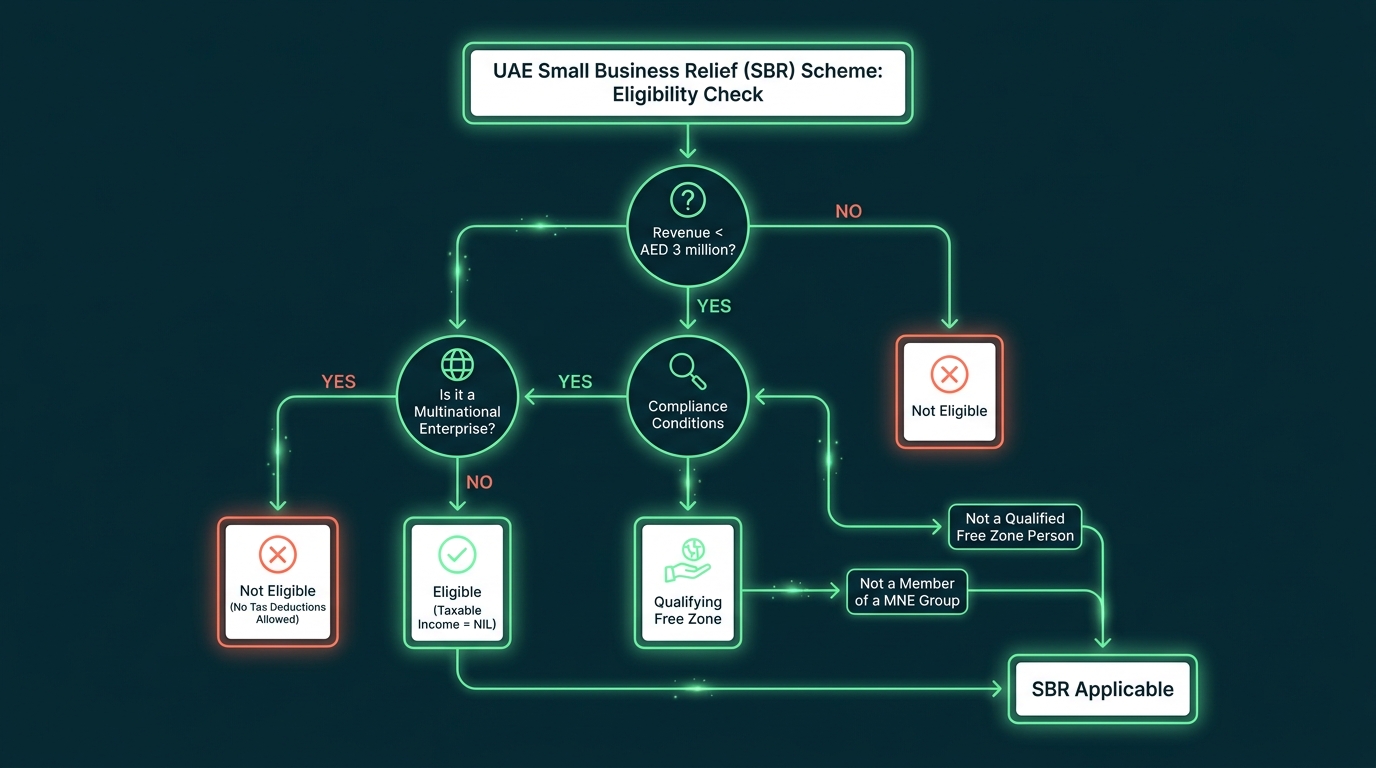
The Small Business Relief scheme was introduced to reduce the compliance burden on smaller UAE businesses entering the UAE corporate tax system for the first time.
Eligibility Conditions:
- Available only to Taxable Persons (not exempt persons)
- Annual revenue must be less than AED 3 million in the relevant tax period and all previous tax periods
- If the above conditions are met, the taxable income is treated as NIL
Important Restrictions When SBR is Elected:
- Tax deductions cannot be claimed
- Transfer pricing documentation is not required
- Losses cannot be carried forward to future periods
- Tax loss relief is not available
- Not eligible for Qualifying Free Zone Person treatment
- Not available to Multinational Enterprise Groups
Mandatory Audit Requirement: If gross revenue exceeds AED 10 million, a mandatory audit is required under the SBR scheme — a lower threshold than the AED 35 million that applies to regular corporate taxpayers.
Tax Loss Relief and Tax Groups
UAE corporate tax allows for the carry forward of tax losses to offset future taxable income — subject to conditions. This is a significant planning consideration for businesses in their early growth phases.
A Tax Group can be formed where a parent company holds at least 95% of the share capital and voting rights of its subsidiaries, allowing consolidated group tax returns. Related rules govern the formation of a Qualifying Group which enables intra-group asset transfers without immediate tax consequences.
Withholding Tax and Foreign Tax Credit
The UAE currently applies 0% withholding tax on most types of outbound payments — including dividends, interest, and royalties — making it highly attractive for structuring income flows. However, specific cross-border payments may carry withholding obligations depending on applicable treaties.
A Foreign Tax Credit is available against UAE corporate tax liability for taxes paid on income earned abroad, preventing double taxation on the same profits.
Related Party and Connected Person Rules
UAE corporate tax contains transfer pricing provisions that align with OECD guidelines. Transactions between related parties and connected persons must be conducted at arm’s length. Related parties are broadly defined to include entities under common ownership or control, and individuals with significant influence over business decisions.
Connected person rules extend these arm’s length requirements to transactions between a natural person and entities they control — preventing profit extraction through artificially inflated payments.
Accounting Method, Record Keeping, and Audit Requirements
Businesses subject to UAE corporate tax must maintain their financial accounts in accordance with IFRS or IFRS for SMEs (as applicable) and must retain all records and supporting documents for a minimum prescribed period.
The accounting method used for tax purposes must be consistent with the financial statements. Where a business earns both qualifying and non-qualifying income (particularly relevant for free zone entities), separate accounting records and allocation methods are essential.
Non-compliance carries financial penalties under the UAE Corporate Tax Law, making robust record-keeping and timely filings critical for all businesses in scope.
Qualifying Free Zone Persons — Qualifying vs Non-Qualifying Activities
The distinction between qualifying and non-qualifying activities is one of the most practically significant aspects of UAE corporate tax for free zone businesses:
Qualifying Activities include transaction types and service categories specifically approved within the free zone’s regulatory framework — typically financial services, trading, logistics, and professional services conducted within the zone and with overseas counterparties.
Non-Qualifying Activities include any activities conducted outside the permitted list, transactions with UAE mainland businesses (beyond de minimis thresholds), and any other income sources falling outside the free zone regulatory approval.
A misclassification of income can trigger a 9% tax charge on activities incorrectly treated as qualifying, alongside potential penalties — making professional tax advice essential for any free zone operation.
UAE CT Transition Rules
The UAE corporate tax regime includes transition rules addressing how pre-existing assets and liabilities are brought into the new framework. Key provisions cover the opening balance sheet treatment, accounting for assets and liabilities existing before the first tax period, and elections available to simplify the transition for certain categories of taxpayer.
Download the Full UAE Corporate Tax Notes (Free PDF)
The simplified handwritten notes on which this guide is based were prepared by CA Vimal Vinod — a widely respected Chartered Accountant whose UAE tax study materials are used extensively across the Gulf region and South Asia.
📥 Download UAE Corporate Tax Notes by CA Vimal Vinod
Credit: All frameworks, diagrams, and structured notes referenced in this blog are drawn from the UAE Corporate Tax Notes (Simplified Handwritten Notes) authored by CA Vimal Vinod.
Final Thoughts — What This Means for Bangladeshi Businesses in the UAE
The UAE remains one of the most favourable business environments globally — even with UAE corporate tax now in place. A 9% headline rate, combined with zero withholding tax on most outbound payments, a growing network of double tax treaties, and robust free zone infrastructure, means the UAE still offers exceptional opportunities for Bangladeshi entrepreneurs and investors.
However, the compliance requirements are real. Registration with the Federal Tax Authority, annual tax return filing, transfer pricing documentation, and audit obligations must all be managed professionally.
If you are operating a business in the UAE or advising clients with UAE exposure, ensuring your understanding of UAE corporate tax is current and accurate is no longer optional — it is a professional obligation.
For queries on UAE corporate tax compliance, international tax planning, or accounting support for businesses operating across Bangladesh, UK, and the UAE, connect with Md Rakib Hassan via this platform.
Leave a Reply
You must be logged in to post a comment.