
If you operate a business in Bangladesh, understanding the truncated VAT rate Bangladesh framework is non-negotiable. The system runs parallel to the 15% standard rate but with sharp restrictions that catch many businesses off guard during NBR audits. Under the Value Added Tax and Supplementary Duty Act 2012, the standard VAT rate is 15%, with reduced rates (e.g., 5%, 7.5%, 10%), zero-rates, or exemptions for certain items, and getting the application wrong can trigger penalties, interest, and disallowed input credits.
What Is the Truncated VAT Rate Bangladesh System?
A truncated VAT rate Bangladesh is any rate below the standard 15% applied to specific goods and services through the Third Schedule of the VAT & SD Act 2012 or through SROs issued by NBR. Common rates include 5%, 7.5%, and 10%, alongside specific tax amounts. As per the 3rd schedule VAT rates are: For Traders @ 5% For the supply of medicine @ 2.4% For the supply of Diesel, Kerosene, Octane, Petrol, Furnace oil & LP gas @ 2%.
The logic behind truncation is administrative simplicity: instead of tracking complex input-output adjustments, the government collects a fixed lower rate at supply, but the trade-off is the loss of input tax credit (rebate).
Key Restrictions Under the Truncated VAT Rate Bangladesh Framework
Three rules every taxpayer must internalise:
1. No rebate on inputs. When you sell at a truncated VAT rate Bangladesh like 5% or 7.5%, you cannot claim input tax credit on raw materials or services consumed. This is governed by Rule 3(2) of the VAT & SD Rules 2016. If you operate both standard and truncated activities, you’ll need apportionment.
2. No VAT deduction at source mismatch. The VDS rate must match the truncated rate. For example, if a service falls under a 7.5% truncated VAT rate Bangladesh bracket, the withholding entity should deduct 7.5%, not 15%.
3. Pricing discipline. Suppliers cannot artificially shift between standard and truncated rates to gain unfair advantage. NBR’s audit teams cross-check Mushak 6.3 invoices against declared rates.
When Standard Rate Trumps the Truncated VAT Rate Bangladesh
Manufacturers selling through Mushak 6.3 at 15% generally retain full rebate rights. But mixing standard and truncated VAT rate Bangladesh activities within the same legal entity demands strict bookkeeping. NBR’s position is consistent: a single BIN cannot enjoy both unfettered rebate and reduced output rates without proper allocation.
For commercial importers, the truncated VAT rate Bangladesh of 5% applies on trading supply. However, under Finance Ordinance 2025, the applicable advance tax rate for industrial raw material imports [is reduced] from 3% to 2%, and to increase the applicable advance tax rate from 5% to 7.5% for commercial importers — meaning advance tax planning at import stage now matters more than ever.
Practical Compliance Checklist for 2026
When applying any truncated VAT rate Bangladesh in your invoicing, verify:
- Your HS Code or Service Code matches the Third Schedule entry
- Mushak 6.3 reflects the correct rate clearly
- No input rebate is claimed in Mushak 9.1 against truncated supplies
- Your contracts mention the applicable rate to avoid customer disputes
- Reconcile monthly VDS deposits with output VAT
Common Truncated VAT Rate Bangladesh Errors
In my decade-plus of resolving VAT disputes with NBR and HMRC, three errors recur. First, manufacturers continue claiming full rebate after switching to a truncated VAT rate Bangladesh product line. Second, withholding entities deduct 15% on services that legally attract only 7.5% or 10%, creating refund headaches. Third, businesses forget the apportionment rule under Rule 3(2) when they have mixed output rates.
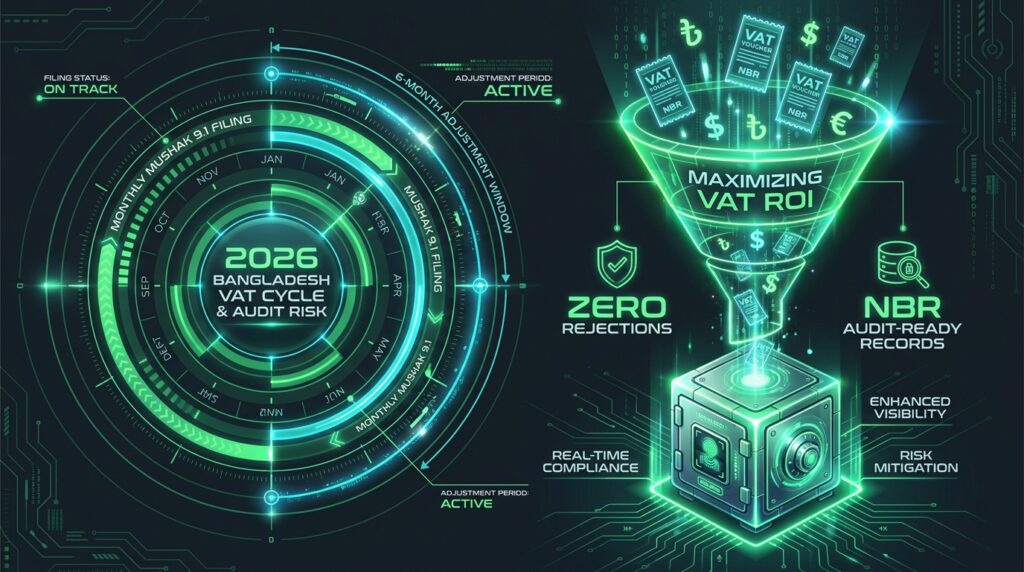
NBR’s adjustment window matters here too. The Interim Government also extended the adjustment period for advance tax adjustment, refund application, and taking input VAT rebates from four to six months — meaning rebate claim windows are now slightly more forgiving for the standard rate, but truncated supplies still get nothing.
Final Word
The truncated VAT rate Bangladesh system isn’t a discount — it’s a trade-off. Lower output rate, zero rebate. Before opting in (where election applies), model your effective VAT cost both ways. Many businesses pay more under truncation because they lose substantial input credits.
Written by Md Rakib Hassan — Income Tax Practitioner with 10+ years of tax compliance and audit experience across Bangladesh and the UK. Former accounts manager at a UK chartered accounting firm managing 1,000+ clients, with direct experience resolving multi-year tax audit disputes with HMRC and the NBR. Currently Finance Controller at a UK-based multinational tech group.
Need help with VAT, Income Tax, Accounting, RJSC compliance, or NBR audit defence? Our team handles end-to-end Bangladesh and UK tax compliance — from BIN registration and monthly Mushak filings to audit representation and group consolidation. Reach out for a free initial assessment.
Leave a Reply
You must be logged in to post a comment.