Written by Md Rakib Hassan — Income Tax Practitioner with 10+ years of tax compliance and audit experience across Bangladesh and the UK. Former accounts manager at a UK chartered accounting firm managing 1,000+ clients, with direct experience resolving multi-year tax audit disputes with HMRC and the NBR. Currently Finance Controller at a UK-based multinational tech group.
Filing a tax return in Bangladesh used to mean a trip to your tax circle office, a stack of printed forms, and hours of waiting. In 2026, that era is firmly over. The National Board of Revenue (NBR) has made the online e-tax return mandatory for all individual taxpayers — and the system at etaxnbr.gov.bd is functional, mobile-accessible, and designed to get your tax return filed in under 30 minutes for straightforward cases.
But “mandatory” and “done correctly” are two different things. This guide explains exactly what a tax return in Bangladesh requires, who must file, what income to declare, how to calculate what you owe, how to pay, and how to avoid the costly mistakes that trigger NBR scrutiny.
What Is a Tax Return in Bangladesh?
A tax return is the formal annual declaration a taxpayer submits to the National Board of Revenue, reporting:
- All sources of income earned during the income year (1 July to 30 June)
- All allowable deductions and investment rebates claimed
- The resulting tax liability (or zero, if income is below the tax-free threshold)
- All assets and liabilities held at the end of the income year
The tax return is governed by the Income Tax Act 2023 — a landmark overhaul of Bangladesh’s income tax legislation that replaced the Income Tax Ordinance 1984 and introduced a simplified, digital-first compliance framework.
Every individual who holds a Taxpayer Identification Number (TIN) must file a tax return annually — even if their income is zero or below the taxable threshold. The obligation is tied to TIN ownership, not to tax liability.
Who Must File a Tax Return in Bangladesh?
Under the Income Tax Act 2023, the following individuals are legally required to file an annual tax return:
- Any person earning taxable income in Bangladesh
- All TIN holders (mandatory annual filing regardless of income level)
- Individuals earning employment income above the basic exemption limit
- Business owners, self-employed professionals, and freelancers
- Landlords receiving rental income
- Individuals earning income from financial securities (bank interest, dividends, savings certificates)
- Anyone claiming a tax rebate on investments
- Individuals with overseas income who are resident in Bangladesh
There is no minimum income requirement for filing. If you have a TIN, you must file a tax return every year — including a “zero return” if your income is below the tax-free threshold.
Online Tax Return: What Changed in 2025–26
The single biggest development in Bangladesh’s tax return system for assessment year 2025–26 is the mandatory shift to online filing. On 4 August 2025, the NBR issued a special order:
Online tax return filing is now mandatory for all individual taxpayers using the portal at www.etaxnbr.gov.bd.
The mandatory online tax return requirement does not apply to:
- Taxpayers aged 65 or above
- Certified persons with disabilities
- Bangladeshi citizens residing abroad
- Legal representatives filing for deceased taxpayers
- Foreign nationals working in Bangladesh
These groups may still file their tax return online voluntarily — and most do, given the convenience.
The result: In assessment year 2025–26, over 5 million taxpayers registered in the online e-tax return system, and approximately 4.1 million filed their returns digitally — a 225% increase from 5.27 lakh in the previous assessment year.
Tax Return Deadline in Bangladesh (2025–26)
| Filing Type | Deadline |
|---|---|
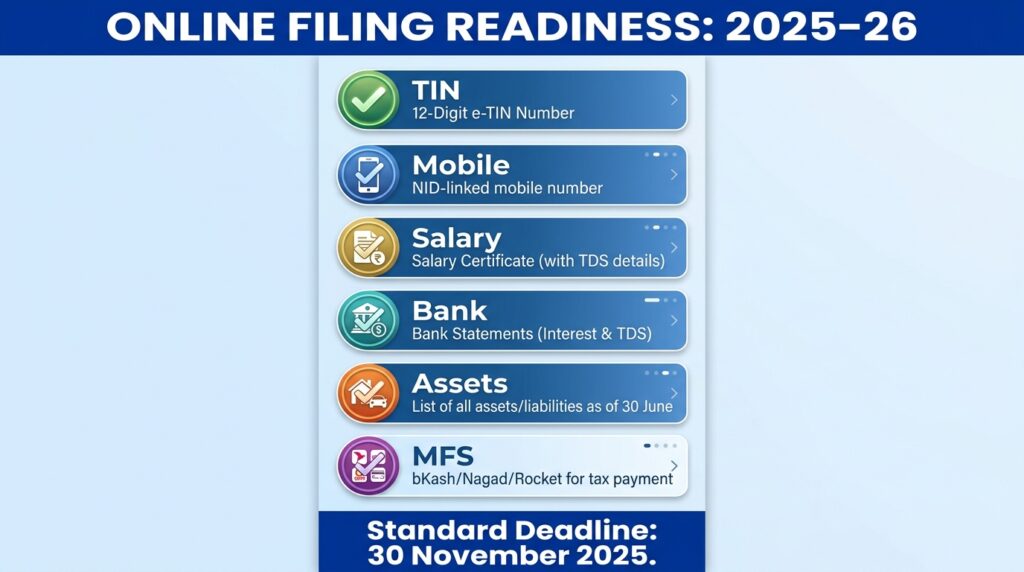
| Standard individual tax return | 30 November 2025 |
| Extended deadline (with approved application) | Up to 31 March 2026 |
| Corporate tax return | 15th day of the 7th month after year-end |
| TDS (withholding tax) return | Quarterly (replaced monthly from AY 2025–26) |
Time extension: If you cannot file your tax return by 30 November, you can apply online through your e-tax return account using the “Time Extension” option. Extensions of up to 90 days are available, subject to approval by the relevant tax commissioner. Applications must be submitted before the original deadline.
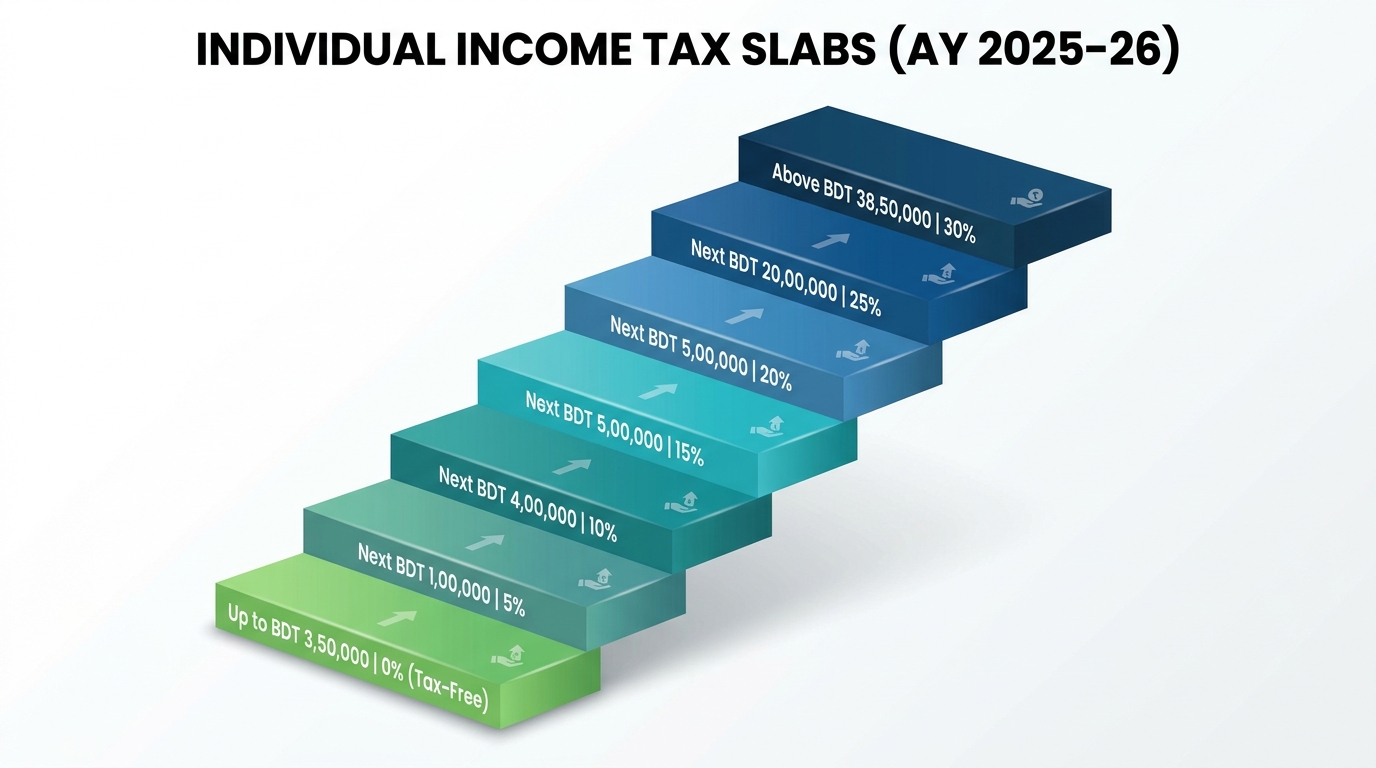
Income Tax Slabs: What You Owe on Your Tax Return (AY 2025–26)
Bangladesh’s income tax follows a progressive slab structure. For assessment year 2025–26 (income earned July 2024 to June 2025):
General Individual Taxpayers
| Income Slab (BDT) | Tax Rate |
|---|---|
| Up to 3,50,000 | Nil — Tax-Free |
| Next 1,00,000 | 5% |
| Next 4,00,000 | 10% |
| Next 5,00,000 | 15% |
| Next 5,00,000 | 20% |
| Next 20,00,000 | 25% |
| Above 38,50,000 | 30% |
Special Category Taxpayers
| Category | Tax-Free Threshold |
|---|---|
| Female taxpayers | BDT 4,00,000 |
| Senior citizens (65+) | BDT 4,00,000 |
| Persons with disabilities | BDT 4,75,000 |
| Gazetted war-wounded freedom fighters | BDT 5,00,000 |
Minimum Tax
Even if your slab calculation results in less, the following minimum tax return payments apply once income exceeds the tax-free threshold:
- Dhaka North, Dhaka South, Chattogram: BDT 5,000
- Other city corporations: BDT 4,000
- Outside city corporations: BDT 3,000
- First-time taxpayers: BDT 1,000
From Assessment Year 2026–27 Onwards
The tax-free threshold increases to BDT 3,75,000 for general taxpayers. A flat minimum tax of BDT 5,000 applies regardless of location (new taxpayers: BDT 1,000).
What to Declare on Your Tax Return: Income Sources
Your tax return must account for all income earned during the income year across every applicable head. Here are the main income categories:
1. Employment Income (Salary)
The most common income source for Bangladeshi taxpayers. Includes basic salary, all allowances (house rent, medical, transport, festival bonus), and any benefits in kind.
Exemption: One-third of employment income or BDT 4,50,000, whichever is lower, is excluded from taxable income. Your employer should provide a salary certificate confirming gross income and TDS deducted.
2. Business or Professional Income
Net profit from any business, trade, or professional activity after deducting allowable business expenses. Requires proper books of account to support the declared figures — which the NBR may request during audit.
3. Rental Income
Gross rent received from residential or commercial property, less:
- 30% standard deduction (for repairs and maintenance)
- Ground rent paid
- Interest on loans taken to acquire or improve the property
4. Income from Financial Securities
Interest from bank accounts, fixed deposits, and DPS; profit from savings certificates (Sanchayapatra); dividend income from listed and unlisted company shares. Note that much of this income may already have TDS deducted at source — declared TDS can be credited against your final tax return liability.
5. Capital Gains
Profit from selling shares, property, or other capital assets. Taxed at specific rates depending on the holding period and asset type.
6. Agricultural Income
Income from farming and agricultural activities. Limited exemptions apply.
7. Other Income
Consultancy fees, freelance income, royalties, commissions, and any other income not falling under the above categories.
Investment Rebate: Reducing Your Tax Return Liability
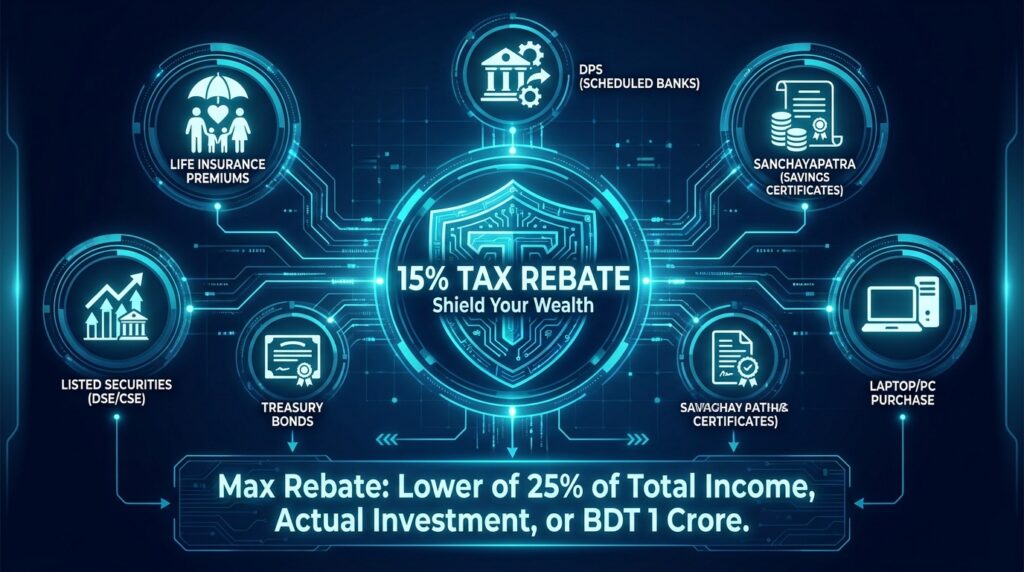
One of the most under-utilised tools in the Bangladeshi tax return system is the investment rebate — a 15% reduction in tax liability for eligible investments and expenditures.
Eligible investments for the 15% rebate:
- Life insurance premium (own and spouse)
- Recognised provident fund contributions (own and employer)
- National Savings Certificates (Sanchayapatra)
- Bangladesh Government treasury bonds
- Unit certificates (mutual funds)
- Investment in securities listed on DSE or CSE
- Purchase of a laptop or personal computer
- DPS contributions with scheduled banks
Maximum eligible investment: The lesser of: 25% of your total income; the actual amount invested; or BDT 1,00,00,000.
How it works: If your tax liability before rebate is BDT 20,000, and your eligible investment is BDT 1,00,000, your rebate is BDT 15,000 (15% of BDT 1,00,000) — reducing your final tax payable on the tax return to BDT 5,000.
Professional tip from my practice: Many taxpayers leave significant tax savings on the table by not planning their investments before the end of the income year (30 June). Investing in Sanchayapatra, DPS, or listed securities before 30 June directly reduces your tax return liability for that assessment year.
How to File Your e-Tax Return Online: Step-by-Step
Filing your e-tax return at etaxnbr.gov.bd follows a logical, guided sequence. Here is the complete process:
Step 1: Register on the e-Tax Return Portal
Visit etaxnbr.gov.bd and click the “e-Return” option.
New users:
- Click “I am not yet registered”
- Enter your 12-digit TIN
- Enter your NID-linked mobile number (drop the leading zero — e.g., 01711 becomes 1711)
- Solve the CAPTCHA
- Enter the OTP sent to your mobile to verify
- Set your password to complete registration
Returning users:
- Log in with your TIN and password
- Use “Forgot Password” for a reset via mobile OTP or email
Step 2: Select the Assessment Year
Navigate to “Income Tax Return” and select the applicable assessment year — “2025–2026” for income earned between 1 July 2024 and 30 June 2025.
Step 3: Choose Your Return Type
- Regular return: Full income declaration for taxpayers with taxable income
- Zero return: For TIN holders whose income is below the tax-free threshold — select “Zero Return” mode; the system auto-fills income as zero
Step 4: Declare All Income Sources
Work through each income head systematically:
- Enter employment income from your salary certificate
- Enter business or professional income with net profit figures
- Enter rental income after allowable deductions
- Enter interest, dividend, and savings certificate income
- Enter any capital gains
No document uploads are required during online tax return submission. However, keep all supporting documents — salary certificates, bank statements, investment receipts — safely for at least five years. The NBR may request them during audit.
Step 5: Declare Assets and Liabilities
Your tax return must include a schedule of assets and liabilities as at 30 June of the income year. This includes:
- Cash in hand and bank balances
- Property (land, buildings, flat)
- Vehicles
- Business capital
- Investments (Sanchayapatra, shares, DPS)
- Outstanding loans (mortgage, personal loans)
- Any other significant assets
The asset declaration is cross-checked by the NBR against previous tax return submissions to identify unexplained wealth accumulation — a common audit trigger.
Step 6: Claim Deductions and Rebates
Enter your eligible investment amounts to claim the 15% investment rebate. The system automatically calculates the rebate and reduces your tax liability accordingly.
Step 7: Pay Any Tax Due
If your tax return shows a net tax payable, you must pay before submitting. Payment options include:
- A-Challan (online): Generate through the government’s automated challan system at ibas.finance.gov.bd/acs
- Internet banking: Through scheduled commercial banks
- Debit/credit card: Via the NBR-Sonali Bank e-payment portal
- Mobile Financial Services: bKash, Rocket, Nagad
Payment by mobile financial service — particularly bKash — has become the most popular method for individual taxpayers due to its speed and convenience.
Keep the payment receipt (challan number or MFS transaction reference) as proof of tax return payment.
Step 8: Submit and Download Your Acknowledgement
After confirming all sections are complete and payment is made, submit your e-tax return. The system instantly generates:
- Acknowledgement Slip — your proof of submission, with a unique return reference number
- Income Tax Certificate — confirming your tax filing status for the assessment year
Download both documents immediately. The income tax certificate is required for savings certificate applications, loan processing, property registrations, and trade licence renewals.
Tax Return for Zero Income: Do You Still Need to File?
Yes — absolutely and without exception.
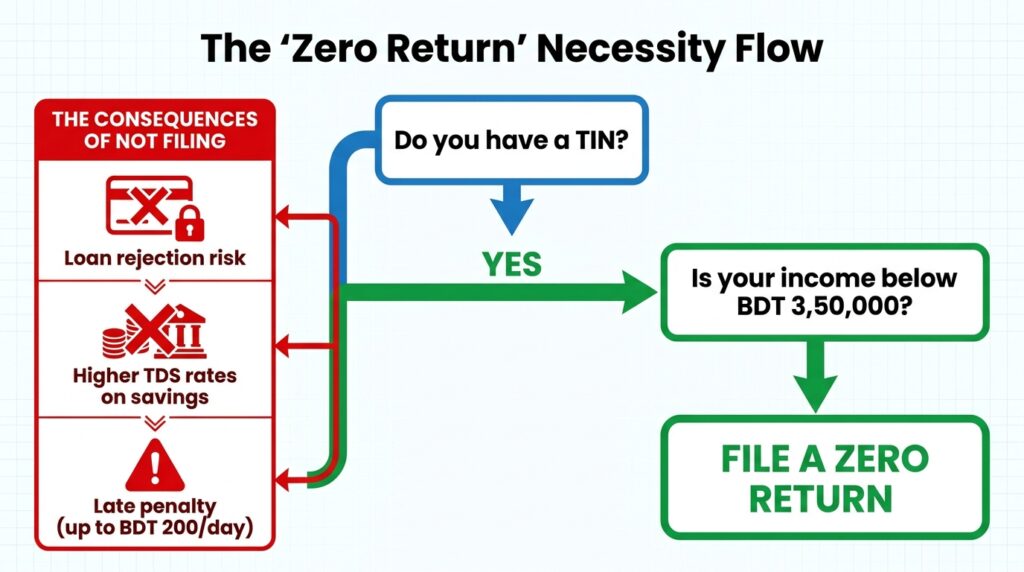
If you hold a TIN but your income for the year is below the tax-free threshold (BDT 3,50,000 for general individual taxpayers in AY 2025–26), you still must file a tax return. This is called a “zero return” (শূন্য রিটার্ন).
Filing a zero tax return takes less than 10 minutes through the e-tax return portal. The consequences of not filing — even when you owe zero tax — are significant:
- Higher TDS rates on bank interest, dividends, and financial transactions
- Inability to renew trade licences in many city corporations
- Loan application delays and rejections
- Restrictions on purchasing savings certificates and DPS
- NBR notice risk and potential penalty of up to BDT 200 per day of delay
Filing a zero tax return is your annual declaration that your tax affairs are in order. Do it every year, without fail.
Tax Return for Expatriate Bangladeshis (NRBs)
Bangladeshi citizens residing abroad are exempt from the mandatory online e-tax return requirement — but are strongly encouraged to file voluntarily, as their Bangladesh-source income (rental property, dividend income, Sanchayapatra) may still be taxable.
For NRBs who wish to file their tax return online, the NBR has a dedicated process: send an email to ereturn@etaxnbr.gov.bd with your TIN, NID/passport details, and contact information. The NBR will issue an OTP and registration link to your email address, enabling full e-tax return access without a Bangladeshi mobile number.
Common Tax Return Mistakes That Attract NBR Audit Attention
From my decade of working with clients across Bangladesh, these are the filing errors that most frequently trigger NBR queries:
Mismatch between monthly VAT returns and annual tax return revenue. For business owners, the total revenue declared on your twelve monthly Mushak-9.1 VAT returns must be consistent with the revenue declared on your annual tax return. Discrepancies are automatically detected by the NBR’s cross-matching system.
Undeclared bank interest. Banks in Bangladesh submit TDS records to the NBR for all interest paid above certain thresholds. If your bank paid you BDT 50,000 in interest but your tax return shows nothing under income from financial securities, the discrepancy is detectable.
Asset growth inconsistent with declared income. If your tax return shows BDT 3,50,000 income but your assets schedule shows you purchased a BDT 50,00,000 flat, the NBR will want to know the source of funds.
Claiming rebates without eligible investments. The NBR can and does request investment proof — salary certificate deductions, DPS passbooks, Sanchayapatra purchase receipts — during audit. Only claim rebates on investments you actually made and can document.
Missing the deadline without an extension. An approved extension protects you from late filing penalties. Filing late without an approved extension is always more expensive than the small administrative effort of applying for one.
Frequently Asked Questions About Tax Return in Bangladesh
Is filing a tax return mandatory even if I have no taxable income? Yes. Any person holding a TIN must file an annual tax return, even if their income is zero or below the tax-free threshold. Select “Zero Return” mode on the e-tax return portal.
What is the penalty for not filing a tax return in Bangladesh? Under the Income Tax Act 2023, failure to file by the deadline can result in a penalty of up to BDT 200 per day of delay. Additionally, you lose eligibility for investment rebates for that year and face higher TDS rates on financial transactions.
Can I file an e-tax return on my mobile phone? Yes. The e-tax return portal at etaxnbr.gov.bd is mobile-friendly and does not require a dedicated app. Most individual taxpayers can complete their entire tax return filing on a smartphone.
Do I need to upload documents when filing my tax return online? No. The e-tax return system does not require document uploads during submission. However, keep all supporting documents safely — the NBR may request them during any subsequent audit or query.
How do I get my income tax certificate after filing? Your income tax certificate is generated automatically and available for immediate download after successfully submitting your tax return through the e-tax return portal. It is also accessible through your account dashboard for future re-downloads.
What is the NBR helpline for tax return support? The NBR’s dedicated call centre for e-tax return queries operates at 09643 71 71 71, available 9:00 AM to 5:00 PM on working days.
Final Thoughts: File Your Tax Return on Time, Every Year
The NBR’s e-tax return system represents the most significant modernisation of Bangladesh’s income tax administration in decades. Over 4.1 million taxpayers filed online in 2025–26 — the system works, it is accessible, and the penalties for ignoring it are growing more strictly enforced.
Whether you are filing a simple salary-based tax return or a complex return with multiple income sources, investment rebates, and an asset schedule that has grown significantly year on year — the discipline of filing accurately and on time is the single most powerful protection against NBR audit risk.
File your tax return every year. File it online through the e-tax return system. File it on time, before 30 November. And if your situation is complex — multiple income sources, overseas assets, business income, or a history of missed filings — seek professional support before, not after, the NBR sends a notice.
Need professional help filing your tax return in Bangladesh — whether you are a salaried employee, business owner, or NRB? As an Income Tax Practitioner with direct NBR audit experience, I provide expert tax return preparation and compliance services for individuals and businesses across Bangladesh and the UK. Get in touch.
Tags: tax return, tax return online, e tax return, tax return bangladesh, online tax return 2025 2026, etaxnbr.gov.bd, income tax return bangladesh, zero tax return, tax return deadline bangladesh, NBR e return filingShare
Leave a Reply
You must be logged in to post a comment.