While most discussions of Bangladeshi VAT focus on percentage rates, a parallel mechanism exists that catches many businesses off guard — specific tax Bangladesh, known locally as “nirdishto kor.” This fixed-amount tax operates differently from ad valorem VAT and has distinct compliance implications.
What Is Specific Tax Bangladesh?
Specific tax Bangladesh is a fixed taka amount charged per unit of product, regardless of selling price. Instead of 15% of value, you pay (say) BDT 5 per kg or BDT 200 per box. The Third Schedule of the VAT & SD Act 2012 lists products subject to specific tax rather than percentage VAT.
When Specific Tax Bangladesh Applies
Common categories under specific tax Bangladesh include:
- Certain types of edible oil
- Specific tobacco product categories
- Some carbonated beverages (per litre rates)
- Particular packaged food items
- Selected industrial inputs at specific stages
The rationale is administrative simplicity — for high-volume, standardised products, taxing per unit is easier than taxing percentage of declared value.
Specific Tax Bangladesh and Packaging Weight
A subtle but important rule under specific tax Bangladesh relates to packaging size. SROs typically prescribe rates by weight or volume bracket — for example, a different rate for packs up to 2.5kg versus packs above 2.5kg.
Manufacturers must classify their packaging size correctly. A 2.4kg pack and a 2.6kg pack might face different specific tax Bangladesh brackets. Misclassification creates either over-payment or under-payment, both audit-relevant.
Input Rebate Under Specific Tax Bangladesh
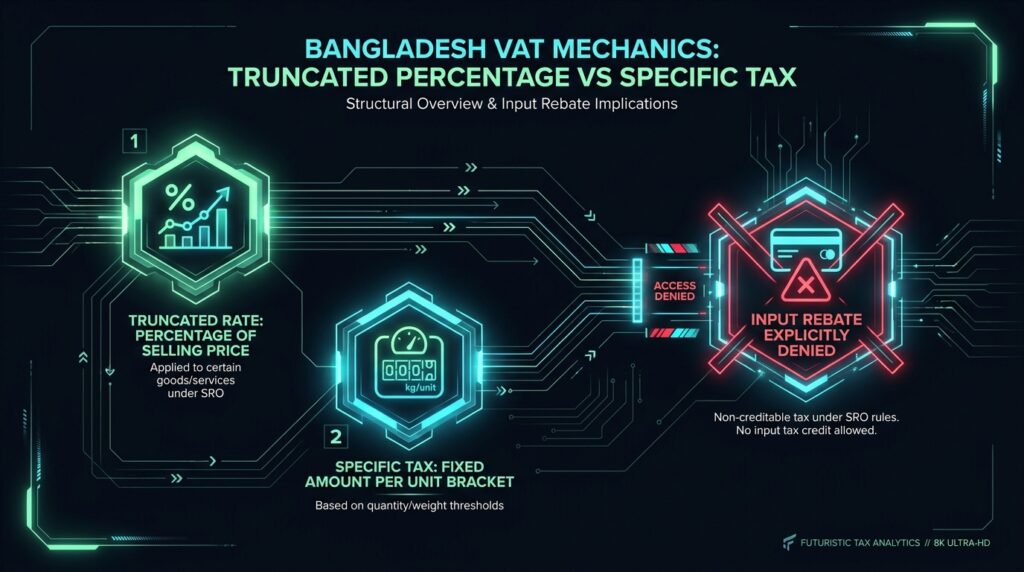
Like truncated rates, specific tax Bangladesh generally denies input rebate. The fixed-amount tax functions as a final tax, with the per-unit price already factoring in the assumed value addition.
This makes specific tax Bangladesh products somewhat inflexible in pricing — you can’t reduce VAT burden through input optimisation the way you can under standard 15% with rebate.
Difference Between Specific Tax Bangladesh and Truncated Rate
A common confusion. Both deny input rebate, but:
- Truncated rate: percentage of selling price (e.g., 5% of BDT 1,000 = BDT 50)
- Specific tax Bangladesh: fixed amount per unit (e.g., BDT 100 per pack regardless of selling price)
For high-value supplies, specific tax Bangladesh is often more favourable than percentage rates. For low-value supplies, it can be brutal.
Compliance for Specific Tax Bangladesh
Businesses subject to specific tax Bangladesh must:
- Apply the correct per-unit rate from the SRO
- Issue Mushak 6.3 showing units, rate, and total tax
- Maintain detailed inventory records by unit category
- File Mushak 9.1 with specific tax separately disclosed
- Carry no input rebate forward on these supplies
Common Errors
Three patterns:
- Wrong bracket classification by packaging weight or volume
- Mixing specific tax and percentage VAT in the same Mushak 6.3
- Claiming input rebate against specific tax supplies — disallowed
The Strategic Picture
Specific tax Bangladesh isn’t optional — if your product category is listed, you pay specifically. Modelling effective tax cost helps decide whether voluntary movement to standard rates (where election exists) makes commercial sense. For most listed categories, the specific tax route is mandatory.
Written by Md Rakib Hassan — Income Tax Practitioner with 10+ years of tax compliance and audit experience across Bangladesh and the UK. Former accounts manager at a UK chartered accounting firm managing 1,000+ clients, with direct experience resolving multi-year tax audit disputes with HMRC and the NBR. Currently Finance Controller at a UK-based multinational tech group.
Need help with specific tax classification, VAT, Income Tax, RJSC, or Accounting? We support manufacturers and distributors of specific-tax goods across Bangladesh and the UK.
Leave a Reply
You must be logged in to post a comment.