Written by Md Rakib Hassan — Income Tax Practitioner with 10+ years of tax compliance and audit experience across Bangladesh and the UK. Former Accounts Manager at a UK chartered accounting firm managing 1,000+ clients, with direct experience resolving multi-year tax audit disputes with HMRC and the NBR. Currently Finance Controller at a UK-based multinational tech group.
Introduction
If you own land in Bangladesh — whether a plot in a village, an apartment in Dhaka, or a commercial property in Chittagong — you have a legal obligation to pay land tax every year. In Bangladesh, this annual charge is formally called the Land Development Tax (LDT), but most people refer to it simply as land tax or jomi-r tax.
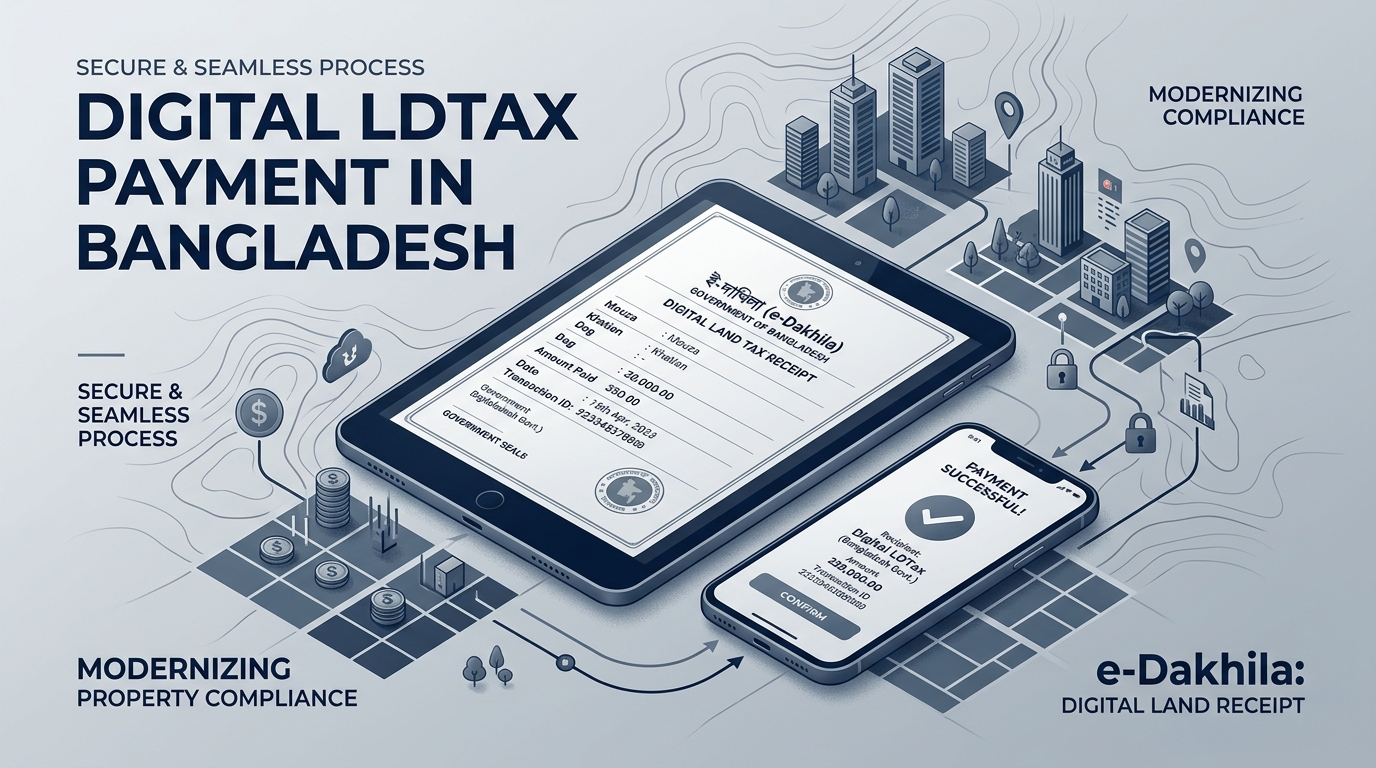
The good news: in 2026, paying your land tax in Bangladesh no longer requires you to stand in long queues at your union or upazila land office. The Ministry of Land has launched a fully digital platform — ldtax.gov.bd — and a dedicated LDTax mobile app that allows every landowner to register, calculate, pay, and download their official receipt (Dakhila) from the comfort of their home.
This guide explains everything: what land tax in Bangladesh is, who has to pay it, how to calculate it, how to pay it online, and what happens if you do not pay.
What Is Land Tax in Bangladesh?
Land tax — formally known as Land Development Tax (LDT) — is an annual charge levied by the Government of Bangladesh on the ownership and use of land. It is collected under the Land Development Tax Ordinance and administered by the Ministry of Land through district and upazila land offices.
Every landowner in Bangladesh, whether individual or corporate, is required to pay land tax annually to maintain the legal continuity of their ownership record. Once paid, the land office issues a Dakhila — an official government receipt — which serves as both proof of payment and a legal document confirming lawful possession of the land.
The land tax amount is calculated based on:
- The size of the land (in bigha or decimal)
- The location of the land (division, district, upazila, mouza)
- The classification of the land (agricultural, residential, commercial)
- The government-assessed rate for that category
Land tax in Bangladesh is generally very low for agricultural and rural land but can be more significant for urban, commercial, or high-value residential plots — particularly in Dhaka or Chittagong.
Land Tax vs Holding Tax: What Is the Difference?
Many property owners in Bangladesh confuse land tax with holding tax. They are separate charges collected by different authorities:
| Feature | Land Tax (LDT) | Holding Tax |
|---|---|---|
| Also Known As | Land Development Tax | Property Tax |
| Collected By | Ministry of Land | City Corporation / Municipality |
| Based On | Land area + classification | Property size + location |
| Receipt | Dakhila | Corporation Receipt |
| Portal | ldtax.gov.bd | City corporation website (e.g., DNCC, DSCC) |
| Frequency | Annual | Annual (usually in two instalments) |
If you own a house in Dhaka or any urban area, you must pay both: the land tax on the land itself, and the holding tax to the city corporation or municipality for civic services.
Who Must Pay Land Tax in Bangladesh?
Every person or organisation that owns or uses land in Bangladesh — for any purpose — is liable to pay land tax. This includes:
- Individual landowners (agricultural or residential)
- Apartment or flat owners (the land component is taxable even in multi-storey developments)
- Commercial property owners
- Industrial landholders
- Government-allocated land users
- Companies with registered premises
If your name appears in the land mutation record (khatian) as the lawful owner, you are responsible for the annual land tax payment. Failure to pay does not transfer this liability — it accumulates as arrears, with penalties and interest added over time.
How to Pay Land Tax Online in Bangladesh (Step-by-Step)
The Ministry of Land’s digital platform at ldtax.gov.bd and the LDTax mobile app have made the entire land tax payment process paperless and queue-free. Here is exactly how to do it:
Step 1 — Register on ldtax.gov.bd
Visit ldtax.gov.bd and create your account using your NID number and mobile phone number. You will receive an SMS confirmation. After registration, the designated land office will generate and link your holding details to your account.
Alternative: If you have difficulty registering online, call the government’s land service hotline at 16122. A representative can assist with registration and provide your holding number via SMS.
Step 2 — Submit Your Khatian (Land Record)
Log in to your account and submit your Khatian details:
- Khatian number
- Mouza name
- JL (Jurisdictional Location) number
- Plot details
The land office will verify and process your holding details. This step is a one-time setup — once your land record is linked to your account, future payments are much faster.
Step 3 — Generate a Payment Token
Once your holding number is confirmed, generate a payment token from within the portal. Alternatively, call 16122 with your holding number and request a token by SMS.
Important: The payment token is valid for 72 hours only. If you do not complete the payment within this window, the token expires and you must generate a new one.
Step 4 — Pay Your Land Tax
Pay your land tax using any of the following methods:
- bKash — The most widely used MFS option for land tax payments in Bangladesh
- Nagad — Available through the Ministry of Land website and app
- Rocket (DBBL) — Also supported for land tax payment
- Online banking — Debit/credit cards and internet banking
- Bank payment — Through scheduled commercial banks
Payment can be initiated directly through the LDTax mobile app, the ldtax.gov.bd website, or via the bKash app (under the Government Services section).
Step 5 — Download Your Dakhila (e-Receipt)
After successful payment, your official Dakhila is generated digitally. You can download it:
- Immediately from within the ldtax.gov.bd portal or LDTax app
- Within 72 hours of payment from the “Dakhila” section of the website
The Dakhila is your legal proof of land tax payment and must be preserved carefully. Courts in Bangladesh accept the Dakhila as evidence of lawful ownership and continuous possession. When selling land, buyers and their lawyers will ask to see the Dakhila record.
The LDTax Mobile App
The Ministry of Land has released an official LDTax mobile app (available on Google Play) that makes land tax payment even more convenient. Key features of the app include:
- Khatian submission directly from your phone
- Auto-verification and processing by land officials
- Secure online payment through integrated gateways (bKash, Nagad, Rocket, cards)
- Instant Dakhila download after payment
- 24/7 access — no need to wait for land office hours
- Real-time status tracking and payment notifications
- Dakhila history — all your previous receipts stored digitally
The app was designed to be simple enough for first-time users, including those with limited technical experience. You can search your property using the owner’s name, plot number, or record number.
Holding Tax: Paying via City Corporation Portal
If you own a residential or commercial property within a City Corporation area, you must also pay your annual holding tax (property tax) separately from your land tax.
Dhaka North City Corporation (DNCC): As of May 2025, DNCC residents can pay their holding tax entirely online. Visit the DNCC e-revenue portal, register your property, and pay via:
- Dutch Bangla Agent Banking
- bKash
- Nagad
- Trust Bank mobile banking
New properties not yet on the holding tax register can be added online through a self-evaluation process on the DNCC portal.
Dhaka South City Corporation (DSCC) and other City Corporations: Similar digital holding tax payment facilities are progressively being rolled out. Check your specific city corporation’s official website for current options.
What Is a Dakhila — and Why It Matters
The Dakhila is the government’s official acknowledgment that your land tax has been paid. It is much more than just a receipt. Here is why preserving your Dakhila matters enormously:
Legal Proof of Ownership: The Dakhila is accepted in civil courts as evidence of lawful ownership and links your mutation (namjari) record with continuous legal possession.
Protection Against Fraud: Unpaid land tax makes your property vulnerable to fraudulent claims and adverse possession proceedings. A consistent Dakhila record demonstrates you have never abandoned your claim to the land.
Required for Land Transactions: When selling, purchasing, or mortgaging land in Bangladesh, all parties’ lawyers and banks will demand a clear Dakhila record going back several years. Missing Dakhilas can delay or block transactions.
Needed for Mutation (Namjari): If you have recently inherited or purchased land, you need to complete mutation — the process of recording ownership change in the khatian. A current Dakhila is typically required to proceed with mutation.
Expert Note from Md Rakib Hassan: From my property transaction experience in Bangladesh, one of the most common delays I see occurs when landowners cannot produce a clear Dakhila trail. Even a single year’s missing land tax receipt can create serious complications during due diligence for a property sale. Always pay on time and always save your Dakhila — both digitally in your ldtax.gov.bd account and as a printed hard copy.
Consequences of Not Paying Land Tax
Ignoring your land tax obligation in Bangladesh can have serious legal and practical consequences:
Accumulation of Arrears and Penalties: Unpaid land tax does not disappear — it accumulates as arrears. The longer you delay, the larger the amount you eventually owe, as interest and late fees are added.
Legal and Ownership Disputes: If your land tax remains unpaid for extended periods, your property becomes legally vulnerable. Third parties may use the absence of a Dakhila record to challenge your ownership in court.
Government Action: In extreme cases of persistent non-payment, the government retains the right to take administrative action against the property — including proceedings that could jeopardise your possession rights.
Blocked Transactions: You cannot sell, transfer, or mortgage land in Bangladesh if the land tax record is not current. Banks will not finance a property purchase without a verified Dakhila trail.
Property Taxes in Bangladesh: A Full Picture
Beyond land tax, property owners in Bangladesh should be aware of the full spectrum of related charges:
Advance Income Tax (AIT): Deducted at the time of property purchase or sale. The rate varies based on property size, value, location, and whether the transaction is between individuals or institutions. AIT is non-refundable and must be budgeted for when planning any property transaction.
VAT on Property Transactions: VAT at 15% (under NBR regulations) applies to commercial real estate transactions and high-end residential sales. Most first-time purchases of standard residential properties do not attract VAT.
Capital Gains Tax: Applicable when selling property for a profit. Assessed on the difference between the purchase price and sale price, subject to applicable exemptions.
Income Tax on Rental Income: If you earn rental income from property in Bangladesh, this must be declared in your annual income tax return. Tax is deducted at source from rental payments under the TDS framework of the Income Tax Act 2023.
Land Tax and Its Relationship to Income Tax Filing
Many taxpayers are unaware that their land tax position is relevant to their income tax return as well. Under the Income Tax Act 2023:
- If you own property in a City Corporation or municipality area, you are required to have a TIN (Taxpayer Identification Number) and file an annual income tax return — even if your total income is below the taxable threshold.
- Your property details, including the land and its annual value, must be disclosed in the assets and liabilities schedule of your income tax return.
- If you have paid land tax or holding tax during the year, this can be noted in your expenditure schedule as a business expense (for commercial properties) or as part of your asset maintenance costs.
Maintaining a clean land tax record, therefore, supports not just your property ownership security but also the accuracy and defensibility of your income tax return.
Frequently Asked Questions
Q1. Where do I pay land tax online in Bangladesh? The official portal is ldtax.gov.bd. You can also pay via the LDTax mobile app or through bKash’s government services section.
Q2. How do I find my land’s holding number? Register on ldtax.gov.bd and submit your Khatian details. Alternatively, call 16122 with your land record information and the land office will assign your holding number.
Q3. What is a Dakhila? A Dakhila is the official government receipt for your land tax payment. It is a legal document accepted in court as proof of ownership continuity.
Q4. How long is my payment token valid? Payment tokens generated on ldtax.gov.bd are valid for 72 hours. If unused, you must generate a new one.
Q5. Can I pay multiple years of land tax arrears at once? Yes. The portal allows you to pay outstanding arrears from previous years together with the current year’s land tax.
Q6. Is holding tax the same as land tax? No. Land tax (LDT) is collected by the Ministry of Land. Holding tax is collected by city corporations or municipalities. If you live in an urban area, you likely need to pay both.
Q7. What if my land record has errors? Visit your local Union Land Office or Upazila Land Office and submit a correction application with supporting documents (NID, original khatian, deed). Corrections are processed manually.
Quick Reference: Land Tax Bangladesh
| Item | Detail |
|---|---|
| Official Portal | ldtax.gov.bd |
| Mobile App | LDTax (Google Play, Ministry of Land) |
| Hotline | 16122 |
| Payment Methods | bKash, Nagad, Rocket, cards, online banking |
| Token Validity | 72 hours |
| Receipt | e-Dakhila (downloadable PDF) |
| Frequency | Annual |
| Holding Tax (Urban) | City Corporation website (DNCC, DSCC) |
| Administered By | Ministry of Land, Bangladesh |
Final Thoughts
Land tax in Bangladesh may be one of the smallest annual financial obligations a property owner faces — but its consequences when ignored are disproportionately large. The digital transformation of Bangladesh’s land administration system through ldtax.gov.bd and the LDTax app has removed every practical barrier to timely payment. There is no longer any reason to miss your annual land tax obligation.
Pay online. Download your Dakhila. Store it safely. And if you own urban property, pay your holding tax too. Your Dakhila trail is the single most powerful document for protecting your property rights in Bangladesh — do not leave any gaps in it.
This article is informational and reflects Bangladesh’s land tax system as understood in 2026. Land tax rates, procedures, and regulations may change. Consult the Ministry of Land website (land.gov.bd) or a registered legal practitioner for advice specific to your property.
Leave a Reply
You must be logged in to post a comment.