Introduction
Every year, millions of Bangladeshis need to file an income tax return — yet most people find the process confusing, delay it until the last week of November, and end up making avoidable mistakes.
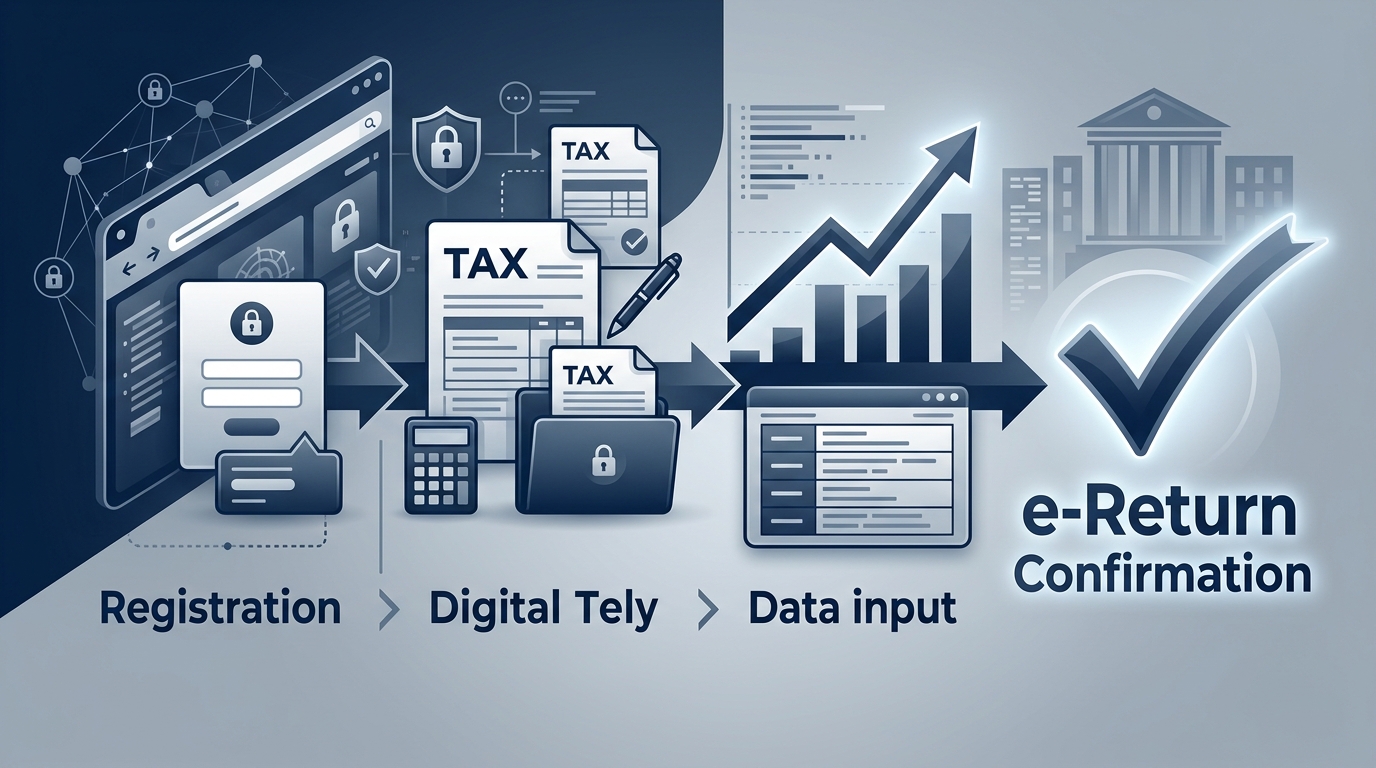
The good news: filing your tax return in Bangladesh has become significantly easier since the NBR launched its online filing system. You can now complete your tax return online from your home or office, generate your acknowledgement slip instantly, and pay any tax due digitally — without visiting a tax circle office.
This guide walks you through the entire process clearly and accurately, drawing on over a decade of tax filing experience and hundreds of NBR return submissions for individuals and businesses across Bangladesh and the UK.
What Is an Income Tax Return in Bangladesh?
An income tax return is a formal declaration submitted to the National Board of Revenue (NBR) stating your total income, allowable deductions, and the amount of tax you owe for a given income year.
In Bangladesh, the income year runs from 1 July to 30 June (e.g., Income Year 2024–25 = 1 July 2024 to 30 June 2025). The assessment year immediately follows the income year.
Submitting your tax return is not just something you do when you owe tax. Under the Income Tax Act 2023, all TIN holders are required to file a return every year — even if their income is zero or below the taxable threshold. Filing a “Nil Return” is not optional for registered taxpayers; it is a legal obligation.
Who Must File a Tax Return in Bangladesh?
You are required to file a tax return if:
- You hold a TIN (Taxpayer Identification Number) — regardless of income level
- Your annual income exceeds the tax-free threshold:
- General taxpayers: ৳3,50,000
- Women and senior citizens (65+): ৳4,00,000
- Persons with disabilities: ৳4,75,000
- Freedom fighters: ৳5,00,000
- You are a salaried employee — your employer should withhold tax, but you are still personally responsible for filing
- You are a business owner, freelancer, or professional with income from any source
- You own property, receive rental income, or have capital gains
- You are a company or partnership registered in Bangladesh
- You hold a trade licence, import/export licence, or government tender
Additionally, proof of tax return submission is now required for a growing number of financial transactions — including renewing credit cards, processing large bank transactions, and submitting tenders.
Tax Return Deadlines in Bangladesh
| Taxpayer Type | Filing Deadline |
|---|---|
| Individual taxpayers | 30 November of the assessment year |
| Company taxpayers | Within 6 months of the end of the income year |
| New companies (first return) | Within 6 months of incorporation or first income, whichever is later |
Missing the deadline triggers automatic penalties under the Income Tax Act 2023. For individuals, late filing results in a penalty of 2% per month on unpaid tax, plus potential disqualification from certain tax rebates.
My strong advice: do not treat 30 November as a target date. Treat it as a hard deadline — and aim to complete your tax return online at least two weeks before it.
Documents You Need to File a Tax Return
Preparing your documents before starting the online filing process will save significant time. Here is what to gather:
For Salaried Individuals
- TIN certificate (12-digit e-TIN number)
- Salary certificate from your employer (showing gross salary, deductions, and tax deducted at source)
- Bank statements for all accounts (July to June)
- Investment details — DPS, Savings Certificates (Sanchayapatra), insurance premiums, provident fund contributions (for tax rebate calculation)
- Rental income details (if applicable)
- Previous year’s tax return acknowledgement slip (assessment year prior)
For Business Owners and Self-Employed
- All of the above, plus:
- Business income and expense records
- Trade licence copy
- Profit and loss statement (can be self-prepared for small businesses)
- Bank statements for all business accounts
- VAT returns submitted to NBR (if VAT-registered)
For Companies
- Audited financial statements (Balance Sheet, P&L, Cash Flow)
- Tax computation prepared by a chartered accountant or tax advisor
- TDS challan receipts (withholding tax deducted and deposited)
- Previous assessment order (if applicable)
How to File Your Tax Return Online in Bangladesh (Step by Step)
The NBR’s tax return online filing system is accessible through the unified tax portal at https://etaxnbr.gov.bd.
Prerequisite: You must have a registered e-TIN and an active account on the portal before filing. If you have not done this yet, read the e-TIN Registration Guide first.
Step 1 — Log In to the NBR Tax Portal
Go to https://etaxnbr.gov.bd and log in using your username and password.
Step 2 — Navigate to the Return Submission Section
From your dashboard, click on “Submit Return” or “e-Return”. The portal will display the relevant return form based on your taxpayer type (individual, company, etc.).
Step 3 — Select the Correct Income Year
Choose the income year for which you are filing (e.g., Income Year 2024–25 for Assessment Year 2025–26). Ensure you are filing for the correct year — particularly if you are catching up on missed returns from prior years.
Step 4 — Fill in Your Income Details
The online tax return form is structured around your income sources. Complete each section that applies to you:
- Employment income — enter gross salary, allowances, and employer-deducted tax (TDS) from your salary certificate
- Business or professional income — enter net profit from your business or profession
- Rental income — enter total rent received, minus allowable deductions (repairs, municipal tax, etc.)
- Interest income — bank interest, savings certificate returns
- Capital gains — profits from property sales, share disposals
- Other income sources — dividend income, foreign remittances, etc.
The system automatically calculates your gross total income and net taxable income as you fill in the sections.
Step 5 — Claim Your Allowable Deductions and Tax Rebate
This is where many taxpayers leave money on the table. Bangladesh’s income tax system allows a tax rebate (not just a deduction) for qualifying investments and expenditures. This directly reduces your tax liability.
Qualifying items for the investment tax rebate include:
- Life insurance premiums
- Contributions to a Recognised Provident Fund (RPF)
- Deposits to Sanchayapatra (National Savings Certificates)
- DPS (Deposit Pension Scheme) contributions
- Contributions to approved pension schemes
- Investment in listed shares or mutual funds
The rebate is calculated as 15% of the lower of:
- Actual investment amount
- 25% of total income
- ৳10,00,000 (maximum eligible investment)
Ensure you enter all qualifying investments accurately — this rebate can substantially reduce the tax you owe.
Step 6 — Calculate Your Tax Liability
The portal auto-calculates your tax based on the current year’s tax slabs. For the 2024–25 income year (general taxpayers):
| Income Slab | Tax Rate |
|---|---|
| Up to ৳3,50,000 | 0% |
| Next ৳1,00,000 | 5% |
| Next ৳3,00,000 | 10% |
| Next ৳4,00,000 | 15% |
| Next ৳5,00,000 | 20% |
| Above ৳16,50,000 | 25% |
Your net tax payable = total tax calculated − investment tax rebate − tax deducted at source (TDS already paid by employer or bank).
Step 7 — Pay Any Tax Due (e-Payment)
If the calculation shows a balance tax payable, you must pay it before or at the time of filing your tax return. The NBR’s e-payment system allows you to pay online via internet banking or mobile banking.
For the full e-payment process, see the dedicated guide → NBR e-Payment: How to Pay Your Tax Online in Bangladesh.
Once payment is made, you will receive a challan number — enter this into the portal before submitting your return.
Step 8 — Submit Your Return and Download the Acknowledgement
Review your completed tax return carefully before submitting. Once you are satisfied:
- Click “Submit Return”
- The system will generate your “Income Tax Return Acknowledgement Slip” (also called a Return Receipt)
- Download and save this PDF immediately
This acknowledgement slip is critical. It is proof that you filed your tax return for the year. Banks, government offices, and employers increasingly require this slip alongside your TIN certificate for financial and compliance transactions.
What Is a Nil Return? Do You Still Need to File?
A Nil Return is a tax return submitted when your income is zero or below the taxable threshold — meaning you owe no tax. Despite this, you are still legally required to file if you hold a TIN.
Filing a Nil Return:
- Keeps your TIN active and compliant
- Prevents penalties for non-filing under the Income Tax Act 2023
- Maintains your eligibility for financial services requiring proof of return submission
- Takes less than 5 minutes to complete on the portal
There is no valid reason to skip filing your Nil Return. The cost of non-compliance far outweighs the fifteen minutes it takes to file.
Filing a Tax Return for Prior Years (Back-Filing)
If you have missed filing your tax return for one or more prior years, you can still file — though the process requires more care.
Back-filing options:
- Within the same assessment year — file before 30 November with no penalty if no tax is due
- After the deadline — a late return can be filed at your tax circle office. Penalties may apply based on any unpaid tax
- Amended return — if you filed but made an error, an amended return can be submitted within a limited window
I strongly recommend getting professional guidance for back-filing multiple years, particularly if income figures or TDS amounts need to be reconstructed.
Common Mistakes to Avoid When Filing Your Tax Return
1. Not including all income sources Every source of income must be declared — salary, rental, bank interest, freelance earnings. Omissions — even accidental ones — can trigger scrutiny or penalties during assessment.
2. Forgetting to claim the investment tax rebate This is the most expensive mistake I see. If you have DPS, Sanchayapatra, or insurance premium payments, always enter them. The 15% rebate directly reduces your tax bill.
3. Entering TDS incorrectly The TDS figure on your return must exactly match the amount actually deducted and deposited by your employer or bank. Mismatches trigger notices from the tax authority.
4. Missing the 30 November deadline Even by one day. Late filing penalties compound quickly. Set a reminder for mid-November.
5. Not saving the acknowledgement slip Once submitted, the portal generates your acknowledgement immediately. Download it straight away — retrieving it later is possible but adds friction.
6. Filing for the wrong income year It sounds obvious, but it happens. Confirm the income year before starting.
Tax Return for Expatriates and Foreign Income
If you are a Bangladeshi resident with income from abroad (freelancing for foreign clients, salary from a foreign employer, remittances), you are generally required to declare this income in your Bangladesh tax return. However, Bangladesh has Double Taxation Avoidance Agreements (DTAAs) with several countries, which may reduce or eliminate double taxation.
This is an area where professional advice adds significant value — the interaction between foreign income, DTAA provisions, and Bangladesh domestic tax law is complex and case-specific.
Frequently Asked Questions
What is the deadline for submitting a tax return in Bangladesh? 30 November of the assessment year for individual taxpayers. Companies have 6 months from the end of their income year.
Can I file my tax return online from abroad? Yes — the NBR’s tax return online system at etaxnbr.gov.bd is accessible from anywhere in the world.
What happens if I file a tax return but cannot pay the tax? File the return by the deadline regardless. Late payment carries interest charges, but late filing penalties are separate and often larger. Filing on time — even without full payment — demonstrates good faith compliance.
Do I need an accountant to file my tax return in Bangladesh? For simple salary-based returns, the online system is manageable independently. For business returns, multiple income sources, or prior-year back-filing, engaging a tax professional avoids costly errors.
Is the tax return acknowledgement slip the same as the TIN certificate? No — they are different documents. The TIN certificate proves your registration in the NBR system. The acknowledgement slip proves you submitted your tax return for a specific year. Both are often required together.
What is the minimum tax in Bangladesh? Regardless of income or deductions, there is a minimum tax liability based on your location. For example, taxpayers in Dhaka City Corporation area have a minimum tax of ৳5,000 per year. Check the NBR circular for the current assessment year’s minimum tax table.
Final Thoughts
Filing your income tax return in Bangladesh is no longer the bureaucratic ordeal it once was. The NBR’s tax return online system has made it accessible, fast, and free — and there is genuinely no good reason to delay or avoid it.
The consequences of non-filing compound over time: penalties, blocked financial transactions, compliance risk during audits, and the stress of sorting out multiple missed years at once. None of that is worth it.
If you are filing for the first time, start with your e-TIN registration, gather your salary certificate and investment documents, log in to the portal, and work through the return section by section. It is far less complex than most people expect.
For complex situations — multiple income sources, business returns, back-filing, or foreign income — professional assistance is a worthwhile investment.
Written by Md Rakib Hassan — Income Tax Practitioner and Manager – Accounts with 10+ years of tax compliance experience across Bangladesh and the UK. Specialist in NBR income tax returns, BD VAT, and financial operations for individuals and multinational business groups.
Leave a Reply
You must be logged in to post a comment.