Introduction
If you are planning a career in accounting or considering hiring a qualified finance professional, understanding the chartered accountant salary in Bangladesh is the first thing you need to get right.
The demand for qualified chartered accountants in Bangladesh has surged dramatically over the last decade — driven by a growing private sector, expanding multinational presence, stricter NBR compliance requirements, and the increasing adoption of modern ERP systems across industries.
But here is the catch: salary figures floating around online are often outdated, vague, or pulled from irrelevant markets. This guide gives you real, ground-level data on the chartered accountant salary in Bangladesh — broken down by experience level, sector, designation, and city — backed by 10+ years of hands-on finance experience across both Bangladeshi and UK accounting markets.
What Is a Chartered Accountant in Bangladesh?
In Bangladesh, a Chartered Accountant (CA) is a professional certified by the Institute of Chartered Accountants of Bangladesh (ICAB). This is the gold standard for accounting qualifications in the country.
There is also the Cost and Management Accountant (CMA) designation awarded by ICMAB (Institute of Cost and Management Accountants of Bangladesh), which is widely recognised for management accounting, budgeting, and cost control roles in manufacturing and corporate finance.
Both qualifications are rigorous, internationally respected, and increasingly in demand across Dhaka, Chittagong, Sylhet, and beyond.
Chartered Accountant Salary in Bangladesh — 2026 Overview
The chartered accountant salary in Bangladesh varies significantly depending on:
- Years of experience
- Industry sector (public, private, MNC, Big 4)
- Location (Dhaka vs other cities)
- Additional qualifications (CMA, MBA, UK ACCA, etc.)
- Scope of role (audit, tax, financial reporting, treasury)
As a general benchmark for 2026:
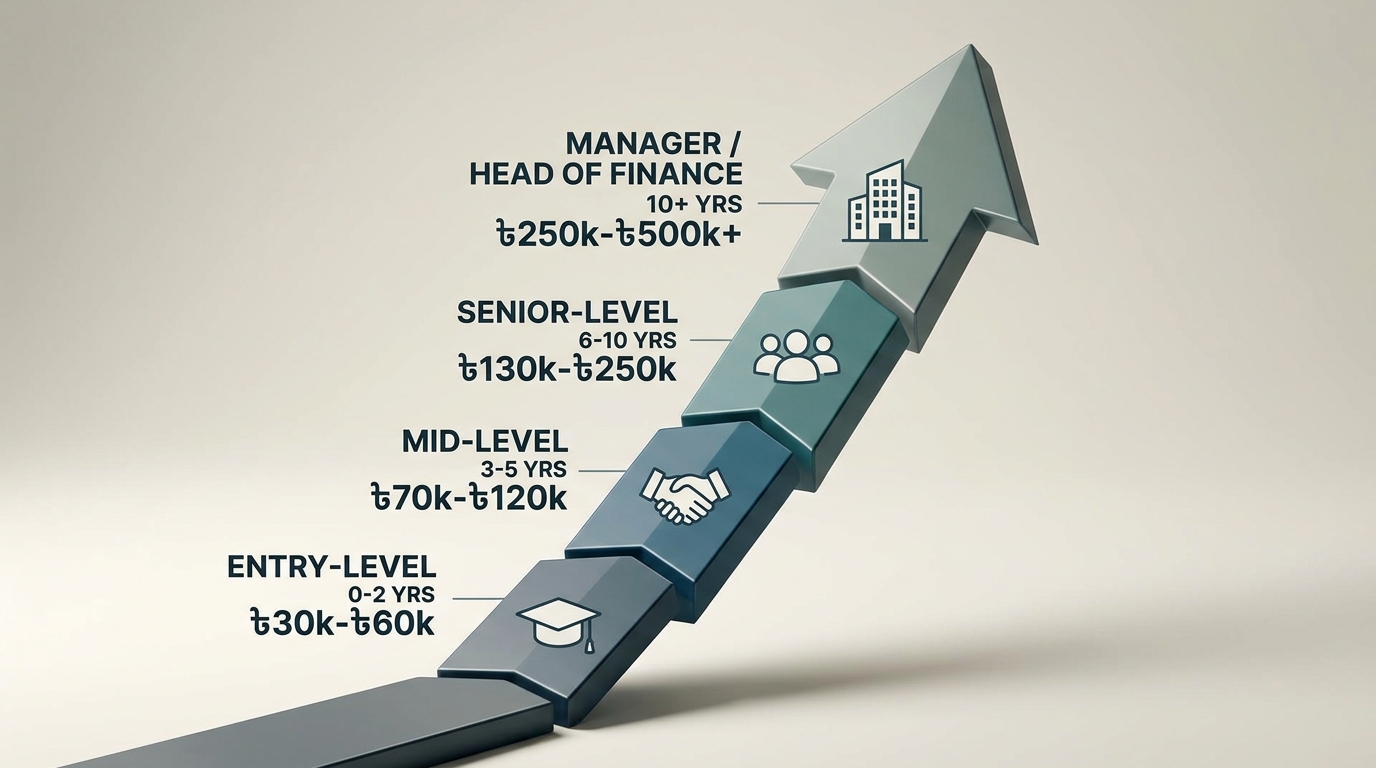
| Level | Monthly Salary Range (BDT) |
|---|---|
| Entry Level (0–2 years) | ৳30,000 – ৳60,000 |
| Mid-Level (3–5 years) | ৳70,000 – ৳1,20,000 |
| Senior Level (6–10 years) | ৳1,30,000 – ৳2,50,000 |
| Manager / Head of Finance | ৳2,50,000 – ৳5,00,000+ |
| CFO / Group Finance Director | ৳5,00,000 – ৳15,00,000+ |
These figures represent the chartered accountant salary range across industries and should be used as a starting point, not a ceiling.
Chartered Accountant Salary in Bangladesh by Experience Level
Entry Level (0–2 Years)
Freshly qualified CAs entering the job market in Bangladesh can expect salaries between ৳30,000 and ৳60,000 per month. This range is common in smaller private companies and local audit firms.
Big 4 firms (KPMG, Deloitte, PwC, EY — operating through their local affiliate partners in Bangladesh) tend to offer slightly higher packages at entry level, often between ৳50,000 and ৳80,000, given the brand premium and structured career progression.
Key insight: Entry-level candidates who combine their CA qualification with hands-on experience in VAT, TDS, and NBR compliance are positioned to negotiate from the higher end of this range from day one.
Mid-Level (3–5 Years)
At this stage, the chartered accountant salary in Bangladesh becomes considerably more rewarding. Professionals with 3–5 years of experience — especially those who have managed tax filings, coordinated external audits, or handled multi-company consolidation — can realistically command between ৳70,000 and ৳1,20,000 per month.
Roles at this level typically include Senior Accountant, Deputy Manager – Finance, or Tax Manager.
Senior Level (6–10 Years)
With 6–10 years of experience, the chartered accountant salary in Bangladesh climbs sharply — particularly for those who have built expertise in areas like:
- Corporate tax planning and VAT compliance
- Cash flow forecasting and budgeting
- Cross-border financial management
- ERP implementation and process automation
Senior finance professionals managing teams and overseeing full financial operations for companies or groups can earn between ৳1,30,000 and ৳2,50,000 per month — and often more in multinational environments.
Manager and Head of Finance Level (10+ Years)
At the managerial level, total monthly compensation (salary + bonuses + benefits) for a qualified chartered accountant managing large teams and group entities in Bangladesh can range from ৳2,50,000 to ৳5,00,000+ depending on the employer’s scale and sector.
Professionals working for fast-growing tech companies, MNCs, or conglomerates with multi-entity structures (UK, Canada, India, Bangladesh) are increasingly seeing compensation packages that reflect global standards.
Chartered Accountant Salary in Bangladesh by Sector
1. Banking and Financial Services
This is consistently one of the highest-paying sectors for chartered accountants in Bangladesh. Commercial banks, investment banks, and insurance companies offer competitive packages and structured bonus schemes. Expect salaries 20–40% above the market average for equivalent experience levels.
2. Multinational Corporations (MNCs)
MNCs operating in Bangladesh — particularly in FMCG, pharma, telecom, and technology — pay a significant premium for CA professionals who can navigate both local NBR requirements and international financial reporting standards (IFRS). Senior roles here can breach ৳4,00,000–৳6,00,000 per month in total compensation.
3. Garments and Manufacturing (RMG Sector)
Bangladesh’s garments sector remains a massive employer of finance professionals. However, the chartered accountant salary in RMG tends to sit at the lower-to-mid range of the market unless the employer is a large group or export-heavy operation with complex compliance structures.
4. Tech and Ed-Tech Companies (Emerging Sector)
One of the most rapidly evolving sectors in Bangladesh right now. Fast-growing tech companies — particularly those with UK or international parent entities — are offering aggressive packages to attract finance talent capable of managing multi-currency books, cross-border tax compliance, and automated financial systems. This is exactly where roles combining accounting depth with Google Sheets, AppScript automation, and ERP skills are being rewarded above market rate.
5. Big 4 and Large Audit Firms
A career at a Big 4 firm or large local accounting firm in Bangladesh builds unmatched technical credibility. While the base salary at junior levels may not match the private sector, the progression is structured and the exit opportunities are premium.
6. NGOs and Development Sector
NGOs and INGO offices in Bangladesh (World Bank-funded projects, USAID programmes, etc.) offer competitive salaries for finance professionals — often benchmarked against international pay scales — along with other benefits. Roles here require strong donor reporting and compliance skills.
Chartered Accountant Salary in Bangladesh by City
Dhaka commands the highest salaries without question. The capital is home to the vast majority of MNCs, bank head offices, large conglomerates, and tech firms. Salary premiums of 20–35% over other cities are standard.
Chittagong is the commercial hub of the port and manufacturing industry. Finance professionals here — particularly those with expertise in customs, VAT on imports, and export documentation — find strong demand and reasonable salary levels.
Sylhet has a smaller but growing market, primarily driven by the real estate sector, NRB-backed businesses, and local conglomerates. The chartered accountant salary here tends to be lower than Dhaka and Chittagong, but cost of living adjusts the equation.
Key Factors That Influence the Chartered Accountant Salary in Bangladesh
Beyond experience and sector, several other factors directly affect how much you earn:
1. Additional Qualifications Professionals who hold dual qualifications — for example, CA + CMA (ICMAB), or CA + ACCA (UK) — consistently earn more. Companies with international operations actively look for this combination.
2. VAT and Tax Expertise Given Bangladesh’s complex VAT system under the VAT and SD Act 2012 and the NBR’s increasing enforcement capacity, professionals with hands-on BD VAT, Mushak filing, and withholding tax (TDS/VDS) expertise are in high demand and can negotiate from strength.
3. ERP and Automation Skills Finance professionals who can use Tally ERP, Xero, QuickBooks, or automate processes using Google Sheets and AppScript are increasingly valuable — especially in organisations trying to scale without proportionally increasing headcount.
4. Leadership and Team Management Managing large accounting teams, training junior staff, and building scalable processes is a premium skill. Finance professionals who can do this — and demonstrate results — earn significantly above the standard chartered accountant salary in Bangladesh.
5. International Exposure Experience working with UK HMRC filings, IFRS financial statements, or multinational group consolidations is a differentiator that commands a salary premium in Bangladesh’s evolving market.
ICAB vs ICMAB — Does the Qualification Affect Salary?
ICAB (CA) is the traditional gold standard for statutory audit, tax advisory, and financial reporting roles. Historically, ICAB-qualified professionals have commanded a slight premium in the market.
ICMAB (CMA) qualifications are increasingly valued in the corporate sector — particularly in manufacturing, cost analysis, budgeting, and management reporting roles. As companies mature beyond basic compliance into financial planning and analysis, CMA holders are finding their compensation converge with — and in some sectors exceed — equivalent CA holders.
The bottom line: the chartered accountant salary in Bangladesh is increasingly less about the specific qualification and more about the combination of technical depth, practical experience, and demonstrated impact.
How to Maximise Your Earning Potential as a CA in Bangladesh
Here are the practical steps that actually move the needle on your salary:
- Build dual qualification credibility — CA + CMA, or CA + ACCA (UK) if you have international aspirations
- Master BD VAT and TDS — this is a persistent skills gap in the market; expertise here is directly monetisable
- Learn at least one ERP platform deeply — Xero, QuickBooks, or Tally. Add AppScript or Excel automation skills on top
- Seek roles with group or multi-entity exposure — managing consolidated financials across entities significantly boosts your market value
- Get hands-on with budgeting and forecasting — management accounting skills are what separate a strong salary ceiling from a limited one
- Document your financial impact — tax savings recovered, processes automated, compliance penalties avoided — these are your negotiating ammunition
Frequently Asked Questions
What is the starting chartered accountant salary in Bangladesh? A fresh CA can expect between ৳30,000 and ৳60,000 per month in most private sector roles, with Big 4 and MNC entry points slightly higher.
Is the chartered accountant salary in Bangladesh competitive compared to regional markets? Compared to India and Pakistan, Bangladesh salaries for CAs remain lower in absolute terms. However, the gap is narrowing — particularly in tech, banking, and MNC sectors — and is offset by lower living costs outside Dhaka.
Do chartered accountants in Bangladesh get bonuses? Yes — festival bonuses (Eid-ul-Fitr and Eid-ul-Adha) are standard, typically equivalent to 1–2 months’ salary. Performance bonuses are increasingly common in private sector and MNC environments.
How does UK experience affect chartered accountant salary in Bangladesh? Significantly. Professionals who have worked with UK VAT (HMRC), IFRS, or international group structures are in high demand from companies expanding internationally and command 20–40% premiums in relevant roles.
Is CMA (ICMAB) worth it for salary growth in Bangladesh? Absolutely — particularly if you are aiming for corporate finance, FP&A, or managerial roles in manufacturing or tech. Combining CMA with practical BD VAT and tax expertise is a powerful combination.
Final Thoughts
The chartered accountant salary in Bangladesh in 2026 reflects a market in transition — one that is becoming more sophisticated, more compliance-driven, and more open to rewarding professionals who bring both technical depth and commercial impact.
Whether you are a fresh CA planning your first move, an experienced finance professional benchmarking your current package, or a business owner building a finance function, the key takeaway is this: qualifications open the door, but what you can demonstrate — in tax savings, compliance accuracy, team leadership, and financial insight — is what determines where you land on the salary spectrum.
The market rewards professionals who evolve beyond bookkeeping into true business partners. That gap between average and exceptional is where the real salary differential lives.
Written by Md Rakib Hassan — 10+ year finance professional, Income Tax Practitioner, and Accounts Manager with experience across UK, Bangladesh, Canada, and India. Specialist in BD VAT, UK VAT, corporate tax compliance, and financial operations for multinational group entities.
Leave a Reply
You must be logged in to post a comment.