Written by Md Rakib Hassan — Income Tax Practitioner with 10+ years of tax compliance and audit experience across Bangladesh and the UK. Former accounts manager at a UK chartered accounting firm managing 1,000+ clients, with direct experience resolving multi-year tax audit disputes with HMRC and the NBR. Currently Finance Controller at a UK-based multinational tech group.
If you are involved in importing or exporting goods through Bangladesh customs — whether as an importer, C&F agent, procurement officer, or finance controller — understanding the Bill of Entry is not optional. It is the primary customs declaration document that determines how much duty and tax your consignment will attract, how fast it clears, and whether your goods end up in a red lane or sail through green.
This guide covers every field of the Bill of Entry in Bangladesh, the ASYCUDA World submission process, required supporting documents, customs procedure codes, and the complete duty and tax structure applied at the import stage. You can download the full BoE field reference guide here. (Link to your PDF)
What Is a Bill of Entry in Bangladesh?
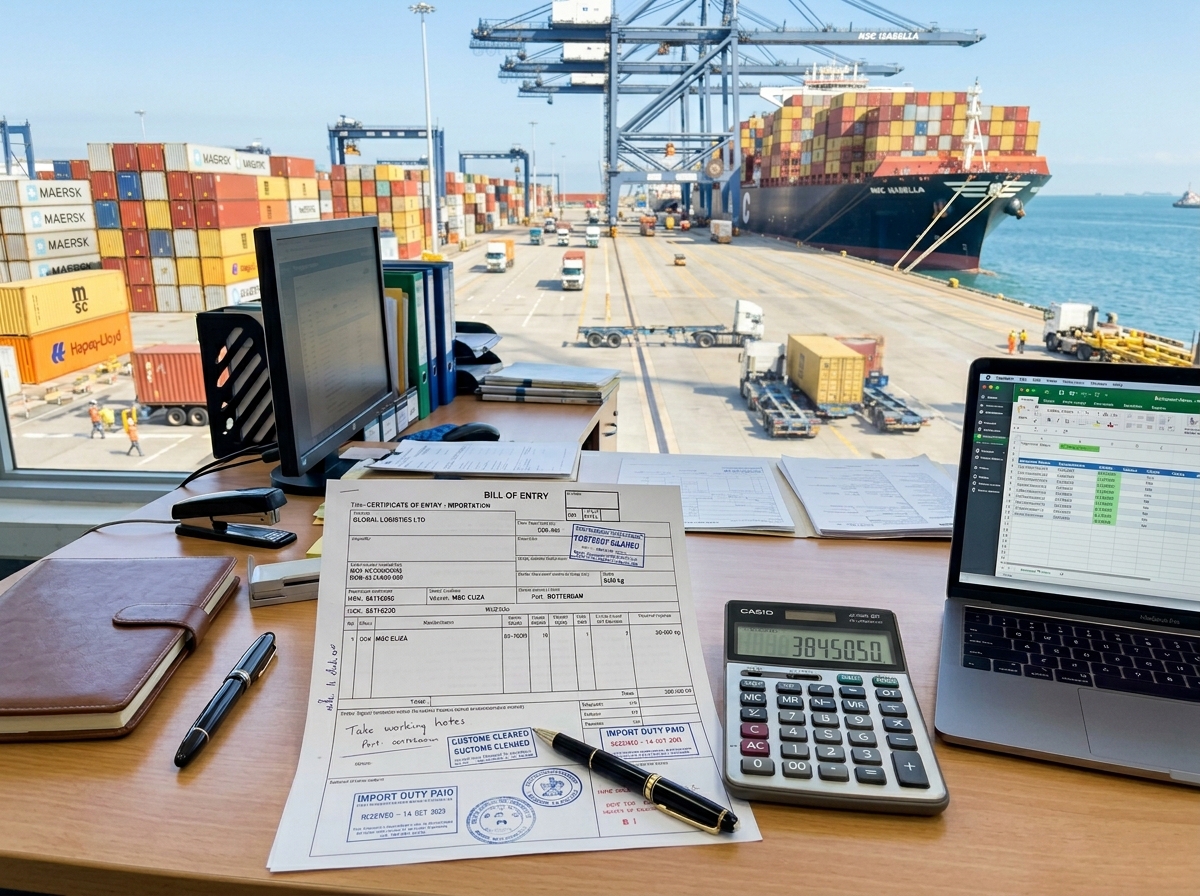
A Bill of Entry (BoE) is the official customs declaration form submitted by an importer (or their appointed C&F agent) to Bangladesh Customs for every import consignment. It is prepared in the Single Administrative Document (SAD) format and submitted electronically through ASYCUDA World — the customs IT platform used by the National Board of Revenue (NBR).
The legal framework governing the BoE is the Prescribed Bill of Entry and Bill of Export Form Order, 2001 issued by the NBR. For exports, the equivalent document is the Bill of Export (BoEx), with declaration type code EX. For imports, the declaration type code is IM.
Once the Import General Manifest (IGM) is submitted online by the shipping agent, the nominated C&F Agent — or the importer themselves — completes the goods declaration (the Bill of Entry) from their own premises and submits it to the Customs system through ASYCUDA World.
Step 1: Before You File — Documents You Must Have Ready
Required importation documents generally include a letter of credit authorisation form, a bill of lading or airway bill, a commercial invoice or packing list, and a certificate of origin. For certain goods, additional certifications are required.
Here is the complete list for standard commercial imports:
| Document | Required For |
|---|---|
| Letter of Credit (L/C) | All import Bill of Entry filings |
| Bill of Lading / Airway Bill | All modes of transport |
| Commercial Invoice | All imports |
| Packing List | All imports |
| Certificate of Origin | All imports |
| IRC (Import Registration Certificate) | All commercial importers |
| BIN (VAT Registration Number) | Must appear on the Bill of Lading |
| BSTI Certificate | 55 mandatory items as per Import Policy |
| PSI Report (if applicable) | Milk products, coal, MS Billets, and public sector items over BDT 50 lac |
| CRF Number (Clean Report of Findings) | PSI-method imports; use 99999999 if no PSI done |
| IP Certificate (for branded goods) | Goods with IP rights registered in Bangladesh |
Practitioner’s Note: Effective 1 July 2025, certificates, licences, and permits issued by 19 organisations including BSTI, DGDA, EPB, BEZA, BTRC, and others are mandatory through the BSW (Bangladesh Single Window) system for customs clearance. If your C&F agent is still handling CLPs manually, they are operating outside the new BSW-mandated process.
Step 2: Understanding Every Field of the Bill of Entry
The BoE has 56 fields. Here is a complete, practical breakdown of the most critical ones.
Field 1 — Declaration (ঘোষণা)
Declaration Type: Use IM for imports and EX for exports. Sub-Category: Indicates the purpose of the shipment.
| Sub-Category | Code |
|---|---|
| General Procedure | 1 |
| Permanent Export | 1 |
| Import Entry for Home Use | 4 |
Field 2 — Consignor/Exporter Name and Address
For Bill of Export: the full name, address, and BIN (VAT number) of the Bangladeshi exporter. For Bill of Entry: the full name and address of the foreign supplier (from the invoice/bill of lading).
Field 3 — Page
The page number of this BoE page out of the total. A 3-page BoE reads: Page 1 of 3, Page 2 of 3, Page 3 of 3.
Field 5 — Items
The total number of line items (goods descriptions) across all pages. Example: 17
Field 6 — Total Package Number
The total count of all packages across all item types. Example: 450
Field 7 — Agent Reference Number (AIN)
The C&F agent’s serial number assigned at registration. Example: 725
Field 8 — Consignee/Importer Name and Address
For Bill of Entry: the full name, address, and BIN of the Bangladeshi importer. For Bill of Export: the full name and address of the foreign buyer.
Field 12 — Total Assessable Value
The total customs-assessable value of the entire consignment in local currency. This is what all duties are calculated against.
Formula:
FOB Value + Freight + Insurance + Landing Charge + Other charges = Assessable Value OR: CIF Value + Landing Charge + Other charges = Assessable Value OR: C&F Value + Insurance + Landing Charge + Other charges = Assessable Value
Field 14 — C&F Agent (Name and Address)
The declaring agent’s full name, address, and AIN number. This is the C&F firm responsible for the filing.
Field 15a — Country of Export
The country from which the goods were shipped. Example: If Country Code is SG, field reads “Singapore.”
Field 15b — Country of Export Code
The two-letter country code of the exporting country. Example: IN for India.
Field 16 — Country of Origin
The country where the goods were manufactured or produced. If goods from multiple countries are in one shipment, write “many.”
Fields 17a / 17c — Country of Destination (Bill of Export only)
The final destination country of exported goods. Example: US = United States of America.
Field 18 — Carrier Name and Nationality
The name of the vessel, airline, or transport company. Include the flight number or vessel name. Example: Kotak Khinabalu (vessel name), Singapore Airlines SQ-420 (flight number). Nationality = the country where the carrier is registered.
Field 19 — Container Flag (C.F.)
For import BoE only. Use 1 if the cargo is containerised, 0 if not.
Field 20 — Delivery Terms
The Incoterm governing the transaction. Example: CFR = Cost and Freight | CIF = Cost, Insurance and Freight
Field 22 — Currency and Total Invoice Value
The currency code (e.g., USD for US Dollar) and the total invoice value. Example: USD 157,899.89
Field 23 — Exchange Rate
The customs exchange rate (BDT per foreign currency unit) applicable on the date of filing. Example: BDT 84.95 per USD (August 2020 — verify the current rate from NBR at filing date).
Field 24 — Nature of Transaction
The payment method code for the import transaction.
| Description | Code |
|---|---|
| LC | 01 |
| Import Permit (IP) | 06 |
| Clearance Permit (CP) | 07 |
Field 25 — Mode of Transport (MOT)
| Mode | Code |
|---|---|
| Maritime (Sea) | 1 |
| Rail | 2 |
| Road | 3 |
| Air | 4 |
Field 27 — Place of Loading/Unloading
International port code of the loading and unloading ports. Example: NZAKL = Auckland, New Zealand | BDCGP = Chittagong, Bangladesh
Field 28 — Financial and Banking Data (Import BoE Only)
Includes Bank Code, Bank Name, LC Number, LC Date, LCA Number, and LCA Date. LC Date format: dd mm yy → 1st December 2001 = 011201 LCA Date format: dd mm yy → 10th February 2002 = 100202
Field 29 — Office of Entry/Departure
The customs station where the goods enter or depart Bangladesh. Example: 101 = Dhaka Custom House | 301 = Chittagong Custom House
Field 30 — Location of Goods
Where the goods are physically located at time of filing. Example: 301 SH02 = Shed 2, Chittagong
Field 31 — Item Description (Marks, Packages, Container Number)
Marks and Number: Shipping marks from the invoice and packing list. Number of Packages: Total packages per item. Package Code: From Appendix 12 (e.g., CR = goods in crates). Container Number: If containerised, list up to 4 container numbers per item. Tariff Description: The HS-based goods description. Commercial Description: Exact product specification from the invoice.
Example: Jute Carpet, Size 9’×6′, item code, art no, purity etc.
Field 32 — Item Number
Sequential number for each item line — starts at 1 on page 1 and increments across all pages.
Field 33 — HS Code
The 8-digit Harmonized System code for the goods, per Bangladesh Customs Tariff (BCT). Example: 5702.39.11
Field 34 — Country of Origin Code
The alpha code from Appendix 3 identifying where goods were manufactured. Example: SG = Singapore.
Fields 35 & 38 — Gross and Net Weight (KG)
Both gross and net weight to two decimal places. Example: Gross: 443.27 | Net: 333.67
Field 36 — Agreement Code
Only applicable if a preferential duty rate is claimed under a bilateral trade agreement. For Bangladesh–Bhutan, code is 111.
Field 37 — Customs Procedure Code (CPC)
This is one of the most important fields. The CPC is a 4-digit code: the first 2 digits represent the current customs procedure requested, and the last 2 digits represent the previous procedure applied.
Examples:
- 4000 = Direct import for home use, no prior procedure applied
- 1071 = Permanent export, goods previously warehoused
Additional Procedure Code (APC): Used for special duty exemption claims.
- 179 = Diplomatic reduction of Duty and VAT
- 000 = No duty or tax reduction claimed
Field 40 — Line/Serial Number – Cargo Lading Number
The Bill of Lading, Airway Bill, or rail/truck receipt number. If multiple lading numbers exist, separate with commas.
Field 41 — Quantity and Unit
Statistical quantity per item, as per the HS code classification, and the unit of measurement (e.g., 1000 ML).
Field 42 — Item Invoice Value
The line-item value from the invoice.
Field 43 — Valuation Method (V.M. Code)
The method used to determine customs value.
- Code 1 = Transaction value (most common)
- Code 6 = Fall-back method
Field 44 — Additional Documents
Includes IRC/ERC Number, CRF Number, EXP Number (for exports), UP/UD Number, Invoice Number and Date.
CRF Number format: Company code + date (DDMMYYYY). If no PSI: 99999999 + date.
Field 45 — Adjustment
Only applicable if the customs assessable value differs from the declared value. Formula: Assessable Value ÷ Declared Value = Adjustment Factor Example: If Declared = USD 200/unit and Assessable = USD 300/unit, Adjustment = 1.5
Field 46 — Item Assessable Value
The customs assessable value in BDT for each item. Formula: (FOB + Freight + Insurance + Landing Charge) × Exchange Rate = Assessable Value
Field 47 — Tax Calculation by Item
This field is the heart of the BoE — it shows the full duty and tax breakdown for each line item.
| Tax Type | Base | Rate Applied |
|---|---|---|
| CD (Customs Duty) | Assessable Value | Per Item |
| RD (Regulatory Duty) | Assessable Value | Per Item |
| SD (Supplementary Duty) | Assessable Value + CD + RD | Per Item |
| VAT | Assessable Value + CD + RD + SD | Per Item |
| AIT (Advance Income Tax) | Assessable Value | Per Item |
| AT (Advance Tax) | Assessable Value + CD + SD | Per Item |
| AVAT (Advance VAT) | Assessable Value + CD + SD | Per Item |
| LF (Licence Fee) | Assessable Value | Per Item |
| IDSC (Infrastructure Dev. Surcharge) | Assessable Value | Per Item |
| PSISC (Pre-Shipment Inspection Service Charge) | Assessable Value | Per Item |
Field 55 — Total Consignment Weight and Value
The overall gross and net weight of the entire consignment, plus the total invoice value in foreign currency. This must reconcile with the invoice.
Example: Gross 900 KG | Net 895 KG | Invoice C&F USD 100,000 + Freight USD 500 + Insurance USD 1,000 + Landing USD 1,000 = Total USD 102,500
Field 56 — Declaration
The signature, designation, and date of the importer/exporter, plus the C&F agent’s card number and signature.
The Import Duty Calculation — A Worked Example
Based on the formulas from Section 28 of the VAT Act 2012, here is the full duty cascade for a sample import:
Given: FOB = BDT 1,000 | Freight = BDT 100 | Insurance = BDT 50 CD Rate = 25% | RD Rate = 5% | SD Rate = 20% | VAT Rate = 15% | AT Rate = 5% | AIT Rate = 5%
Step 1 — Assessable Value: CIF = FOB + Freight + Insurance = 1,000 + 100 + 50 = BDT 1,150 Landing Charge = 1% of CIF = 11.50 Assessable Value = 1,150 + 11.50 = BDT 1,161.50
Step 2 — Customs Duty (CD): CD = 1,161.50 × 25% = BDT 290.375
Step 3 — Regulatory Duty (RD): RD = 1,161.50 × 5% = BDT 58.075
Step 4 — Supplementary Duty (SD): SD Base = 1,161.50 + 290.375 + 58.075 = 1,509.95 SD = 1,509.95 × 20% = BDT 301.99
Step 5 — VAT: VAT Base = 1,161.50 + 290.375 + 58.075 + 301.99 = 1,811.94 VAT = 1,811.94 × 15% = BDT 271.79
Step 6 — Advance Tax (AT): AT = 1,811.94 × 5% = BDT 90.60
Step 7 — Advance Income Tax (AIT): AIT = 1,161.50 × 5% = BDT 58.075
Total Duty & Tax = 290.375 + 58.075 + 301.99 + 271.79 + 90.60 + 58.075 = BDT 1,070.905
This calculation follows the cascade structure: each tax type feeds into the base of the next. Getting this sequence wrong is a common error that causes either under-assessment (triggering penalties) or over-payment.
Green Lane, Yellow Lane, Red Lane — What Happens After Filing?
Once you submit the BoE through ASYCUDA World, it is risk-assessed and routed to one of three clearance lanes:
Green Lane: Auto-released without examination. A minimum 20% of consignments from Authorised Economic Operators (AEOs) are eligible for auto-release.
Yellow Lane: Documentary check only — no physical examination.
Red Lane: Full physical examination plus documentary check. Customs may open containers and inspect goods.
After duties and taxes are assessed and paid via e-challan (treasury payment), the importer or C&F agent receives the gate pass to collect the goods from the customs shed or port.
Key Compliance Points for Importers in 2025
The Authorised Economic Operator (AEO) rules have been updated via SRO No. 217-AIN/2024/67/Customs (June 2024). AEOs can now clear consignments within 14 days of deferred payment against a bank guarantee, and receive fast-track physical inspection with 24/7 release.
The Customs Act, 2023 also provides the option of seeking advance rulings on the classification of goods proposed for import and their country of origin — a powerful tool for importers who regularly bring in goods where HS classification disputes have previously caused delays.
Frequently Asked Questions
Q: What is the difference between a Bill of Entry and a Bill of Lading? The Bill of Lading is a transport document issued by the shipping company as a contract of carriage. The Bill of Entry is the customs declaration document prepared by the importer or C&F agent based on the Bill of Lading and other shipping documents.
Q: Who prepares the Bill of Entry in Bangladesh? The importer or their appointed C&F (Clearing and Forwarding) agent prepares and submits the BoE through the ASYCUDA World system. The C&F agent must have an AIN (Agent Identification Number) to file.
Q: What is ASYCUDA World? ASYCUDA (Automated System for Customs Data) World is the NBR’s electronic customs processing platform. All Bill of Entry and Bill of Export submissions are made through this system.
Q: What is the landing charge used in assessable value calculation? Landing charge is 1% of CIF value, added to arrive at the customs assessable value. If freight is unavailable, customs may apply 20% of FOB value as the deemed freight figure.
Q: Can I get an advance ruling on HS classification? Yes. Under the Customs Act 2023, importers can seek advance rulings from customs authorities on the classification of goods and their country of origin before the goods arrive.
You can download the full Bill of Entry field reference guide here. (Link to your PDF)
This article is for general guidance only. Customs regulations, rates, and procedures are subject to change. Always consult the latest NBR notifications and a licensed C&F agent for shipment-specific advice.
Leave a Reply
You must be logged in to post a comment.