Written by Md Rakib Hassan — Income Tax Practitioner with 10+ years of tax compliance and audit experience across Bangladesh and the UK. Former accounts manager at a UK chartered accounting firm managing 1,000+ clients, with direct experience resolving multi-year tax audit disputes with HMRC and the NBR. Currently Finance Controller at a UK-based multinational tech group.
Running a business in Bangladesh without proper financial tools is not just inconvenient — in 2026, it is a compliance liability. The National Board of Revenue (NBR) now cross-matches your monthly Mushak-9.1 VAT returns against your annual audited financial statements automatically. One mismatch, and you are flagged for audit. This is exactly why choosing the best small business accounting software is no longer a luxury for Bangladeshi SMEs — it is a legal and operational necessity.
Whether you run a retail shop in Dhanmondi, a trading company in Chattogram, or a growing service firm in Sylhet, this guide will help you cut through the noise, compare the top accounting software solutions available in the Bangladeshi market, and make a financially sound, compliance-first decision for 2026 and beyond.
Why Small Businesses in Bangladesh Must Prioritise Accounting Software in 2026
Throughout 2025, the NBR aggressively expanded its digital monitoring infrastructure. The revenue authority is now capable of catching financial discrepancies faster than ever — by simultaneously cross-matching import data, banking transactions, and monthly VAT returns. This creates a new reality: manual bookkeeping, spreadsheets, and paper-based records are not just inefficient — they are audit risks.
Under the VAT and Supplementary Duty Act 2012, businesses with an annual taxable turnover exceeding BDT 50 million are legally required to use NBR-approved VAT processing software. However, even businesses below this threshold are strongly advised to adopt digital accounting systems, because NBR’s compliance net is widening every year.
From my 10+ years of working with both the NBR and HMRC, I can tell you clearly: the businesses that survive tax audits are those with clean, digitised, real-time financial records. The best small business accounting software does exactly that — it automates your books, generates compliant VAT forms (Mushak 6.3, 6.6, 9.1), and produces a full audit trail at the click of a button.

What to Look for in Small Business Accounting Software in Bangladesh
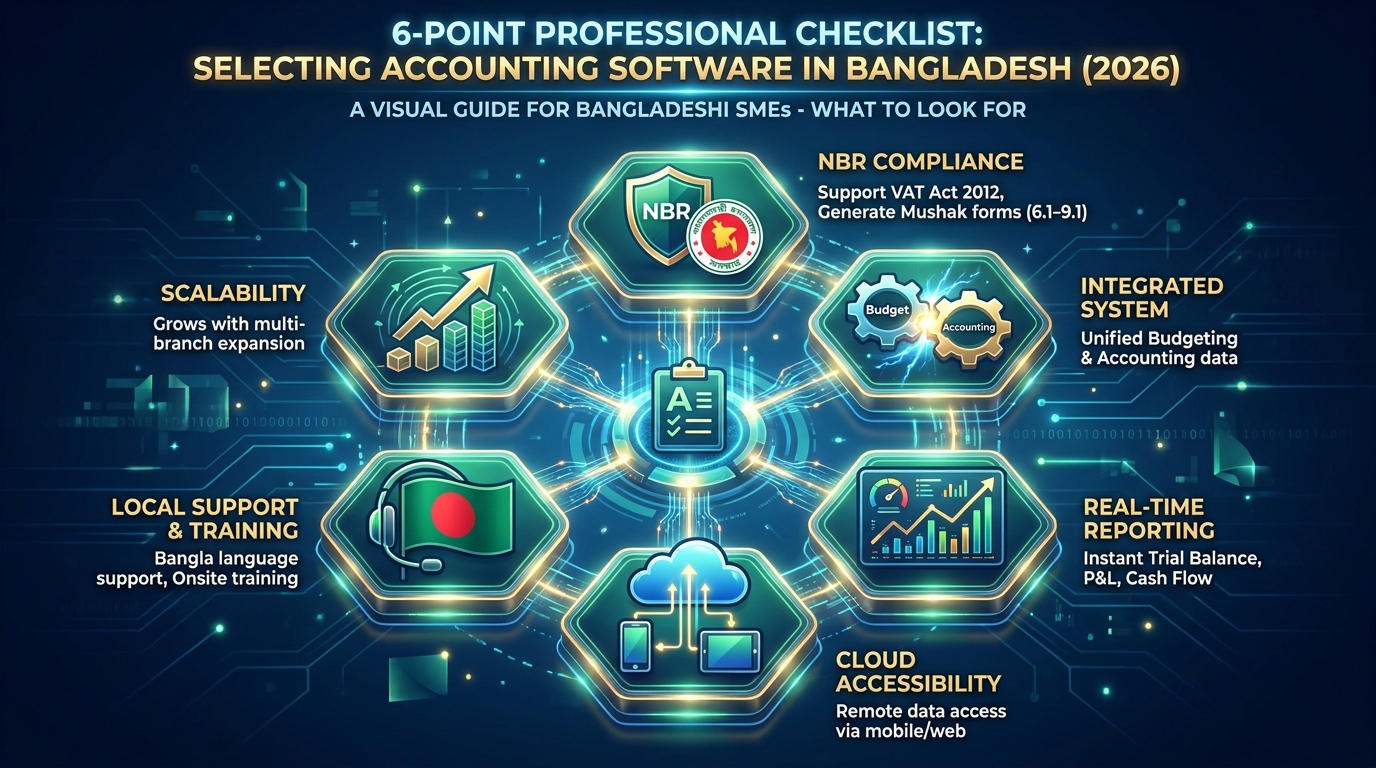
Before jumping into specific platforms, let me give you the professional checklist I use when evaluating accounting software solutions for Bangladeshi clients:
1. NBR Compliance The software must support the VAT Act 2012, auto-generate Mushak forms (6.1 through 9.1), and ideally have API integration with NBR’s central monitoring servers. In 2026, the NBR’s central system is directly linked to the APIs of major ERP providers, meaning discrepancies can trigger immediate audits.
2. Integrated Budget and Accounting System A disconnected setup — one tool for budgeting, another for accounting — is a recipe for errors. The best small business accounting software includes a fully integrated budget and accounting system that unifies income, expenditure, payroll, and tax data under one roof.
3. Real-Time Financial Reporting You should be able to pull a Trial Balance, Profit & Loss Statement, or Cash Flow Statement at any moment — not just at year-end. Real-time visibility protects you from nasty surprises.
4. Cloud Accessibility Bangladesh’s mobile internet penetration is at an all-time high. The ability to access your financial data from any device, anywhere, is now a baseline expectation — not a premium feature.
5. Local Support and Training A globally recognised platform is meaningless if your team cannot use it confidently, or if your support call goes to a call centre unfamiliar with Bangladeshi tax law. Local language support (Bangla) and onsite training matter enormously for SMEs.
6. Scalability The right best small business accounting software grows with your business. As you open branches, hire staff, and expand turnover, your software should handle increased complexity without requiring a complete system overhaul.
Top Accounting Software Solutions for Small Businesses in Bangladesh (2026)
1. Financfy — Best Overall for Bangladeshi SMEs
Financfy is a cloud-based platform built exclusively for the Bangladeshi market — from small shops to large enterprises. It functions as a fully integrated budget and accounting system, combining multi-branch cash management, supplier and customer portals, NBR-compliant reporting, and inventory management in a single interface.
Why it ranks top: Unlike global tools, Financfy is engineered around how Bangladeshi businesses actually operate — multi-book hierarchies for HQ, branches, and projects; fund transfer controls; and 24/7 local support in Bangla.
- Pricing: From BDT 4,500/month
- Best for: Small to medium-sized businesses needing cloud-based financial management
- NBR Compliance: Yes — full Mushak report generation
2. TallyPrime — Best for Traditional Accountants
TallyPrime is one of the most trusted names in South Asian accounting and remains a strong contender as the best small business accounting software for businesses that prefer a keyboard-first, locally hosted approach. It handles multi-currency transactions with automatic forex calculations, supports bank reconciliation, and allows businesses to toggle between multiple company books instantly.
- Pricing: One-time licence fee + annual maintenance
- Best for: Small businesses, traders, distributors
- NBR Compliance: Available via local customisation
- Local Office: Uttara, Dhaka
Important caveat from my professional experience: While TallyPrime is excellent for basic bookkeeping, achieving deep VAT customisation for Bangladeshi compliance often requires additional Tally Definition Language (TDL) work, which adds cost and technical overhead for smaller businesses.
3. Biznify ERP — Best Integrated ERP-Accounting Solution
Biznify is a comprehensive Cloud ERP engineered specifically for the Bangladeshi market, integrating Accounting, HRM, and Inventory into a single unified database. It stands out as an integrated budget and accounting system that automates accrual-based expense tracking, generates VAT-compliant vouchers, and keeps your books NBR-ready at all times.
- Best for: Growing SMEs needing an all-in-one solution
- Standout feature: Bangla language interface, local training support
- NBR Compliance: Full VAT Mushak 6.3 compliance built-in
4. Xero — Best for International-Facing Businesses
If your small business deals with UK clients, international invoicing, or foreign currency transactions, Xero is the most professionally credible best small business accounting software option. It is the platform I worked with most extensively during my time managing over 1,000 clients at a UK chartered accounting firm, and its bank reconciliation, multi-currency handling, and third-party integrations are best-in-class.
- Pricing: From approximately BDT 3,500–7,000/month (USD-based subscription)
- Best for: Export businesses, consultants with international clients, UK-Bangladesh trade entities
- NBR Compliance: Requires customisation; best paired with a local accountant
- HMRC Compliance: Full Making Tax Digital (MTD) compliant for UK operations
5. Zoho Books — Best Value Accounting Software Solution
Zoho Books offers a feature-rich cloud accounting platform at a competitive price point, making it an attractive accounting software solution for tech-savvy SMEs, service industries, and freelancers. It covers invoicing, expense tracking, bank reconciliation, and financial reporting with a clean, modern interface.
- Best for: Service businesses, agencies, consultants
- Standout feature: Deep integration with the full Zoho ecosystem (CRM, Payroll, Inventory)
- NBR Compliance: Requires local configuration
6. QuickBooks — Best for Sole Traders and Micro-Businesses
QuickBooks has been a global staple for small business accounting for decades. Its interface is intuitive, its reporting is solid, and it is an excellent entry-level best small business accounting software for sole traders, freelancers, and micro-businesses just beginning to digitalise their finances.
- Pricing: From approximately BDT 2,500/month
- Best for: Freelancers, consultants, sole traders with straightforward finances
- NBR Compliance: Requires significant local customisation
7. ERPNext — Best Open-Source Accounting Solution
For Bangladeshi tech startups and NGOs with lean budgets but complex operational needs, ERPNext has emerged as the leading open-source choice. Local implementation partners have built extensive “Bangladesh Localisation” layers that include specific modules for the VAT Act 2012, making it a viable and cost-effective accounting software solution for organisations that want to avoid heavy licensing fees.
- Pricing: Free (open-source); costs redirect to local customisation and server management
- Best for: Tech startups, NGOs, export-oriented businesses
- NBR Compliance: Available via local Bangladesh localisation packages
The Critical Role of an Integrated Budget and Accounting System
In my experience working across both Bangladesh and the UK, one of the most costly mistakes small businesses make is treating budgeting and accounting as separate functions. They use spreadsheets for budgeting and accounting software purely for invoicing — then spend weeks reconciling the two at year-end, often discovering errors that attract NBR scrutiny.
A truly integrated budget and accounting system eliminates this gap entirely. Here is why it matters in practice:
Real-Time Budget vs. Actual Tracking: When your budget lives inside your accounting software, every transaction is automatically measured against your financial plan. Overspending on a cost centre triggers an alert — before it becomes a problem.
Cash Flow Forecasting: Integrated systems can project future cash positions based on committed expenses, outstanding receivables, and sales forecasts. For a small business operating on tight margins, this is not a luxury — it is survival intelligence.
NBR Audit Preparedness: When the NBR questions a supplier payment from eight months ago, a properly integrated system allows you to pull the invoice, the payment proof, and the associated tax challan in under three minutes. That level of digital organisation builds instant trust with an auditor and shortens investigations dramatically.
Year-End Efficiency: Businesses with integrated systems can close their annual books in days, not weeks. This directly reduces the cost of external accountancy support, as your accountant is not spending hours reconstructing your financial picture from disconnected records.
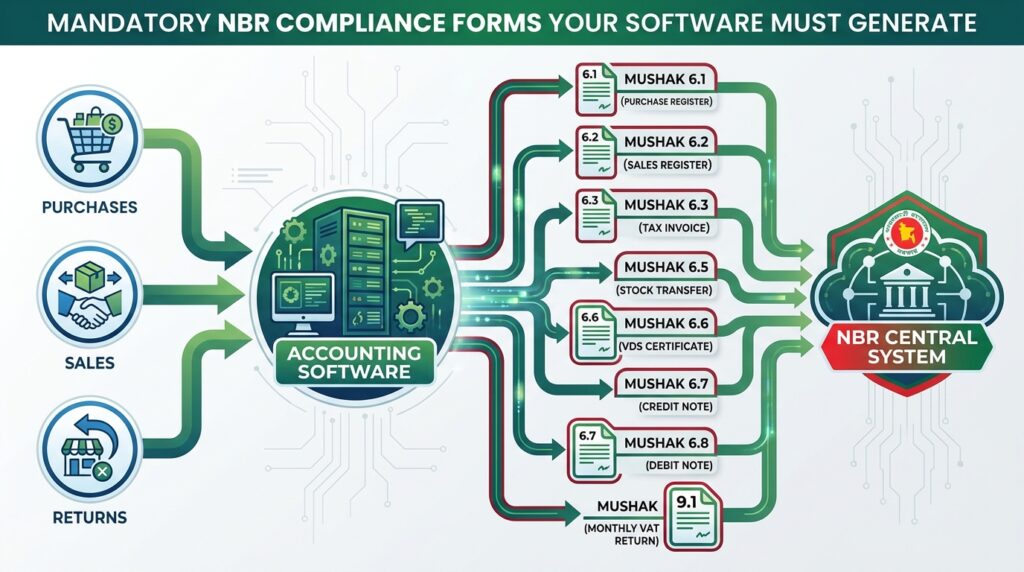
NBR Compliance: What Your Accounting Software Must Cover
This section is non-negotiable. If you are selecting the best small business accounting software for a Bangladesh-registered business, your shortlist must only include tools that cover the following NBR compliance requirements:
| Mushak Form | Description | Who Needs It |
|---|---|---|
| Mushak 6.1 | Purchase Register | All VAT-registered businesses |
| Mushak 6.2 | Sales Register | All VAT-registered businesses |
| Mushak 6.3 | Tax Invoice (VAT Invoice) | Businesses making taxable supplies |
| Mushak 6.5 | Stock Transfer | Manufacturers, multi-branch businesses |
| Mushak 6.6 | VDS Certificate (VAT Deducted at Source) | Service buyers |
| Mushak 6.7 | Credit Note | Businesses processing sales returns |
| Mushak 6.8 | Debit Note | Businesses processing purchase returns |
| Mushak 9.1 | Monthly VAT Return | All VAT-registered businesses |
Any accounting software solution that cannot generate these forms automatically is not fit for purpose in the current Bangladeshi compliance environment.
Cloud vs. On-Premise: Which Architecture is Right for Your Business?
This is a question I am frequently asked by clients across both Bangladesh and the UK. Here is the honest professional answer:
Cloud-based accounting software is the right choice for the vast majority of small businesses in 2026. It offers automatic updates, remote access, lower upfront costs, and built-in disaster recovery. As Bangladesh’s digital infrastructure continues to strengthen, the historical concern about internet reliability is significantly less relevant than it was five years ago.
On-premise software (such as traditional TallyPrime deployments) remains a valid choice for businesses in areas with unreliable internet connectivity, or for organisations with strict data sovereignty requirements. However, it places the burden of backups, security patches, and system updates squarely on the business — a responsibility most small businesses are not equipped to manage effectively.
My recommendation: choose a cloud-first best small business accounting software that also offers offline functionality as a fallback. This gives you the best of both worlds.
Common Mistakes When Choosing Accounting Software in Bangladesh
After more than a decade working with SMEs across Bangladesh and the UK, I have seen the same mistakes made repeatedly. Here are the ones that cost businesses the most:
Choosing on price alone. The cheapest accounting software is almost always the most expensive in the long run. Budget for compliance failures, audit penalties, and the cost of migrating to a new system when the cheap option cannot scale.
Ignoring local NBR compliance. A globally popular platform that requires six months of expensive customisation to generate a Mushak 6.3 form is not the right accounting software solution for a Bangladeshi SME. Always verify NBR compliance capability before purchase.
Underestimating the importance of training. Even the best software produces garbage if your team does not know how to use it. Ensure your chosen vendor provides local language training and ongoing support.
Buying software your business will outgrow. If you plan to open multiple branches, take on employees, or expand turnover significantly in the next three years, choose a platform with that scalability built in today.
Failing to integrate your budget and accounting system. As I discussed earlier, running disconnected financial tools is a structural risk. Prioritise integration from day one.
My Professional Recommendation by Business Type
| Business Type | Recommended Software | Key Reason |
|---|---|---|
| Retail/Trading SME | Financfy or TallyPrime | Local support, NBR compliance, inventory management |
| Growing SME (multi-branch) | Biznify ERP | Fully integrated ERP + accounting |
| Export/International Business | Xero | Multi-currency, HMRC compliant for UK operations |
| Service Business/Consultancy | Zoho Books | Clean interface, strong CRM integration |
| Micro-Business/Sole Trader | QuickBooks | Simple, affordable entry point |
| Tech Startup/NGO | ERPNext | Open-source, low licensing cost, localisation available |
Frequently Asked Questions
Is accounting software mandatory for small businesses in Bangladesh? Under NBR rules, businesses with annual taxable turnover above BDT 50 million are legally required to use NBR-approved VAT software. However, all VAT-registered businesses are strongly advised to use compliant digital accounting tools, as manual records are increasingly insufficient to withstand NBR audit scrutiny.
What is the difference between accounting software and an integrated budget and accounting system? Basic accounting software records transactions. An integrated budget and accounting system goes further — it connects your financial plan (budget) directly to your live accounting data, giving you real-time visibility on variances, cash flow forecasts, and departmental performance. For serious business management, you need the latter.
Can I use Xero or QuickBooks for my NBR VAT returns in Bangladesh? Both platforms can be configured to manage Bangladesh VAT, but they require local customisation and technical expertise. They are not NBR-pre-approved out of the box. For straightforward NBR compliance, locally built solutions like Financfy or Biznify carry a lower implementation risk.
How much should a small business budget for accounting software in Bangladesh? A reliable, NBR-compliant cloud accounting solution will typically cost between BDT 3,000 and BDT 8,000 per month for an SME. View this as a compliance and operational investment, not an expense — a single NBR audit penalty can cost far more than several years of software subscriptions.
Final Thoughts: Invest in the Right Accounting Software Before You Need It
The businesses I have seen struggle most with NBR audits are not the ones that made deliberate errors. They are the ones that let their financial systems lag behind their business growth. They outgrew their spreadsheets, never adopted a proper integrated budget and accounting system, and found themselves scrambling to reconstruct years of records under audit pressure.
The best small business accounting software for your business in Bangladesh is not necessarily the most expensive, the most globally recognised, or the one with the longest feature list. It is the one that keeps you NBR-compliant, gives you real-time financial visibility, scales with your ambition, and is backed by support that understands the Bangladeshi business environment.
Make the decision now — before the NBR makes it for you.
Have questions about accounting software selection, NBR compliance requirements, or audit preparedness for your business? As an Income Tax Practitioner with direct NBR and HMRC audit experience, I work with SMEs across Bangladesh and the UK to build financial systems that withstand scrutiny. Get in touch for a professional consultation.
Tags: best small business accounting software, accounting software solutions, integrated budget and accounting system, NBR compliance Bangladesh, VAT software Bangladesh, cloud accounting Bangladesh, Mushak 6.3, small business finance Bangladesh 2026Share
Leave a Reply
You must be logged in to post a comment.