
Written by Md Rakib Hassan — Income Tax Practitioner with 10+ years of tax compliance and audit experience across Bangladesh and the UK. Former accounts manager at a UK chartered accounting firm managing 1,000+ clients, with direct experience resolving multi-year tax audit disputes with HMRC and the NBR. Currently Finance Controller at a UK-based multinational tech group.
Whether you are a business owner in Dhaka, a government officer using iBAS++, a student preparing for ICAB or ICMAB examinations, or a finance professional trying to understand the DPE accounting system — you have landed on the right page.
Accounting is the backbone of every financially functioning organisation in Bangladesh, from a small tea stall in Sylhet to a listed company on the Dhaka Stock Exchange (DSE), and from a rural primary school reporting into the DPE accounting system to a multinational submitting consolidated group accounts under IFRS. In this guide, I will walk you through everything you need to know: the accounting definition, the core accounting principles recognised in Bangladesh, how financial accounting works in practice, the fundamental accounting equation, the role of accounting and information systems, and how Bangladesh’s government sector has digitised public finance through iBAS++ and the DPE accounting system.
What Is Accounting? The Official Accounting Definition
Let us start at the very beginning — the accounting definition.
Accounting is the systematic process of recording, classifying, summarising, analysing, and communicating the financial transactions and events of an entity, so that users of that information — managers, owners, investors, creditors, regulators, and government bodies — can make informed economic decisions.
A more precise accounting definition used by professional bodies including the Institute of Chartered Accountants of Bangladesh (ICAB) is: “Accounting is a way of recording, analysing, and summarising the transactions of an entity.”
In practical terms, accounting serves three core functions:
Recording — Every financial transaction, whether it is a sale, a purchase, a loan repayment, or a salary payment, is captured systematically in the books of account.
Reporting — Recorded transactions are transformed into structured financial statements: the Balance Sheet (Statement of Financial Position), the Income Statement (Profit & Loss Account), and the Statement of Cash Flows.
Compliance — In Bangladesh, accounting records are the primary evidence used by the National Board of Revenue (NBR) during tax audits, by the Bangladesh Securities and Exchange Commission (BSEC) for listed company oversight, and by the Comptroller and Auditor General (C&AG) for government expenditure accountability.
Understanding the accounting definition is not merely academic. From my decade of experience working with NBR audits and HMRC investigations, I can say with absolute certainty: businesses that do not understand what accounting means — and why it matters — are the ones who end up with unreconciled VAT returns, missing TDS challans, and seven-figure audit penalties.
The Accounting Equation: The Mathematical Foundation of All Accounting
Every transaction in accounting — from the simplest cash sale to the most complex group consolidation — is governed by one foundational rule. This is the accounting equation:
Assets = Liabilities + Owner’s Equity
Or equivalently:
Assets = Capital + Liabilities
The accounting equation states that everything a business owns (Assets) is financed either by money borrowed from others (Liabilities) or by funds contributed and retained by the owners (Owner’s Equity/Capital). It is the mathematical spine of double-entry bookkeeping — the global standard system upon which all modern financial accounting is built.
Breaking Down the Accounting Equation
Assets are resources controlled by the business that are expected to generate future economic benefits. In Bangladesh, common business assets include: cash and bank balances, trade receivables, inventory, property and equipment, and investment securities.
Liabilities are present obligations of the business arising from past events, the settlement of which will result in an outflow of economic resources. Examples include: bank loans, trade payables, VAT payable to the NBR, and accrued salaries.
Owner’s Equity (also called capital or net worth) represents the residual interest in the assets of the business after deducting all liabilities. It increases when the business generates profit and decreases when losses occur or when the owner makes drawings.
A Practical Accounting Equation Example (Bangladesh Context)
Suppose you start a trading business in Chittagong with BDT 5,00,000 of your own capital. You then take a BDT 2,00,000 bank loan. Your accounting equation at that moment is:
| Assets | = | Liabilities | + | Owner’s Equity |
|---|---|---|---|---|
| BDT 7,00,000 Cash | = | BDT 2,00,000 Bank Loan | + | BDT 5,00,000 Capital |
The accounting equation must always remain in balance. Every transaction in accounting affects at least two sides of this equation simultaneously — which is the essence of double-entry bookkeeping.
Core Accounting Principles Recognised in Bangladesh
Accounting principles are the foundational rules and conventions that govern how financial transactions are recorded and reported. In Bangladesh, accounting principles are primarily governed by:
Bangladesh Accounting Standards (BAS) — set by the ICAB and modelled on International Accounting Standards (IAS) issued by the International Accounting Standards Board (IASB).
Bangladesh Financial Reporting Standards (BFRS) — also prescribed by ICAB, modelled on the IFRS issued by the IASB. All foreign companies, and domestic companies listed on the DSE and/or Chittagong Stock Exchange (CSE), are legally required to prepare financial statements in accordance with BFRS.
Here are the most fundamental accounting principles every Bangladeshi business professional must understand:
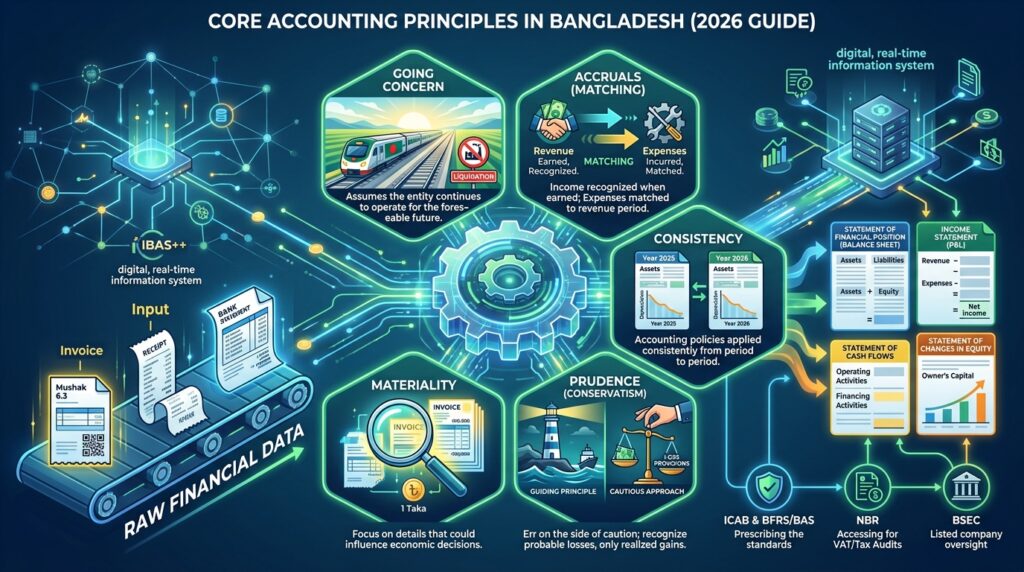
1. The Going Concern Principle
Financial statements are prepared on the assumption that the entity will continue to operate for the foreseeable future. This accounting principle affects asset valuation — assets are valued at historical cost rather than liquidation value, precisely because the business is expected to keep using them.
2. The Accruals (Matching) Principle
One of the most important accounting principles in practice. Income must be recognised when it is earned — not when cash is received. Expenses must be matched to the period in which they help generate revenue — not when they are paid. This is the accruals basis of accounting, as opposed to the cash basis.
Why this matters in Bangladesh: NBR often challenges businesses whose declared revenue on monthly Mushak-9.1 VAT returns does not match the revenue recognised in their audited annual accounts. The accruals principle explains this difference — and your accounting records must be able to explain it clearly.
3. The Consistency Principle
Once an entity selects an accounting policy (for example, a depreciation method for fixed assets), it should apply that policy consistently from period to period. Changes in accounting principles must be disclosed and justified.
4. The Prudence (Conservatism) Principle
In conditions of uncertainty, accounting should err on the side of caution. Losses should be recognised as soon as they are probable; gains should only be recognised when they are realised. Do not overstate assets or income; do not understate liabilities or expenses.
5. The Materiality Principle
An item is material if its omission or misstatement could influence the economic decisions of users of the financial statements. This accounting principle guides the level of detail required in financial reporting — not every trivial transaction needs separate disclosure.
6. The Business Entity Principle
The business is treated as a completely separate entity from its owners. This foundational accounting principle underpins the accounting equation itself — the owner’s personal finances must be kept entirely separate from the business’s records.
Financial Accounting: What It Is and Why It Matters in Bangladesh
Financial accounting is the branch of accounting concerned with the preparation and presentation of financial statements for use by external stakeholders — investors, creditors, government regulators, and the public.
Financial accounting in Bangladesh is governed by:
- The Companies Act 1994 (for companies)
- The Bangladesh Accounting Standards (BAS) and BFRS (for listed companies)
- The Income Tax Act 2023 (for tax-related accounting requirements)
- The VAT and Supplementary Duty Act 2012 (for VAT reporting)
The Four Key Financial Accounting Statements
1. The Statement of Financial Position (Balance Sheet) A snapshot of the business at a specific point in time, showing assets, liabilities, and owner’s equity. It is the accounting equation expressed in full detail.
2. The Income Statement (Profit & Loss Account) Shows the business’s revenues and expenses over a period, resulting in either a net profit or a net loss. This statement feeds directly into the owner’s equity section of the Balance Sheet.
3. The Statement of Cash Flows Often overlooked by small businesses, this is critically important in financial accounting. It shows actual cash movements — operational, investing, and financing — and reconciles the net profit with changes in cash. Many profitable businesses fail due to poor cash management; this statement is designed to prevent exactly that.
4. The Statement of Changes in Equity Shows how the owner’s equity section of the Balance Sheet changed during the reporting period — through profit earned, dividends paid, and capital contributions.
Financial Accounting vs. Management Accounting
A common point of confusion in Bangladesh, particularly among students preparing for ICAB and ICMAB examinations:
| Dimension | Financial Accounting | Management Accounting |
|---|---|---|
| Primary audience | External (investors, NBR, BSEC) | Internal (managers, CFO) |
| Time orientation | Historical (past performance) | Forward-looking (budgets, forecasts) |
| Format | Standardised (BAS, BFRS) | Flexible (as needed) |
| Legal requirement | Yes (Companies Act 1994, BFRS) | No |
| Bangladesh bodies | ICAB (CA qualification) | ICMAB (CMA qualification) |
Both are essential. Financial accounting tells you what happened; management accounting helps you decide what to do next.
Accounting and Information Systems in Bangladesh
The convergence of accounting and information systems has fundamentally transformed how businesses and government bodies manage financial data in Bangladesh. In 2026, accounting is no longer a manual, paper-based function — it is a digital, real-time information system that spans the entire organisation.
Accounting and information systems (AIS) refer to the structured frameworks — combining people, procedures, data, software, and technology — that collect, store, process, and communicate financial information to support decision-making and regulatory compliance.
Why Accounting and Information Systems Matter More Than Ever
The NBR’s 2025 digital monitoring expansion has made the integration of accounting and information systems a matter of legal survival for Bangladeshi businesses. The revenue authority now cross-matches import data, banking transactions, and monthly VAT returns through its own central information system. Any business whose internal accounting and information systems are not producing consistent, accurate, real-time data is immediately at risk.
From a practical standpoint, a properly implemented accounting and information system should deliver:
Automated data entry — reducing human error in ledger posting and bank reconciliation.
Real-time financial reporting — management can access Profit & Loss statements, cash positions, and receivables ageing at any moment.
Regulatory compliance automation — Mushak forms (6.1 through 9.1) are auto-generated from transactional data, ensuring consistency between VAT returns and annual accounts.
Audit trail integrity — every entry is time-stamped, user-attributed, and irreversible, providing the complete audit trail that ICAB auditors and NBR inspectors require.
Multi-entity consolidation — for businesses operating across multiple branches or legal entities, a robust AIS consolidates data automatically, eliminating the weeks of manual work that previously preceded year-end reporting.
The DPE Accounting System: Bangladesh’s Government Primary Education Finance Platform
One of the most specific and frequently searched topics in Bangladeshi government accounting is the DPE accounting system. Let me explain it clearly.
What Is the DPE?
The Directorate of Primary Education (DPE) — known in Bangla as প্রাথমিক শিক্ষা অধিদপ্তর — is an autonomous government department responsible for the administration and oversight of primary schools across Bangladesh. Established in 1981, the DPE sits under the Ministry of Primary and Mass Education (MoPME) and oversees a network of over 126,000 primary schools and more than 540,000 teachers across the country.
The sheer scale of DPE operations — managing school-level budgets, teacher payrolls, infrastructure development grants, and Primary Education Development Programme (PEDP) funding — demands a robust, dedicated accounting and information management system.
The DPE Accounting Information System (AIS)
The DPE accounting system is formally known as the DPE Accounting Information System (AIS), accessible at ais.dpe.gov.bd. It was developed as part of the Primary Education Development Programme-3 (PEDP3) — a large-scale education sector reform programme supported by the World Bank and other development partners.
The DPE accounting system was designed to:
Bring financial transparency to the management of development programme funds flowing from the Ministry of Finance through DPE down to field-level offices, Upazila Education Offices, and individual school management committees.
Integrate with iBAS++ — Bangladesh’s national government financial management platform — ensuring that all DPE expenditure data aligns with the Government of Bangladesh’s central accounting records maintained by the Controller General of Accounts (CGA).
Enable compliance with international donor requirements — PEDP3 funds disbursed by the World Bank and other partners required Disbursement Linked Indicators (DLIs) to be tracked transparently, with financial data available for annual fiduciary reviews by the Foreign Aided Project Audit Directorate (FAPAD).
How the DPE Accounting System Connects to iBAS++
This is a critical point for government finance officers working within the DPE structure. The DPE accounting system does not operate in isolation. It feeds into and is governed by iBAS++ — the Integrated Budget and Accounting System of the Government of Bangladesh.
iBAS++ is an internet-based Government Financial Management Information System (GFMIS) developed and maintained by the Finance Division under the Ministry of Finance. As of 2026, it contains eight core modules covering budget preparation, budget execution, accounting, online bill submission, salary payment, General Provident Fund (GPF) management, pension processing, and financial reporting.
For Drawing and Disbursement Officers (DDOs) operating within the DPE structure, iBAS++ is the mandatory platform for:
- Submitting salary bills for primary school teachers
- Processing development expenditure bills
- Managing fund allocation and re-appropriation between budget heads
- Performing bank reconciliation against Bangladesh Bank and Sonali Bank debit/credit scrolls
The iBAS++ system transmits EFT payment orders to Bangladesh Bank using secured channels with digital signatures, creating a complete, tamper-proof accounting trail for all government expenditure flowing through the DPE.
iBAS++ as Bangladesh’s National Integrated Budget and Accounting System
For readers beyond the DPE context, iBAS++ deserves a fuller explanation as Bangladesh’s most significant accounting and information system achievement.
iBAS++ (Integrated Budget and Accounting System, Version 2) is the Government of Bangladesh’s GFMIS — a single platform managing the accounting of the entire national budget. Key capabilities include:
Budget preparation — through a combination of top-down and bottom-up approaches, capturing budget requirements from field offices up to the Ministry of Finance.
Budget execution — distributed budget from Parliament-approved grants flows through iBAS++ to directorates and field offices before expenditure can be authorised.
Commitment control — DDOs enter work orders into iBAS++ before expenditure is incurred, ensuring spending stays within approved allocations.
Real-time accounts — the system provides instant access to government revenue and expenditure accounts against each budget code, replacing the previously weeks-delayed manual reconciliation process.
Payroll automation — iBAS++ is integrated with Bangladesh’s central employee database, automating pay bill preparation for all government employees, including DPE’s massive teacher workforce.
For any government finance officer — whether working within DPE, a Ministry, or a field-level accounts office — understanding how iBAS++ works is no longer optional. It is the primary accounting and information system through which public money is managed, tracked, and reported in Bangladesh.
The Regulatory Bodies Governing Accounting in Bangladesh
Understanding accounting in Bangladesh requires familiarity with the professional and regulatory ecosystem:
ICAB (Institute of Chartered Accountants of Bangladesh) — established under the Bangladesh Chartered Accountants Order 1973. ICAB is the national professional accounting body responsible for prescribing BAS and BFRS, regulating the Chartered Accountant (CA) profession, setting auditing standards, and ensuring ethical compliance among its members. Membership in ICAB is mandatory for all Chartered Accountants practicing in Bangladesh.
ICMAB (Institute of Cost and Management Accountants of Bangladesh) — established under the Cost and Management Accountants Ordinance 1977. ICMAB governs the Cost and Management Accounting (CMA) profession, with particular expertise in cost accounting, management accounting, financial management, and taxation. The Government of Bangladesh recognises CA (ICAB) and CMA (ICMAB) professionals as equal for government service employment purposes.
BSEC (Bangladesh Securities and Exchange Commission) — the capital market regulator. Listed companies on the DSE and CSE must follow BFRS and submit audited financial accounting reports to BSEC annually.
NBR (National Board of Revenue) — the apex tax authority, established in 1972. While not a professional accounting body, the NBR is the most operationally significant external user of business accounting records in Bangladesh. Its compliance requirements — income tax, VAT, and withholding taxes — directly shape how accounting is performed by every registered business in the country.
C&AG (Comptroller and Auditor General) — the supreme audit authority for government accounting in Bangladesh. The C&AG audits all government ministries, directorates, and autonomous bodies — including DPE — ensuring that public funds managed through iBAS++ and the DPE accounting system are used lawfully and efficiently.
Accounting in Practice: Common Mistakes I See in Bangladesh
Over a decade of working with businesses across Bangladesh and the UK, I have seen the same accounting errors repeated. Here are the ones with the most serious consequences:
Mixing personal and business finances. This violates the most basic accounting principle — the business entity concept. It creates chaos during audits and makes the accounting equation impossible to balance accurately.
Using cash-basis accounting where accruals are required. BFRS and BAS require the accruals basis. Businesses that record income only when cash arrives — and expenses only when bills are paid — will produce financial statements that do not comply with accounting principles and will create reconciliation gaps with their VAT returns.
Not maintaining a proper chart of accounts. A disorganised chart of accounts makes financial accounting reports meaningless and audit trail reconstruction nearly impossible. I have seen NBR auditors issue maximum-penalty assessments simply because the business could not produce a clean, structured set of ledgers.
Treating the accounting equation as theoretical. Every unexplained balance sheet difference is an error waiting to become an audit issue. The accounting equation — Assets = Liabilities + Equity — must balance to the last taka at every reporting date.
Ignoring accounting and information systems integration. If your payroll system, sales system, and accounting software are not integrated, you are producing three sets of data that will contradict each other under scrutiny. This is the single most common trigger for NBR audit escalation in medium-sized businesses.
Frequently Asked Questions
What is the simplest accounting definition I can use for my business? Accounting is the practice of recording all your business’s financial transactions accurately, summarising them into financial statements, and using those statements to make sound business decisions and meet your legal obligations to the NBR, BSEC, and other authorities.
What is the accounting equation and why does it matter? The accounting equation — Assets = Liabilities + Owner’s Equity — is the fundamental rule that every financial transaction must follow. It ensures that your books remain balanced, that your Balance Sheet is accurate, and that your financial accounting records can withstand audit scrutiny.
What are the most important accounting principles in Bangladesh? The key accounting principles applied in Bangladesh are: going concern, accruals/matching, consistency, prudence, materiality, and the business entity principle. These are embedded in Bangladesh Accounting Standards (BAS) and Bangladesh Financial Reporting Standards (BFRS), both prescribed by ICAB.
What is the DPE accounting system? The DPE accounting system is the Accounting Information System (AIS) of the Directorate of Primary Education (ais.dpe.gov.bd). It manages the financial records of DPE’s education development programmes and integrates with the national government accounting platform, iBAS++, to ensure transparency and compliance with both government financial rules and international donor reporting requirements.
What is iBAS++ and who uses it? iBAS++ is the Government of Bangladesh’s Integrated Budget and Accounting System — a digital GFMIS used by all government Drawing and Disbursement Officers (DDOs), accounts offices, and ministry finance departments for budget preparation, bill submission, salary payments, and financial reporting. DPE finance officers use it to process teacher payroll and development programme expenditure.
What is the difference between financial accounting and management accounting? Financial accounting produces standardised financial statements (Balance Sheet, Income Statement, Cash Flow) for external users, governed by BAS and BFRS, and is legally required. Management accounting produces internal reports (budgets, variance analyses, cost reports) for decision-making by management, and has no fixed format requirement.
Which body regulates the accounting profession in Bangladesh? ICAB regulates the Chartered Accountant (CA) profession; ICMAB regulates the Cost and Management Accountant (CMA) profession. Both are under the administrative control of Bangladesh’s Ministry of Commerce.
Final Thoughts: Why Accounting Is the Language of Every Bangladeshi Business
Accounting is not just a technical skill. It is the common language through which businesses communicate their financial health to investors, banks, and tax authorities; through which government departments justify their use of public funds; and through which professionals like myself identify — and fix — the financial problems that threaten business survival.
Whether you are a student learning the accounting equation for your ICAB examinations, a government officer navigating the DPE accounting system and iBAS++, a business owner trying to understand your financial accounting obligations under Bangladesh’s tax laws, or a finance professional implementing accounting and information systems across a group of companies — the foundation is always the same.
Master the accounting definition. Apply the accounting principles. Keep your accounting equation balanced. And build the accounting and information systems that protect your organisation from the audit risks that are only growing more serious in Bangladesh’s increasingly digitised compliance environment.
Have questions about accounting compliance, NBR audit readiness, BFRS financial reporting, or how to structure your accounting and information systems for a Bangladeshi or UK-registered business? As an Income Tax Practitioner with direct experience across both tax authorities, I offer professional consultations for businesses at every stage. Get in touch.
Tags: accounting, accounting definition, accounting principles, financial accounting, accounting equation, DPE accounting system, accounting and information systems, iBAS Bangladesh, ICAB ICMAB, NBR compliance, Bangladesh accounting standards, BFRS BAS, government accounting BangladeshShare
Leave a Reply
You must be logged in to post a comment.