Marketing departments distribute free samples, promotional giveaways, and “buy one get one” bonus units routinely — but few accountants realise these movements trigger VAT obligations. VAT on free samples Bangladesh is a frequent audit finding, especially for FMCG, pharma, and consumer goods companies.
Why VAT on Free Samples Bangladesh Exists
The principle is anti-avoidance. If “free” supplies escaped VAT, businesses could disguise sales as gifts, eroding the tax base. So Bangladesh — like most VAT jurisdictions — requires VAT on free samples to be calculated on fair market value, not zero.
The Fair Market Value Rule
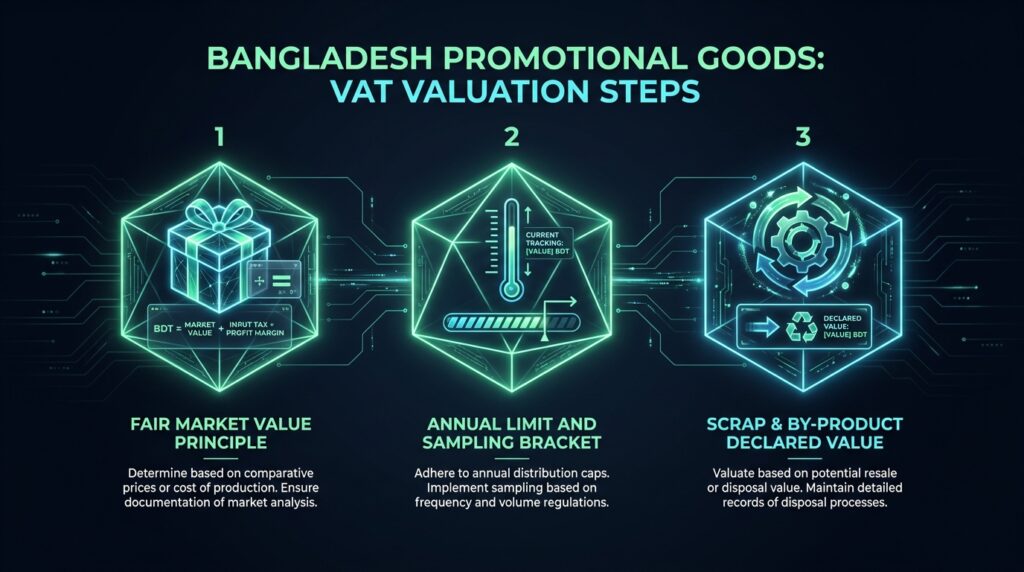
Under the VAT & SD Act 2012, VAT on free samples Bangladesh is computed on the same basis as if the goods were sold at normal price. The notional sale value triggers VAT, even though no cash changes hands.
Finance Ordinance 2025 brought clarification. If any registered person for any income year provides any free sample goods VAT will be as follows — with prescribed treatment for samples within and beyond certain thresholds. KPMG
When VAT on Free Samples Bangladesh Applies
Common triggers:
- Pharmaceutical samples distributed to doctors
- FMCG promotional packs (“free with purchase”)
- Trade show giveaways
- Customer loyalty gifts
- Bonus units in promotional schemes (“buy 10 get 2 free”)
How VAT on Free Samples Bangladesh Is Calculated
The supplier:
- Determines fair market value of the sample goods
- Computes notional output VAT at the applicable rate
- Records as output VAT in Mushak 6.2 and 9.1
- Issues internal Mushak 6.3 for record-keeping
- Pays the VAT through monthly Mushak 9.1
The recipient doesn’t pay cash, but the supplier still owes the VAT to NBR.
Input Rebate on Sample Inputs
Here’s the silver lining for VAT on free samples Bangladesh — because the samples are treated as taxable supplies, the supplier can claim input VAT rebate on the materials used to produce the samples. Net cashflow impact depends on margin structure.
Common VAT on Free Samples Bangladesh Errors
In audits, the recurring issues:
- No VAT recorded on free samples — treated as if outside VAT scope
- Below-cost notional value used instead of fair market value
- Missing internal Mushak 6.3 for sample movements
- Inventory differences between sample dispatches and accounting records
Special Rules for Pharmaceutical Samples
The pharma sector has particularly strict VAT on free samples Bangladesh rules because of high abuse risk. Sample packaging must clearly indicate “Physician Sample — Not for Sale” or similar, and detailed records must support all distributions.
Scrap and By-Product Treatment
A related rule: In case of sale of scrap or waste of by-products, there is no requirement to determine the fair market value of the fair market value rules, 2019. It means that value declared through Mushak- 4.6 is the final value for the determination of VAT based amount. So scrap sales follow a different valuation rule — your declared value through Mushak 4.6 stands. KPMG
Strategic Compliance
The VAT on free samples Bangladesh rules are manageable but require process integration with marketing operations. Sample dispatches should flow through proper inventory and VAT books — not handled informally outside the main accounting system.
Written by Md Rakib Hassan — Income Tax Practitioner with 10+ years of tax compliance and audit experience across Bangladesh and the UK. Former accounts manager at a UK chartered accounting firm managing 1,000+ clients, with direct experience resolving multi-year tax audit disputes with HMRC and the NBR. Currently Finance Controller at a UK-based multinational tech group.
Need help with promotional VAT, marketing compliance, Income Tax, RJSC, or Accounting? We support FMCG, pharma, and consumer goods companies across Bangladesh and the UK.
Leave a Reply
You must be logged in to post a comment.