One of the most expensive misunderstandings in Bangladeshi VAT compliance is treating “zero rate” and “exempt” as the same thing. They aren’t. The zero VAT rate Bangladesh framework gives you full input tax rebate; exemption gives you none. For exporters, manufacturers, and service providers, this single distinction can mean lakhs of taka in recoverable input VAT every month.
What Is the Zero VAT Rate Bangladesh?
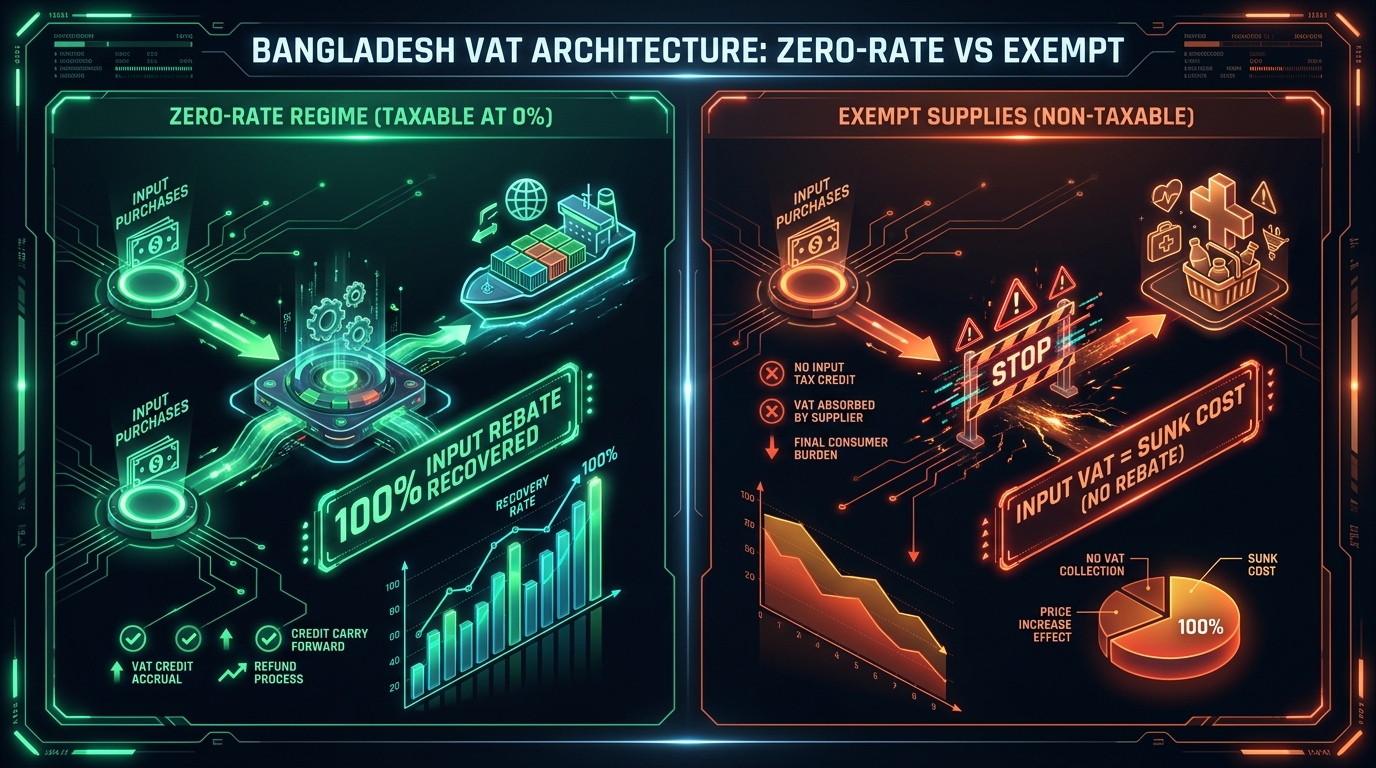
The zero VAT rate Bangladesh means VAT is technically charged on the output, but at 0%. Crucially, the supply remains a “taxable supply” — and that’s the magic word. Because it’s taxable (just at zero), you keep your right to claim input VAT rebate on purchases used to make that supply.
Under Section 21 of the VAT & SD Act 2012, exports of goods, services rendered outside Bangladesh, and certain international transport supplies fall under the zero VAT rate Bangladesh regime. Supply of goods in order to export. Supply of service rendered outside Bangladesh. Temporarily imported goods (the goods will be sent back after fulfillment of purpose). Supply of service rendered to international transport are all zero-rated categories. National Board of Revenue
Exempt Supplies: A Different Beast Entirely
Exempt supplies are listed under the First Schedule of the VAT & SD Act 2012 or via specific SROs. VAT-exempt goods and services are mentioned in the 1st Schedule of the VAT & SD Act 2012. Additionally, the National Board of Revenue (NBR) issues separate SROs each year to grant VAT exemptions for specific goods or services. VAT exemption means no VAT is applicable, so there will be no VAT deduction. Caripon
Examples include unprocessed food, life-saving medicines, and certain public transport services. For 2026, NBR also extended exemptions strategically — the VAT exemption on Metro Rail services has been extended until June 30, 2026. Sdttacademy
The critical point: exempt suppliers cannot claim input VAT rebate. Every taka of input VAT becomes a sunk cost.
Zero VAT Rate Bangladesh vs Exempt: Side-by-Side
Here’s where the zero VAT rate Bangladesh wins commercially:
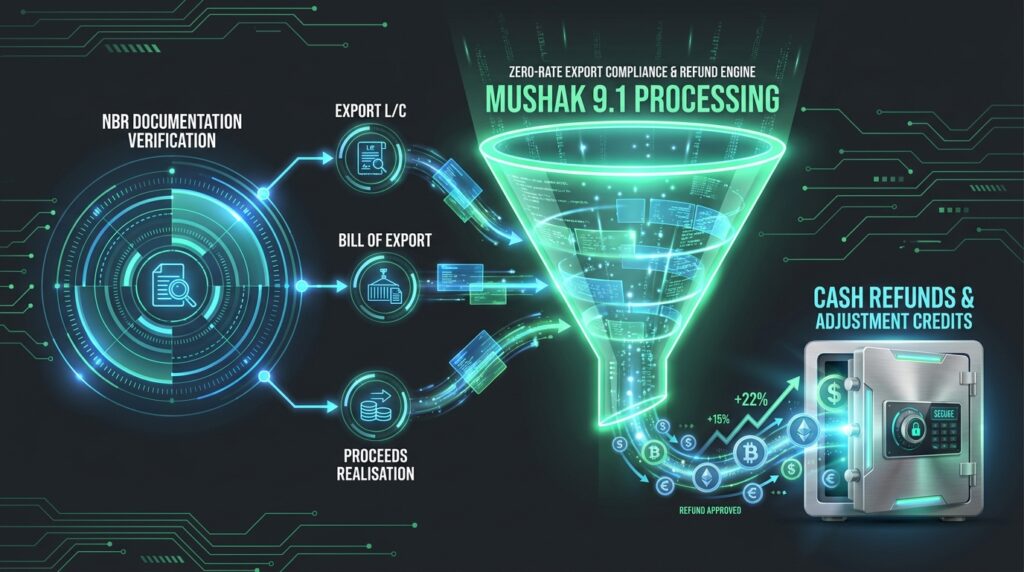
A garment exporter buying fabric, accessories, and utilities pays input VAT on every purchase. Because their export sale is at the zero VAT rate Bangladesh, output VAT is zero — but they can claim the full input VAT back through Mushak 9.1, getting cash refunds or adjustment credits. Their effective VAT burden is genuinely zero.
A hospital providing exempt medical services pays the same input VAT on equipment, utilities, and consumables. Output is exempt, so they charge no VAT — but they cannot reclaim any input. That input VAT silently inflates their cost structure.
Why the Zero VAT Rate Bangladesh System Exists
The policy goal is competitiveness. Bangladeshi exports must compete globally without carrying domestic VAT as embedded cost. The zero VAT rate Bangladesh mechanism ensures exports leave the country VAT-free at every stage of production. Without it, our RMG, leather, frozen food, and ICT exports would be priced 10–15% higher in foreign markets.
For exemptions, the goal is consumer protection — keeping essentials affordable.
Documentation for Zero VAT Rate Bangladesh Claims
Claiming the zero VAT rate Bangladesh isn’t automatic. You need:
- Export L/C, EXP form, and Bill of Export
- Bank realisation certificate (Proceeds Realisation Certificate)
- Mushak 6.3 marked as zero-rated supply
- Proper entry in Mushak 6.1 and 6.2 (purchase and sales books)
- Mushak 9.1 monthly return showing zero-rated turnover separately
For service exports, foreign remittance documentation through proper banking channels is non-negotiable. NBR routinely disallows zero-rating where remittance trails are weak.
Reverse Charge and the Zero VAT Rate Bangladesh
Interestingly, while exporting services attracts the zero VAT rate Bangladesh, importing services triggers reverse charge VAT. Reverse charge is applicable to service recipient at import level. Reverse charge is realizing tax from the service recipient in case of imported service. Software imports, cloud services, and SaaS subscriptions all fall here — and the importer can usually claim rebate on the reverse-charged VAT, neutralising it. National Board of Revenue
Common Mistakes to Avoid
In NBR audits, three errors repeatedly cost businesses money. First, suppliers wrongly classify domestic supplies as zero-rated based on the customer being a foreign-funded project — zero-rating depends on where the supply is consumed, not who funds it. Second, exporters fail to keep proper input-output linkage records, weakening their rebate claims. Third, mixed-supply businesses don’t apportion input VAT correctly between exempt, taxable, and zero-rated outputs.
Bottom Line
If your business has any export component, the zero VAT rate Bangladesh regime is your friend — protect it with documentation discipline. If you operate in exempt sectors, model your effective tax cost honestly; the hidden VAT in your cost base is real.
Written by Md Rakib Hassan — Income Tax Practitioner with 10+ years of tax compliance and audit experience across Bangladesh and the UK. Former accounts manager at a UK chartered accounting firm managing 1,000+ clients, with direct experience resolving multi-year tax audit disputes with HMRC and the NBR. Currently Finance Controller at a UK-based multinational tech group.
Looking for expert support on VAT refunds, Income Tax filing, RJSC compliance, or full-scope Accounting? We support exporters, manufacturers, and service businesses with input VAT recovery, zero-rate documentation, and NBR audit defence across Bangladesh and UK operations. Get in touch for a tailored compliance review.
Leave a Reply
You must be logged in to post a comment.