Last updated: May 2026 | By Md Rakib Hassan, Income Tax Practitioner
If your company exports software, IT-enabled services, BPO, or digital products from Bangladesh, the government owes you money — and most exporters never collect the full amount. The Export Cash Incentive in Bangladesh is one of the most under-claimed government subsidies in the country, not because firms are not eligible, but because the documentation chain across BASIS, your Authorized Dealer Bank, and Bangladesh Bank is unforgiving of even small errors.
This guide walks you through exactly how the Export Cash Incentive in Bangladesh works in 2026 — what the rate is, who qualifies, what documents you need, how source tax bites into your subsidy, and what changes after Bangladesh’s LDC graduation in November 2026. I have personally handled dozens of these claims across IT/ITES, RMG, and light engineering files, and the patterns are predictable. Get the basics right and the cash flows. Miss one form, and your file sits for months.
What Is the Export Cash Incentive in Bangladesh?
The Export Cash Incentive in Bangladesh — also called cash assistance, export subsidy, or export incentive — is a direct cash payment from the Government of Bangladesh, disbursed through Bangladesh Bank, to exporters in 43 designated sectors. It is calculated as a percentage of the net inward remittance against an export shipment and credited to the exporter’s operative account through their AD Bank.
The purpose is stated plainly in the Bangladesh Bank’s annual Foreign Exchange (FE) circulars: to keep Bangladeshi exporters competitive in global markets, encourage backward linkage industries, accelerate foreign currency inflow, and diversify away from RMG dependency. For the IT/ITES sector specifically, the cash incentive has been one of the major drivers behind Bangladesh’s rise as a regional digital services exporter.
The scheme is governed by FE Circular No. 28 dated July 10, 2025 (covering shipments from 1 July to 31 December 2025) and the January 12, 2026 extension circular issued by the Foreign Exchange Policy Department of Bangladesh Bank, which carries the rates forward for shipments made between 1 January 2026 and 30 June 2026.
Current Cash Incentive Rates for 2026
The 2026 rates cover 43 sectors. Below is a focused snapshot of what matters most to service exporters and selected manufacturing categories:
| Sector | Cash Incentive Rate (2026) |
|---|---|
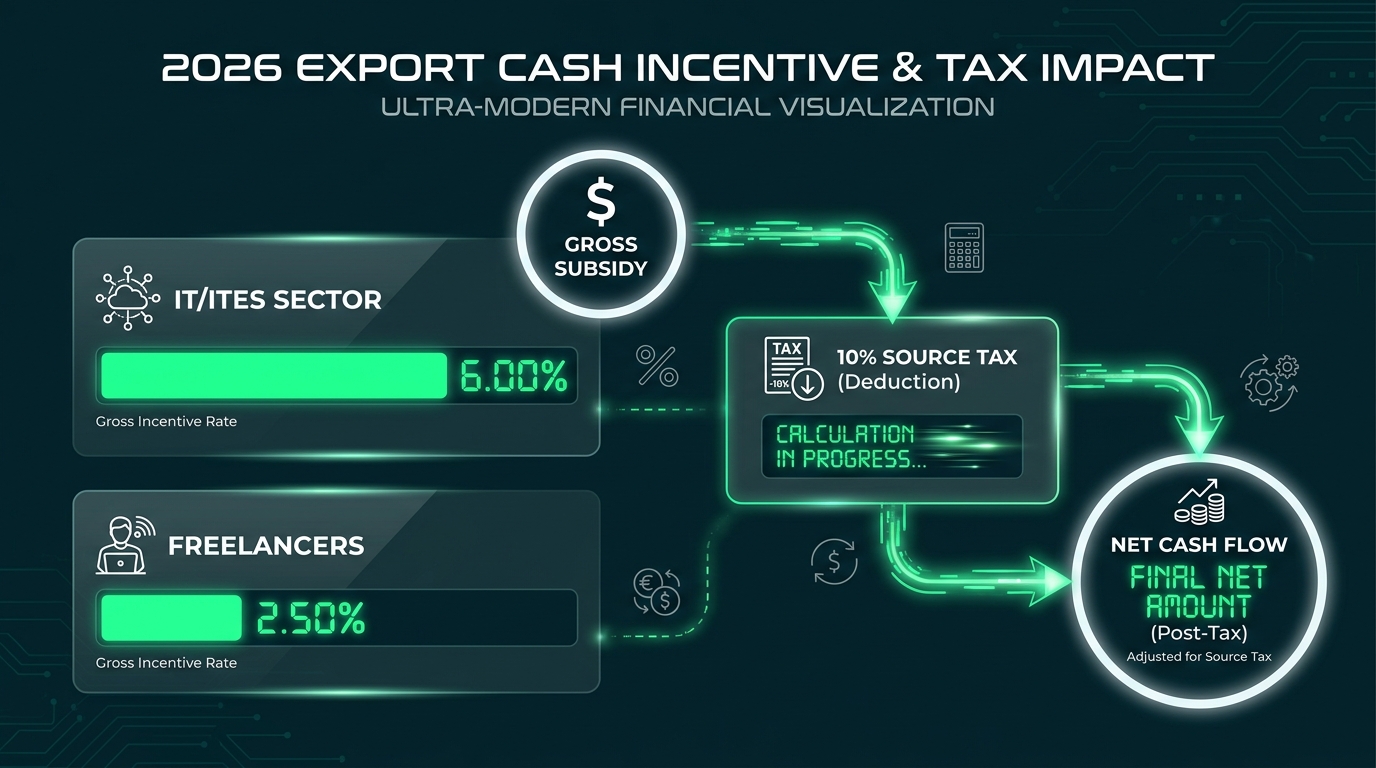
| Software, IT/ITES, Hardware exports | 6.00% |
| Individual freelancers (Software & ITES) | 2.50% |
| Diversified jute products, leather goods, processed agro, halal meat | 10.00% (max) |
| Pharmaceutical instruments, motorcycles, solar PV, consumer electronics | 6.00% |
| Crust and finished leather (outside Savar) | 6.00% |
| Chemicals (chlorine, HCl) | 5.00% |
| Tea, MS steel, bicycles, cement sheets | 2.00–3.00% |
| EPZ, IEPZ, Hi-Tech Park enterprises | 0.30–2.00% (tiered) |
| New products in new markets (outside US/Canada/EU/UK) | +0.50% bonus |
The IT/ITES rate has been reduced from the earlier 10% as part of Bangladesh’s gradual alignment with WTO subsidy disciplines ahead of LDC graduation. That makes correctly claiming what is currently available even more important — the window is narrowing.
Who Is Eligible for the Export Cash Incentive in Bangladesh?
To claim the Export Cash Incentive in Bangladesh for IT/ITES, you must satisfy four conditions:
First, you must be a Bangladeshi software, IT, or ITES exporter — registered as a company, partnership, or proprietorship in Bangladesh. Both BASIS members (general and associate) and non-BASIS members are eligible. The Bangladesh Association of Contact Center & Outsourcing (BACCO) also issues certificates for BPO and call-centre exporters.
Second, your services must fall within the defined IT/ITES scope: software development and maintenance, SaaS, digital content development, 2D/3D animation, GIS services, website development and hosting, BPO, data entry and processing, call centre services, graphics design, SEO, e-commerce platforms, document conversion, imaging and archiving, software application customization, software test lab services, overseas medical transcription, robotic process outsourcing, cybersecurity services, AI/ML services, and cloud computing.
Third, your export proceeds must be repatriated through formal banking channels into Bangladesh in convertible foreign currency, within the prescribed realization period (generally 4 months, extendable). The remittance must hit your AD Bank account and be converted to BDT at the prevailing rate.
Fourth, you must not be availing duty drawback or bonded warehouse facilities for the same shipment — the cash incentive is an alternative, not an add-on.
For freelancers operating through platforms like Upwork, Fiverr, Freelancer.com, or Toptal, a simplified 2.50% scheme exists, requiring the marketplace to be ICT Division-recognized and supported by audit-trail evidence (web links, statements, screenshots).
Documents Required for the Export Cash Incentive in Bangladesh
This is where most claims die. The Export Cash Incentive in Bangladesh requires two parallel document sets — one for BASIS certification, one for the AD Bank claim submission.
BASIS Certification Documents
You will submit a hardcopy file containing the Forwarding Letter addressed to the President of BASIS, BASIS-prescribed Form Ka and Form Kha, the Commercial Invoice(s) covering the export proceeds being claimed, the underlying Export Work Order, Sales Contract, MoU, or email correspondence/online notification proving the contract, the SWIFT message or Advice confirming inward remittance, and Format A. BASIS will conduct preliminary verification and issue the certificate, which then unlocks your bank-side filing.
AD Bank Submission Documents
The bank file is significantly heavier. You will need a Forwarding Letter to the Bank, the BASIS Certificate just obtained, an Undertaking on a Tk. 300 non-judicial stamp, Form Ka, Form Ga, Form Gha, a Discount Certificate, ICT Form-C (or Form-C), the Bank Statement showing the credit, the Bank Calculation Rate sheet, supporting mail or communication trail, the Commercial Invoice, the underlying Export Work Order/Contract/MoU, Format A, an Acknowledgment Letter from the buyer, your KYC documentation, the SWIFT message/Advice, and a Beneficiary Certificate.
For larger claims, Bangladesh Bank may also require Auditor’s verification documents prepared by an externally appointed audit firm — this is mandatory under the latest circulars where external audit has been formalized as a precondition for disbursement.
The Proceed Realization Certificate (PRC) and Format-A (Certificate of Authorized Dealer per FE Circular No. 03) are non-negotiable. Without these two, your file goes nowhere.
Step-by-Step Process to Claim the Export Cash Incentive in Bangladesh
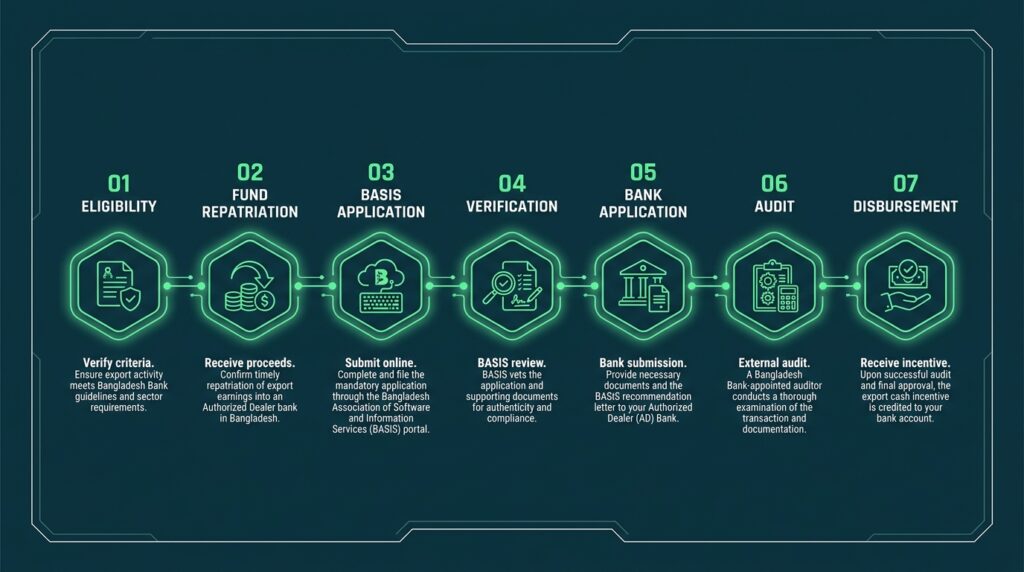
The process to secure the Export Cash Incentive in Bangladesh runs in seven sequential steps. Skipping a step or filing out of order is the single most common reason for rejection.
Step 1 — Confirm Eligibility. Review whether your export contract, service classification, and remittance structure align with the latest FE Circular. Get this wrong upfront and you waste months downstream.
Step 2 — Repatriate Funds. Ensure full proceeds are realized through your AD Bank in convertible foreign currency, with the SWIFT/Advice on file and the PRC issued. Group invoices in batches of up to five per BASIS file.
Step 3 — Prepare and Submit BASIS Application. Three hardcopy sets — one for BASIS, one for the AD Bank, one for your internal record. Pay the slab-based BASIS certification fee (see below).
Step 4 — BASIS Verification & Certificate Issuance. The BASIS Service Officer reviews documents, raises clarifications, and on approval issues the Cash Incentive Certificate. Typical timeline: 2–4 weeks.
Step 5 — File the Bank Application. Submit the full 17+ document bank pack to your AD Bank branch, who forwards it to head office.
Step 6 — External Audit (where applicable). Bangladesh Bank-appointed audit firms verify the claim under the established audit guidelines.
Step 7 — Disbursement. Bangladesh Bank credits the subsidy to your AD Bank’s account, which then credits your operative account. Source tax is deducted at this point.
End-to-end, expect 3 to 6 months from BASIS filing to cash in hand.
BASIS Certification Fees (2026 Slab)
BASIS charges a slab-based fee for issuing the Cash Incentive Certificate. Members pay in USD, non-members in BDT:
| Export Value (USD) | BASIS Member Fee (USD) | Non-Member Fee (BDT) |
|---|---|---|
| Up to 5,000 | 10 | 2,000 |
| 5,001 – 10,000 | 19 | 4,000 |
| 10,001 – 30,000 | 37 | 7,500 |
| 30,001 – 50,000 | 73 | 10,500 |
| 50,001 – 80,000 | 143 | 18,500 |
| 80,001 – 120,000 | 284 | 31,500 |
For every additional USD 50,000 above USD 120,000, an extra BDT 3,000 applies. Plan invoice grouping carefully — five invoices per file is the cap, and splitting a single shipment across multiple files can multiply your fee burden unnecessarily.
The Tax Catch: 10% Source Tax on Your Export Cash Incentive in Bangladesh
Here is what most exporters overlook. The Export Cash Incentive in Bangladesh is not received tax-free. Under the Income Tax Act 2023 (which replaced the 1984 Ordinance), the AD Bank deducts a 10% tax at source when crediting the subsidy. This deduction was earlier treated as a minimum tax and final settlement, but the 2023 law removed the final-settlement language — meaning the subsidy income may now be included in your regular taxable income.
Recent reporting from late April–May 2026 indicates the National Board of Revenue is considering doubling the source tax to 20% in the upcoming FY27 budget, as a revenue-mobilization measure following corporate tax rate alignment debates. Exporter associations are pushing back, but the proposal is live and worth tracking. For now, plan your accounting on the basis of the 10% deduction and book the net subsidy income accordingly.
There is also a 15% VAT consideration on professional service fees if you outsource your claim filing, though the subsidy itself is not VAT-able.
Why Claims Get Rejected (And How to Prevent It)
In a decade of audit and compliance work, I have seen the same six rejection reasons repeat:
- Mismatched names or signatures between the export contract, invoice, SWIFT message, and bank records.
- Late realization of proceeds beyond the permitted window without prior regularization.
- Missing or wrongly drafted Format A — the AD Bank certificate that confirms the inward remittance.
- Service description that does not match the IT/ITES definition — vague invoice wording like “consultancy” without specifying the digital service type.
- Currency or amount inconsistencies between contract, invoice, and credit.
- Failing the external audit because supporting records (timesheets, deliverables, client confirmations) cannot be produced on demand.
The fix in every case is the same: build your claim file the day you sign the contract, not the day you file. Maintain a parallel evidence vault for every export — emails, deliverable acknowledgments, work orders, change requests, payment confirmations. When the audit firm asks for verification six months later, you produce it in 24 hours.
What Happens After Bangladesh’s LDC Graduation (November 2026)?
Bangladesh officially graduates from the Least Developed Country (LDC) category on 24 November 2026. Under World Trade Organization (WTO) rules, LDC graduation triggers the loss of the country’s right to provide most forms of export subsidies, including direct cash incentives. The government has indicated a phased withdrawal of the Export Cash Incentive in Bangladesh framework over the post-graduation period, with policymakers actively studying replacement mechanisms such as Production-Linked Incentive (PLI)-style schemes seen in India and “Made in China 2025”-type sectoral support.
The practical takeaway: claim what you can now, file aggressively for current and prior eligible shipments, and start modelling your unit economics without the 6% cushion for FY28 and beyond.
Final Word
The Export Cash Incentive in Bangladesh remains, for the next 18–24 months, one of the highest-ROI compliance activities an IT/ITES exporter can undertake. The 6% effective subsidy, even after the 10% source tax, leaves you with roughly 5.4% net cash on every dollar repatriated — money already earned, already yours, sitting unclaimed because the paperwork felt overwhelming.
It does not need to be. With the right documentation discipline, a clear understanding of the BASIS-AD Bank-Bangladesh Bank chain, and proactive monitoring of FE Circulars, the claim is mechanical. The exporters who treat cash incentive filing as a quarterly compliance rhythm — not a once-a-year scramble — capture the full benefit. The ones who treat it as an afterthought leave six- and seven-figure subsidies on the table every year.
Plan now. Build the file before the deadline. And if the internal cost of doing this in-house exceeds the value of getting it right, get expert help.
About the Author
Md Rakib Hassan is an Income Tax Practitioner with 10+ years of tax compliance and audit experience across Bangladesh and the UK. He is the former Accounts Manager at a UK chartered accounting firm managing 1,000+ clients, with direct experience resolving multi-year tax audit disputes with HMRC and the NBR. He currently serves as Finance Controller at a UK-based multinational tech group.
Leave a Reply
You must be logged in to post a comment.