Written by Md Rakib Hassan — Income Tax Practitioner with 10+ years of tax compliance and audit experience across Bangladesh and the UK. Former accounts manager at a UK chartered accounting firm managing 1,000+ clients, with direct experience resolving multi-year tax audit disputes with HMRC and the NBR. Currently Finance Controller at a UK-based multinational tech group.
Why Every Finance Professional Needs These VAT Tips Bangladesh
If you work in accounts, procurement, audit, or compliance in Bangladesh, VAT errors are not a theoretical risk — they are a daily operational hazard. The Value Added Tax and Supplementary Duty Act, 2012, alongside its Rules 2016 and a constantly evolving body of SROs, general orders, and NBR clarifications, creates a compliance landscape where even experienced practitioners regularly get caught out.
That is precisely why the serial VAT tips Bangladesh practitioners have been following for the past three years — authored by Dr. Md. Abdur Rauf and compiled meticulously by Abu Taeb (RAT, ITP, PGDSCM) — have become one of the most practically useful resources in the country’s tax community.
This blog unpacks the essential lessons from that landmark collection of 133+45 tips, enriched with the most current 2025 legislative updates from the NBR.
About the Authors
Dr. Md. Abdur Rauf is one of Bangladesh’s foremost VAT experts and trainers. He has been publishing serial VAT tips covering interpretive issues, practical compliance challenges, and reform proposals across 2023, 2024, and 2025. His tips are widely followed by VAT professionals, officials, and business owners across the country.
Abu Taeb (RAT, ITP, PGDSCM) compiled and organised Dr. Rauf’s tips into the structured PDF resource referenced in this blog. Abu Taeb is an active member of the Bangladesh VAT Professionals Forum (VAT Forum) and a CA professional-level candidate.
The 2025 VAT Landscape: What Has Changed
Before diving into the tips, it is important to understand the regulatory backdrop. In January 2025, the interim government of Bangladesh issued an ordinance amending the VAT and Supplementary Duty Act 2012. Key changes included:
- Revised registration thresholds. The mandatory VAT registration threshold was significantly reduced from the previous BDT 30 million turnover limit, bringing more businesses into the VAT net.
- Increased VAT and supplementary duty rates on a range of goods and services, followed by partial reversals in late January 2025 after stakeholder pushback.
- New VDS Rules 2025 (SRO No. 182-Law/2025/310-VAT, dated 27 May 2025), which consolidate and update VAT Deduction at Source procedures for FY 2025–26.
- NBR’s online VAT refund system, launched to allow faster, direct bank transfers for VAT refund claims.
- Hard Copy Return Entry module in the e-VAT system, allowing taxpayers to regularise past paper-based VAT returns without penalty until 31 March 2026.
These updates make it more important than ever to stay current on your VAT tips Bangladesh compliance obligations.
Section 1: Understanding the VAT Framework — Foundational Tips
VAT Is a Consumption Tax, Not a Business Tax
One of the most important foundational VAT tips Bangladesh professionals can internalise is this: VAT is a consumer tax. The buyer pays it; the seller collects it on behalf of the government. The seller’s job is not to “pay” VAT from their own pocket — it is to collect it from the buyer and remit it to the Treasury. This seemingly simple distinction has enormous practical consequences.
When businesses absorb VAT rather than charging it to the customer, they distort their pricing, undermine compliance, and expose themselves to audit liability. The correct approach is to charge VAT on every taxable supply, collect it, and remit it through the Mushak-9.1 return.
The Difference Between VAT Exempt and Zero-Rated
Many practitioners confuse VAT-exempt supplies with zero-rated (0%) supplies. They are fundamentally different:
- VAT-exempt supplies are listed in the First Schedule of the VAT Act. No VAT is applicable at any stage. The registered supplier cannot claim input tax rebate on inputs used to make these supplies.
- Zero-rated supplies (0%) — principally exports and deemed exports — are taxable at 0%. The supplier can claim full input tax rebate on all qualifying inputs.
This distinction is critical. Treating an export as simply “VAT-free” rather than zero-rated means the exporter loses their legitimate right to rebate all upstream input taxes — a significant financial cost.
Taxable vs. Non-Taxable Supply
Dr. Rauf’s tips make clear that the VAT Act does not apply to “monetary supply” — the transfer of money itself is not a supply for VAT purposes. This has practical implications for financial transactions, loans, interest payments, and certain intercompany transfers. Interest, for instance, is not subject to VAT, a point that generates regular confusion in audit settings.
Section 2: VAT Registration and Compliance — Practical Tips
Who Must Register?
Under the 2025 amendments, the registration thresholds have been revised. Businesses exceeding the specified annual turnover threshold must register for VAT with the NBR and obtain a Business Identification Number (BIN). Businesses in certain city corporation and district headquarter areas are mandatorily subject to VAT on specified goods and services regardless of turnover.
Dr. Rauf’s tips emphasise that VAT registration is not a licence to operate — it is an administrative mechanism. Failing to register the correct business activities in the Mushak-2.1 form and update that registration when new services are added exposes the business to a BDT 10,000 penalty under Section 85 of the VAT Act.
Filing the Return — Non-Negotiable Even with Zero Sales
A return (Mushak-9.1) must be filed every month by every VAT-registered entity — even if there were zero sales in that period. A nil return takes only minutes to file online. Failure to file attracts a BDT 5,000 penalty per missed period. Given the simplicity of the online system, there is no excuse for non-compliance.
VAT Challan and Treasury Challan — Do Not Ask the Officer to Sign Them
One of the most actionable VAT tips Bangladesh practitioners can implement immediately: you are not required to take a VAT officer’s signature on your Treasury challan, your Mushak-9.1 hard copy, or your Mushak-6.3 invoice. Only three specific services require the revenue officer to countersign the invoice — advertising services, furniture sold directly from factory to a withholding entity, and television/online broadcast content supplied to a withholding entity. Everything else should be handled without officer signatures. This illegal practice wastes time and creates unnecessary dependency.
Section 3: Input Tax Rebate — The Most Misunderstood Area
The input tax rebate system is where the largest compliance errors occur. These are the essential VAT tips Bangladesh finance teams must have absolutely clear.
What Is Input Tax Rebate?
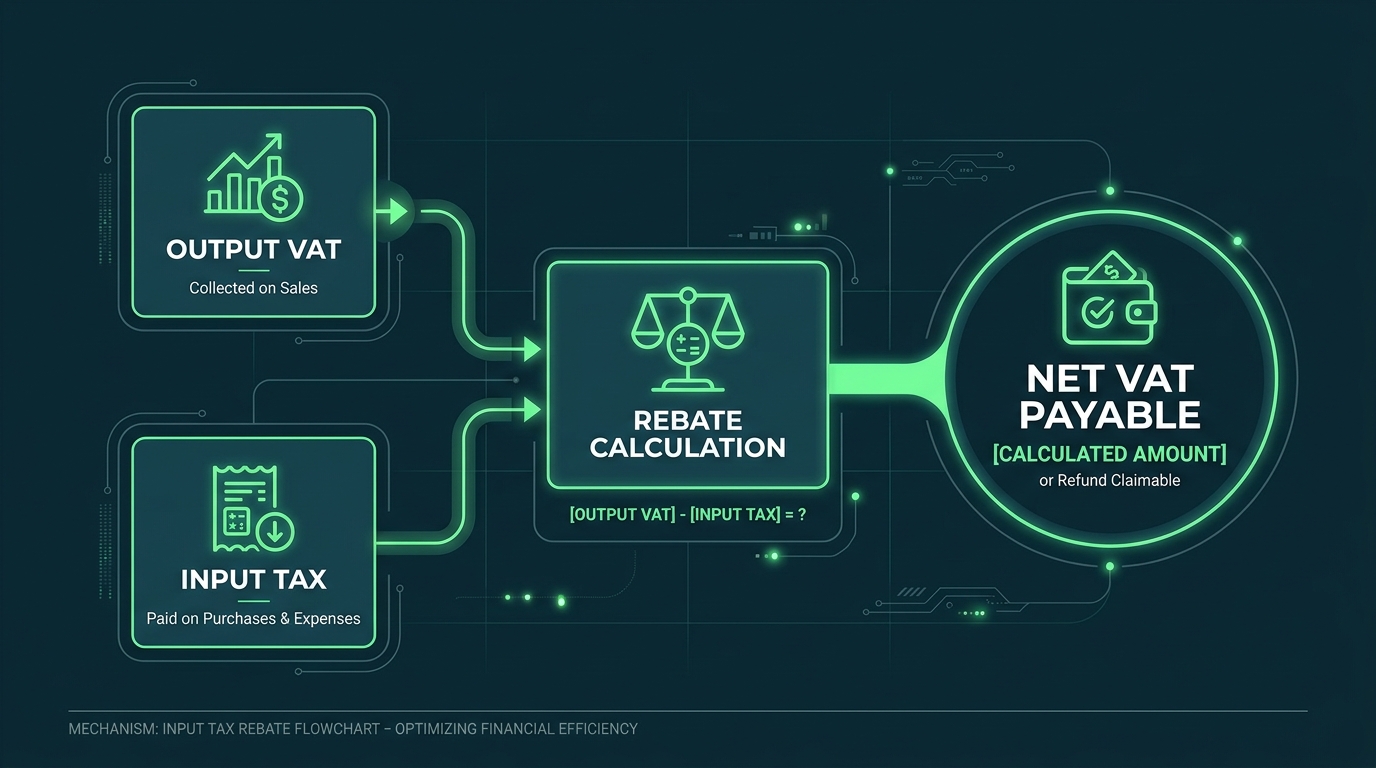
When a registered person purchases taxable inputs and pays VAT on those purchases, they can reclaim (rebate) that VAT against their output VAT liability. The mechanics: output VAT on sales minus input VAT rebate equals net VAT payable.
The Two Core Conditions for Rebate
Dr. Rauf’s framework consistently emphasises two primary conditions:
- Output VAT must be 15% or 0% (zero-rated exports). If your output VAT rate is 5%, 7.5%, or 10%, you cannot take input rebate.
- The purchase must qualify as an “input” under Section 2(18Ka) of the VAT Act. Not everything purchased to run a business qualifies as an input.
What Does NOT Qualify as an Input
This is where many businesses make costly errors. The following do NOT qualify for input tax rebate under Section 2(18Ka) and Section 46 of the VAT Act:
- Land and immovable property (buildings, structures)
- Office furniture and equipment
- Air conditioners, refrigerators, fans, and similar fixtures
- Vehicles — unless purchased for resale, rental, or providing transport services
- Spare parts for vehicles and generator repair
- Travel and entertainment expenses
- Employee welfare expenses
- Depreciation and amortisation entries (these are accounting adjustments, not purchases — no VAT is triggered)
Traders Can Also Take Rebate
A common misconception: traders (businesses that buy and sell without manufacturing) are sometimes told they can only take rebate on goods they directly sell. This is wrong. The rebate provisions of Section 2(18Ka), Section 46, and Section 47 apply equally to manufacturers, service providers, and traders. The trader’s purchased inventory is their primary “input” and is fully rebatable when sold at 15% VAT.
Banking Channel Requirement for Rebate
For purchases exceeding BDT 100,000 in value, input tax rebate requires that payment be made through banking channels (bank transfer, cheque, mobile banking, digital payment gateway). Cash payment for these amounts disqualifies the rebate. Critically — this is about payment method, not timing. If you take the rebate first and later pay cash, you must make an increasing adjustment (Rule 29) to reverse the rebate.
Overpaid VAT — You Can Recover It Without Asking Permission
If you have overpaid VAT for any reason — including excess VDS deducted at source — you can recover it through a decreasing adjustment in the next six VAT periods. Section 72 and Rule 52(6) explicitly permit this. No application to the VAT office is required. No officer approval is needed. Simply adjust it in your Mushak-9.1 return.
Section 4: VDS (VAT Deduction at Source) — Essential Tips
VAT Deduction at Source (VDS), known locally as TDS on VAT (তভ্যাট কর্তন / ভ্যাট উৎসে কর্তন), is one of the most frequently misapplied provisions.
Who Must Deduct VDS?
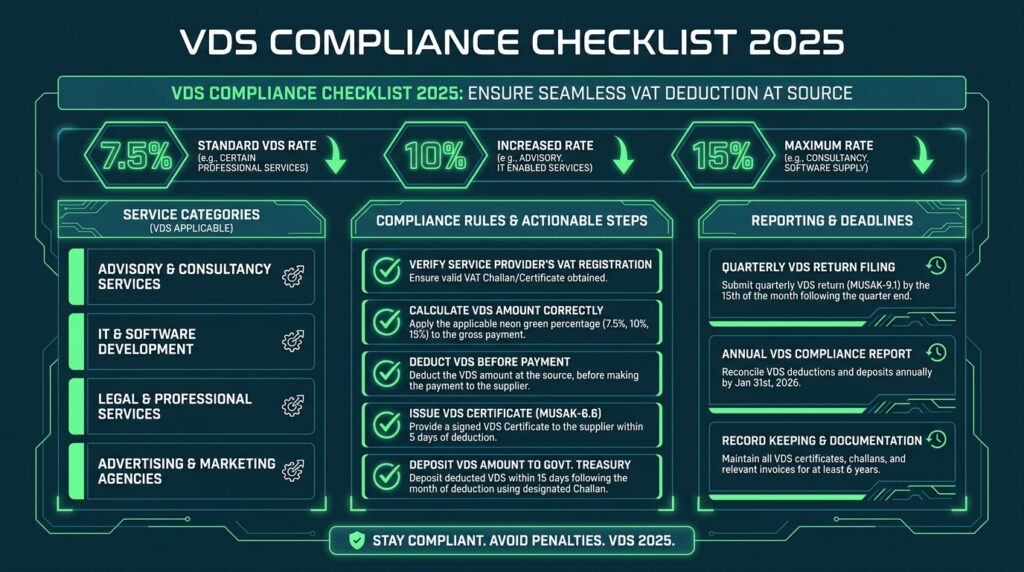
Withholding entities under the VDS Rules 2025 include government offices, ministries, departments, NGOs, banks, insurance companies, educational institutions (secondary and above), and limited companies. These entities must deduct VAT at source when paying for specified goods and services.
The 43-Service List
The VDS Rules contain a list of 43 services where VDS is mandatory in all circumstances — regardless of whether a VAT invoice (Mushak-6.3) is presented. Finance teams at withholding entities must maintain this list and apply it mechanically to every payment for listed services.
When VDS Is NOT Required
- Fuel (petrol, diesel, octane, gas, kerosene)
- Medicines
- Goods and services in the First Schedule (VAT-exempt items)
- Zero-rated services (exports)
- Airline tickets — which fall under the Excise and Salt Act, 1944, not the VAT Act
The Rate Puzzle: 7.5%, 10%, or 15%?
The applicable VDS rate depends on who is supplying and at what VAT rate:
- Manufacturer with Mushak-6.3 at any rate → No VDS required
- Importer or trader at 15% with Mushak-6.3 and VAT Honour Card → No VDS required
- Importer or trader at 15% without the above → Deduct 7.5%
- Importer or trader at 5% → Deduct 7.5%
- Procurement provider (Jogadar) → Always deduct 7.5%
- Services in the 43-list → Deduct at the rate specified in the list
VDS and Self-Payment Are Equivalent — Stop Fighting About It
A recurring dispute between buyers and sellers: the seller says “I have already paid VAT myself, don’t deduct VDS.” The buyer insists on deducting VDS. Dr. Rauf’s analysis makes this clear — both approaches result in the same amount of VAT reaching the government. The VDS mechanism simply changes who remits it. If a supplier has self-paid VAT, they receive a Mushak-6.6 certificate from the buyer and make a decreasing adjustment in their own return. Net result: identical.
Section 5: The Procurement Provider (Jogadar) — Demystified
The concept of the procurement provider (Jogadar / যোগানদার) generates more confusion than almost any other concept in Bangladesh VAT compliance, and it sits at the heart of countless VDS disputes.
What Is a Jogadar?
A Jogadar is a person or entity that sources goods from manufacturers, importers, or traders and supplies them under contract to a buyer — typically against a tender. The Jogadar does not maintain a physical shop, does not stock goods in advance, and does not have significant fixed infrastructure. They win a contract, source the goods, and deliver them directly to the tender authority.
This contrasts with a trader (Dealer/Distributor) who maintains a showroom, stocks goods, and sells to multiple buyers over time.
Why It Matters for VDS
When you receive a supply from a Jogadar, always deduct VDS at 7.5% — regardless of what VAT invoice they present. The Jogadar service carries a 7.5% VAT rate, and the VDS obligation always applies.
Export VAT Exemption for Jogadars
Jogadars supplying VAT-exempt goods to 100% export-oriented industries (BGMEAs, BKMEA members) under SRO No. 188-Law/2019/45-Mushak are exempt from charging VAT on those supplies — but the Jogadar must be registered as a “procurement provider” in their VAT registration (Mushak-2.1) and their trade licence must say “supplier.” The invoice must reference the SRO. Without these, the exemption is invalid.
Section 6: VAT on Services — Key Clarifications
Beauty and Wellness Services Are Taxable
Laser treatment, body wrapping, facial services, hair care, muscle building, skin tightening — these are beauty services, not medical services. They fall under beauty parlour and fitness centre service codes and attract VAT accordingly. Treating them as medical services to avoid VAT is non-compliant.
Interest Is Not Subject to VAT
There is no VAT on interest income. This applies to bank interest, loan interest, and any form of interest payment. It is not a taxable supply under the VAT Act.
Service Export — Physical Travel Not Required
A frequently misunderstood rule: service exports do not require the service physically leaving Bangladesh. A software engineer in Dhaka providing services to a Swedish company via an online server connection is exporting services — VAT at 0%, provided payment is received in foreign currency through a bank and the bank issues an Encashment Certificate.
Similarly, a consultant writing a report and emailing it to a foreign client is exporting services. The key test is: does the beneficiary of the service reside outside Bangladesh, and is payment received in foreign currency through the banking channel?
Board Meeting Fees Are VAT-Able
VAT applies to honoraria paid to directors for attending board meetings. This is distinct from salaries and allowances paid to directors, which are employment income and not subject to VAT. Finance teams should segregate board meeting fees into a separate sub-head in the financial statements to avoid audit disputes.
Depreciation and Amortisation — No VAT Event
VAT officers sometimes raise demands when reviewing CA audit reports that show depreciation, amortisation, and revaluation entries. These are purely accounting adjustments. No goods or services are supplied. No money changes hands. No VAT or VDS is applicable on depreciation, amortisation, intangible additions, or revaluation entries.
Section 7: VAT Audit — Preparing Your Business
Business Promotion Expense — Document Everything
One of the most common VAT audit triggers is the “business promotion expense” heading in a CA audit report. If this heading has no sub-notes or supporting documents, VAT auditors routinely demand 15% VAT on the entire amount. In reality, this heading may include foreign travel, staff training, gifts purchased with VAT, samples, or cash payments — each with different VAT treatment.
The solution: maintain detailed sub-ledgers, vouchers, and supporting documents under every expense heading. Both your CA auditor and your VAT auditor will benefit from this discipline.
VAT Officers Can Access All Business Documents
Under Rule 40(5) of the VAT Rules and Section 2(49) of the VAT Act, VAT officers are entitled to inspect all commercial documents maintained by a registered entity — not just VAT records. HR files, procurement records, engineering documents, marketing files — all are accessible to VAT officers during an audit. Restricting access is not permitted and exposes the business to additional penalties.
Land Auction by Banks — VAT Position
When a bank auctions mortgaged land to recover a defaulted loan (without engaging an auction firm), no VAT applies to the land transaction — land sale is exempt under the First Schedule, Third Part, Clause 7(Na) of the VAT Act. However, if the bank engages an auction firm, the auction firm’s service (service code S060) attracts 15% VAT payable by the buyer at auction.
Section 8: Real Estate VAT — A Rapidly Evolving Area
Flat Developers and Land Developers
VAT applies to flat construction and land development services. The question of whether VAT should be calculated on the registration (mouza) value or the actual sale price has been a long-standing grey area in Bangladesh VAT practice.
Dr. Rauf’s detailed analysis in VAT Tip 133/2025 concludes that — based on longstanding NBR practice, the absence of any contradictory NBR order, and the principle that “benefit of doubt goes to the taxpayer” — VAT on flat and land registration should continue to be calculated on the registration (mouza) value at the time of document registration. However, if the NBR issues a contrary order, practitioners must comply with that order.
Section 9: 2025 Reform Priorities — Dr. Rauf’s Vision
Beyond compliance tips, Dr. Rauf’s series consistently advocates for structural VAT reform. His key proposals remain highly relevant in 2025:
Build 25,000–30,000 VAT professionals. Bangladesh’s VAT system cannot function well with fewer than 300 licensed NBR VAT consultants. The country needs a professional VAT practitioner class similar to how chartered accountants serve income tax.
Automate invoice issuance. The EFD (Electronic Fiscal Device) programme and the e-VAT system are steps in the right direction, but full automated invoicing — where VAT is split off and credited to the government treasury in real time at the point of payment — is the ultimate goal.
Extend VAT to sub-districts and unions. The VAT net in Bangladesh remains heavily concentrated in Dhaka and Chittagong. Rural and semi-urban businesses — hotels, restaurants, furniture shops, electronic goods retailers, beauty parlours — are largely outside the effective VAT net despite clear legal obligations.
Simplify the law. Multiple cross-references, contradictory SROs, and legal vacuums (where economic activity exists but no legal provision covers it) continue to generate disputes and inconsistency.
Quick Reference: Common VAT Rates in Bangladesh (2025–26)
| Supply Type | VAT Rate |
|---|---|
| Standard goods and services | 15% |
| Exports and deemed exports | 0% (zero-rated) |
| Non-AC residential hotels | 7.5% |
| AC residential hotels | 15% |
| Ordinary restaurants | 5% |
| 3-star/above or alcohol-serving restaurants | 15% |
| Catering services | 15% |
| IT-dependent services (incl. software, freelancing) | 5% |
| Jogadar (procurement provider) | 7.5% |
| Construction services | 7.5% |
| Furniture (factory and showroom) | 7.5% |
| Repair and service workshops | 10% |
| Supplementary duty (trader level) | NIL |
Final Thoughts
Bangladesh VAT compliance is not optional, and ignorance of the law is no defence at audit. The good news is that most VAT errors are avoidable with proper knowledge and systematic record-keeping. The VAT tips Bangladesh professionals need most are not complicated — they are about clarity: knowing which supplies are taxable, understanding when VDS applies, keeping your rebate documentation complete, and filing your return every single month.
Dr. Abdur Rauf’s three-year series of tips has done an extraordinary service to Bangladesh’s VAT practitioner community by translating a complex, cross-referenced piece of legislation into practical, daily guidance. Bookmark this page, download the PDF, and share it with your finance team.
Have a VAT compliance question? Connect via the Bangladesh VAT Professionals Forum on LinkedIn or reach the VAT Forum helpline at 09678-208208.
Leave a Reply
You must be logged in to post a comment.