Written by Md Rakib Hassan — Income Tax Practitioner with 10+ years of tax compliance and audit experience across Bangladesh and the UK. Former accounts manager at a UK chartered accounting firm managing 1,000+ clients, with direct experience resolving multi-year tax audit disputes with HMRC and the NBR. Currently Finance Controller at a UK-based multinational tech group.
“What is VAT?” is one of the most searched financial questions in Bangladesh — and one of the most misunderstood. Business owners pay it every month without fully grasping the mechanism. Employees see it on receipts without understanding who actually bears the burden. Accountants calculate it daily without always explaining the principle clearly to their clients.
This guide answers what is VAT completely — from its core definition to how it works at every stage of the supply chain, what distinguishes it from income tax, what input and output VAT mean in practice, what SD VAT and zero-rated VAT are, what the VAT rate is in Bangladesh and the UK, and who ultimately pays VAT. Whether you are a business owner, student, accountant, or simply curious, this is the only VAT explainer you need for 2026.
What Is VAT? The Definition
VAT stands for Value Added Tax. It is an indirect consumption tax levied on the value added to goods and services at each stage of production, distribution, and supply — from manufacturer to wholesaler, wholesaler to retailer, and retailer to final consumer.
The most precise answer to what is VAT is this: it is a tax on consumption, collected in stages throughout the supply chain, but ultimately borne by the end consumer who cannot reclaim it.
VAT differs fundamentally from a simple sales tax:
- A sales tax is charged only at the final point of sale to the consumer — one stage, one collection
- VAT is charged at every stage of the supply chain — but each business in the chain claims back the VAT it paid on its inputs, so it only remits to the government the VAT on the value it added
This is the elegant mechanism at the heart of what is VAT: every business in the chain acts as an unpaid tax collector for the government, collecting VAT from their customers, reclaiming VAT they paid to their suppliers, and remitting only the net difference.
History: Which Country Introduced VAT First?
France introduced VAT first, in 1954, under the pioneering work of economist Maurice Lauré. The innovation spread rapidly through Europe and eventually to most of the world.
Bangladesh introduced VAT in 1991, becoming one of the earlier South Asian nations to adopt the system. The original VAT Act 1991 was substantially modernised by the VAT and Supplementary Duty Act 2012, which came into full force in July 2019 — introducing digital administration, the Integrated VAT Administration System (IVAS), and the online portal at vat.gov.bd.
The UK introduced VAT in 1973 when it joined the European Economic Community (EEC), replacing the earlier Purchase Tax. Post-Brexit, the UK maintains its own VAT framework administered by HMRC, independent of EU VAT rules.
How VAT Works: The Supply Chain Mechanism
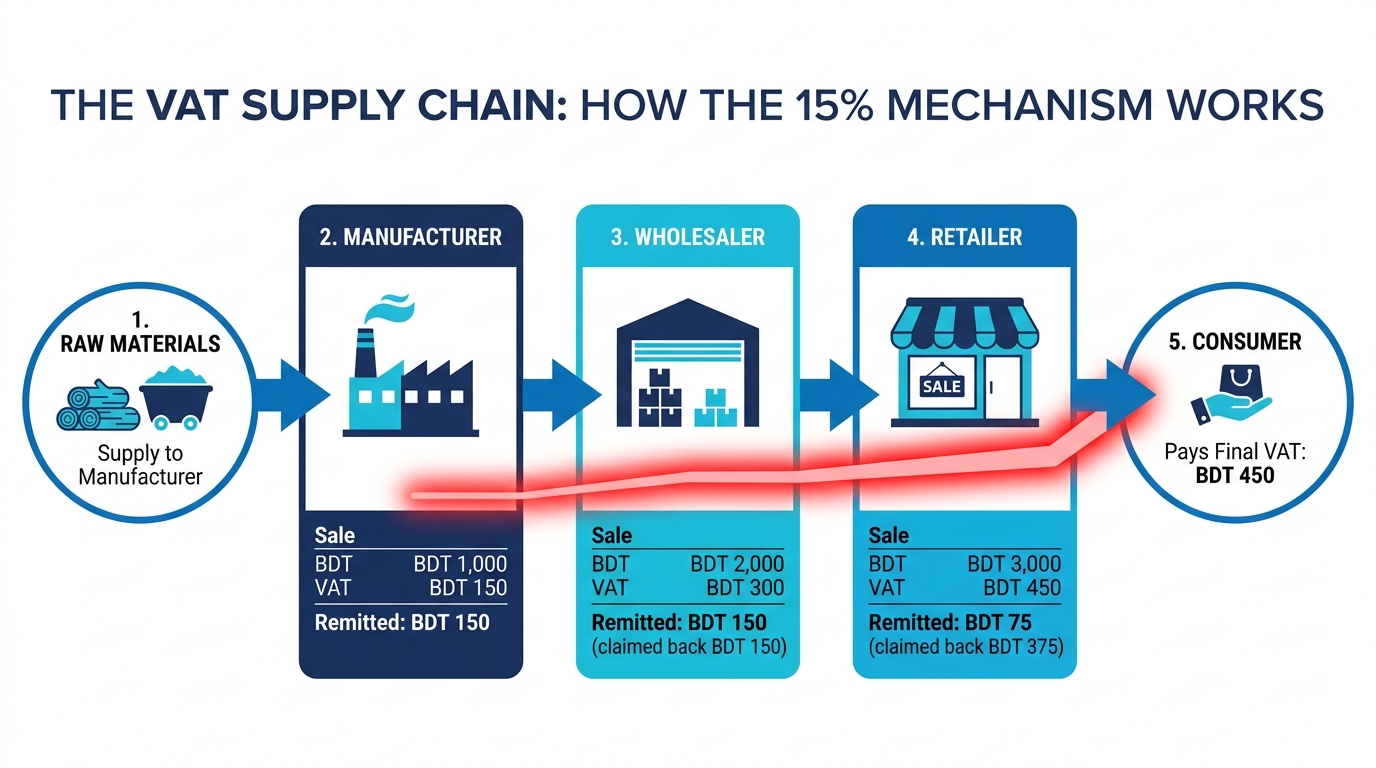
The best way to understand what is VAT and how it works is to trace a product through the supply chain. Here is a practical example using Bangladesh’s standard 15% VAT rate:
| Stage | Actor | Sale Price (Net) | VAT Charged (15%) | VAT Paid on Inputs | VAT Remitted to Govt |
|---|---|---|---|---|---|
| 1 | Raw material supplier → Manufacturer | BDT 1,000 | BDT 150 | Nil | BDT 150 |
| 2 | Manufacturer → Wholesaler | BDT 2,000 | BDT 300 | BDT 150 (claimed) | BDT 150 |
| 3 | Wholesaler → Retailer | BDT 2,500 | BDT 375 | BDT 300 (claimed) | BDT 75 |
| 4 | Retailer → Consumer | BDT 3,000 | BDT 450 | BDT 375 (claimed) | BDT 75 |
| Total VAT collected by Govt | BDT 450 |
The final consumer pays BDT 450 in VAT (15% of BDT 3,000). Every business in the chain only remitted to the government the VAT on the value they added — and the total adds up to exactly what the consumer paid. This is the self-checking genius of how VAT works.
What Is Input VAT?
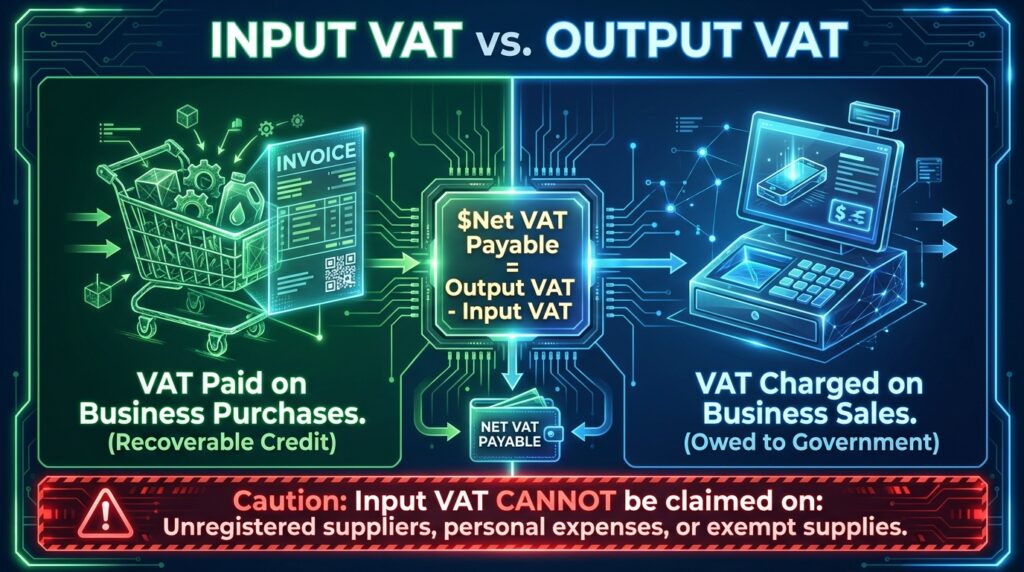
Input VAT is the VAT that a business pays on its purchases of goods and services — the “inputs” into its operations.
When you buy raw materials, stock, office supplies, or professional services from a VAT-registered supplier, you pay VAT on those purchases. That VAT is your input VAT — and it is recoverable. You can deduct it from the VAT you collected from your own customers when filing your monthly VAT return.
Practical example: A clothing manufacturer buys fabric for BDT 5,00,000. At 15% VAT, they pay BDT 75,000 in input VAT. This BDT 75,000 is not a cost to the business — it is a recoverable tax credit that reduces their next VAT payment to the NBR.
When can you NOT claim input VAT?
- When purchasing from an unregistered supplier (no valid BIN/VAT number)
- When the purchase is for personal use rather than business purpose
- When the supply is exempt from VAT (input credit is blocked on exempt purchases)
- When reduced-rate supplies are made — businesses paying reduced rates generally cannot claim input VAT credits
What Is Output VAT?
Output VAT is the VAT that a business charges on its sales of goods and services — the “output” of its operations.
Every time a VAT-registered business sells a taxable product or service, it charges VAT on top of the selling price. This VAT collected from customers is the business’s output VAT — and it must be remitted to the NBR (Bangladesh) or HMRC (UK), less any input VAT credits.
Net VAT payable = Output VAT − Input VAT
If output VAT exceeds input VAT → pay the difference to the government If input VAT exceeds output VAT → carry forward the credit (or apply for refund if exporting)
What Is the Difference Between VAT and Tax?
“What is the difference between VAT and tax” is one of the most frequently asked questions when explaining what is VAT. The distinction matters for understanding your obligations:
| Dimension | VAT | Income Tax |
|---|---|---|
| Type | Indirect tax | Direct tax |
| Who bears it | Final consumer | The taxpayer (individual or company) |
| Who pays it to government | Businesses (as collectors) | Individuals and companies directly |
| Based on | Consumption / value of goods & services | Income earned |
| Governed by (Bangladesh) | VAT & SD Act 2012 | Income Tax Act 2023 |
| Administered by | NBR (VAT wing) | NBR (Tax wing) |
| Filing frequency | Monthly (Mushak 9.1) | Annual (income tax return) |
| Registration trigger | Turnover threshold | Income threshold / TIN requirement |
Is VAT a direct or indirect tax? VAT is unambiguously an indirect tax. It is collected by businesses on behalf of the government and passed on to consumers through prices. The consumer bears the economic burden, not the business collecting it. Income tax, by contrast, is a direct tax — paid directly by the person or entity on whom it falls.
Is VAT an expense for businesses? In most cases, no — VAT paid on business purchases is recoverable through the input VAT credit mechanism and therefore not a cost. However, VAT becomes an actual expense when:
- The business is not VAT-registered (and cannot claim input credits)
- The purchase relates to an exempt supply (input credit blocked)
- The business deals in reduced-rate goods where input credits are restricted
What Is VAT in Bangladesh?
What is VAT in Bangladesh specifically? In Bangladesh, VAT is governed by the VAT and Supplementary Duty Act 2012 and administered by the National Board of Revenue (NBR) through the Customs, VAT and Excise wing.
What is VAT rate in Bangladesh? The standard VAT rate in Bangladesh is 15%, applied to the majority of goods, services, and imports. Bangladesh also operates:
| Rate | Category |
|---|---|
| 15% | Standard rate — most goods, services, imports |
| 10% | Selected services |
| 7.5% | Accounting/audit, specific services |
| 5% | Restaurant services, certain goods |
| 3% | Turnover tax (businesses with BDT 30L–80L turnover) |
| 0% | Exports (zero-rated) |
| Exempt | Essential food, medicines, education, agriculture |
What is VAT in Bangladesh administered through? The NBR’s Integrated VAT Administration System (IVAS) at vat.gov.bd manages all digital VAT activities — registration (BIN), Mushak form generation, monthly return (Mushak 9.1) submission, and compliance monitoring.
VAT contributes more than half of all tax collected by the NBR, making it Bangladesh’s most significant source of domestic revenue. Understanding what is VAT in Bangladesh is therefore not an academic exercise — it is fundamental business knowledge for any entity operating in the country’s formal economy.
What Is Zero-Rated VAT?
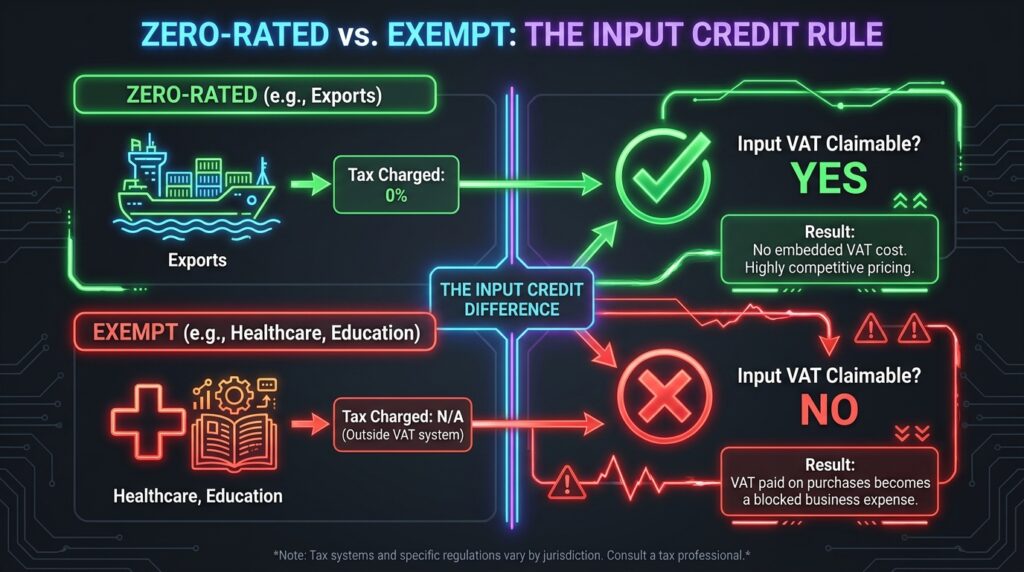
Zero-rated VAT means VAT is charged at a rate of 0% — the supply is within the VAT system, VAT is technically charged, but at zero. This matters because:
- The supplier charges 0% VAT — so no VAT is collected from customers
- The supplier can still claim input VAT credits on their purchases used to make those zero-rated supplies
This is the critical distinction between zero-rated and exempt:
| VAT Rate | Input VAT Claimable? | |
|---|---|---|
| Zero-rated | 0% | ✅ Yes |
| Exempt | N/A (not in VAT system) | ❌ No |
What supplies are zero-rated in Bangladesh?
- All exports of goods — supporting Bangladesh’s export competitiveness
- Exports of services
- Goods and services supplied to foreign-going vessels or aircraft
- Services rendered outside Bangladesh
Why does zero-rated VAT matter? For Bangladesh’s massive export sector — particularly RMG (Ready-Made Garments), leather goods, and pharmaceutical exports — zero-rating means businesses pay no VAT on their export sales but can still fully recover the VAT paid on their raw materials, utilities, and services used in production. This prevents VAT from becoming an embedded cost in export prices.
What Is VAT Rebate?
What is VAT rebate in the Bangladesh context? A VAT rebate (also called input tax credit or decreasing adjustment) is the mechanism by which a VAT-registered business reduces its output VAT liability by the input VAT it has paid on qualifying purchases.
In simple terms: your VAT rebate is the amount the government effectively refunds to you for the VAT you paid on your business purchases — not as a cash payment, but as a deduction from the VAT you owe on your sales.
Key VAT rebate conditions in Bangladesh:
- The purchase must be for a business purpose (not personal)
- The supplier must be VAT-registered with a valid 13-digit BIN
- A valid Mushak 6.3 tax invoice must support the purchase
- The supply being made must be standard-rated (15%) — reduced-rate and exempt suppliers generally cannot claim input rebates
What Is SD VAT (Supplementary Duty)?
What is SD VAT — or more precisely, Supplementary Duty (SD) — is a common question given that SD and VAT are frequently mentioned together in Bangladesh.
Supplementary Duty (SD) is a separate, additional tax levied on specific goods and services deemed luxury items or socially discouraged products under the VAT and Supplementary Duty Act 2012. Examples include:
- Tobacco and tobacco products
- Alcoholic beverages
- High-end vehicles
- Premium consumer electronics (in some categories)
- Certain luxury services
Key differences between SD and VAT:
| Dimension | VAT | Supplementary Duty (SD) |
|---|---|---|
| Applied at | Every stage of supply chain | First stage only (import or first supply) |
| Rate | 15% (standard) or reduced rates | 5% to 65.5% depending on product |
| Input credit | Yes (for standard-rated supplies) | Generally NOT adjustable against VAT |
| Purpose | Revenue collection on value added | Discouragement of luxury/harmful consumption |
SD and VAT interact at import: When goods subject to both SD and VAT are imported, the SD is calculated first, and then VAT is calculated on the combined value (customs duty + SD + other charges). This means SD indirectly increases the VAT base at the import stage.

How Much Is VAT in the UK?
How much is VAT in the UK and what are the rates? The UK VAT rate structure differs from Bangladesh’s and is administered by HMRC:
| Rate | Category |
|---|---|
| 20% | Standard rate — most goods and services |
| 5% | Reduced rate — domestic energy, children’s car seats, sanitary products |
| 0% | Zero rate — food, children’s clothing, books, newspapers, exports |
| Exempt | Financial services, education, healthcare, insurance |
What is the VAT rate in UK for 2025–26? The standard UK VAT rate remains 20% for the 2025–26 period — unchanged since January 2011. The VAT registration threshold in the UK is £90,000 (raised from £85,000 in April 2024), the highest registration threshold of any EU-comparable country.
Who Pays VAT?
Who pays VAT is a deceptively simple question with a nuanced answer:
Legally: VAT-registered businesses pay VAT to the government. They collect it from customers, subtract what they paid to suppliers, and remit the balance to the NBR (Bangladesh) or HMRC (UK).
Economically: The final consumer bears the entire VAT burden. Every business in the supply chain recovers the VAT it paid (through the input credit mechanism), so the cost ultimately falls on the person who cannot claim it back — the end consumer who buys the product or service for personal use.
This is why VAT is called a consumption tax — it is a tax on consuming goods and services, not on earning income.
One important nuance: Unregistered businesses below the VAT threshold also bear the economic cost of VAT on their purchases, since they cannot register to claim input credits. This is a known regressive effect of VAT on very small businesses.
Frequently Asked Questions About VAT
What is VAT tax in simple terms? VAT is a tax added to the price of goods and services at each stage of production and sale. Businesses collect it from their customers and pay it to the government, after deducting the VAT they paid on their own purchases. The final consumer pays the total VAT included in the price.
Is VAT direct or indirect? VAT is an indirect tax. It is collected by businesses on behalf of the government and passed on to consumers through prices. This distinguishes it from income tax, which is paid directly by the person earning the income.
What is the VAT rate in Bangladesh? The standard VAT rate in Bangladesh is 15%, applicable to most goods, services, and imports. Reduced rates of 5%, 7.5%, and 10% apply to specified categories. Exports are zero-rated at 0%.
What is the VAT rate in the UK? The standard UK VAT rate is 20%. A reduced rate of 5% applies to domestic energy and certain other goods. Many essential items (food, children’s clothing, books) are zero-rated at 0%.
What is the difference between input VAT and output VAT? Input VAT is the VAT you pay on purchases. Output VAT is the VAT you charge on sales. The difference between them is what you remit to the government on your monthly VAT return.
What is zero-rated VAT? Zero-rated VAT means VAT is charged at 0% — so no VAT is collected from customers, but the business can still claim back the input VAT it paid on related purchases. In Bangladesh, all exports are zero-rated.
What is VAT rebate? A VAT rebate is the input tax credit — the deduction businesses apply against their output VAT liability for VAT paid on qualifying business purchases. It is the mechanism that prevents VAT from compounding through the supply chain.
Who ultimately pays VAT? The final consumer bears the economic cost of VAT. Businesses collect and remit it, but recover the VAT on their own costs through the input credit mechanism.
Final Thoughts: VAT Is a System, Not Just a Tax Rate
Understanding what is VAT means understanding a system — a precisely designed mechanism where every stage of economic activity contributes proportionally to government revenue, with the final burden resting on the ultimate consumer.
For businesses in Bangladesh and the UK, VAT is not just a compliance obligation — it is a cash flow mechanism that requires precise monthly management. The VAT you collect from customers is not your money. It belongs to the government and must be remitted accurately and on time.
For consumers, knowing what is VAT means understanding why prices include a component that goes directly to the national treasury — funding public services, infrastructure, and social programmes.
For accountants and finance professionals working across both markets — as I do — the most important insight is that while what is VAT has a single universal answer, how it is applied, administered, and enforced differs significantly between Bangladesh’s NBR system and the UK’s HMRC framework. Expertise in both is not just professionally valuable; it is essential for any business operating across these jurisdictions.
Have questions about VAT compliance in Bangladesh or the UK — registration, return filing, BIN verification, or HMRC audit defence? As a tax practitioner with direct NBR and HMRC audit experience, I advise businesses across both markets. Get in touch for a professional consultation.
Tags: what is vat, what is vat tax, how vat works, what is input vat, what is output vat, what is input vat and output vat, what is zero rated vat, what is sd vat, what is vat rebate, who pays vat, is vat direct or indirect tax, what is the difference between vat and tax, what is vat in bangladesh, what is vat rate in bangladesh, how much is vat in uk, what is the vat rate in uk, which country introduced vat first
Leave a Reply
You must be logged in to post a comment.