Written by Md Rakib Hassan — Income Tax Practitioner with 10+ years of tax compliance and audit experience across Bangladesh and the UK. Former accounts manager at a UK chartered accounting firm managing 1,000+ clients, with direct experience resolving multi-year tax audit disputes with HMRC and the NBR. Currently Finance Controller at a UK-based multinational tech group.
Two of the most practically important tools in Bangladesh’s VAT compliance system are BIN verification and the VAT tax calculator — yet both are routinely misunderstood or underused by businesses that end up paying the price during NBR audits.
BIN verification — the process of confirming that a supplier’s Business Identification Number is valid, active, and correctly registered with the NBR — is not optional due diligence. It is the foundation of your right to claim Input Tax Credit on every purchase invoice. Buying from an unverified or inactive BIN exposes your business to rejected ITC claims, penalty assessments, and direct audit liability.
The VAT tax calculator — whether manual or through online tools — is the daily calculation engine behind every Mushak 6.3 invoice you issue, every purchase price you pay, and every monthly VAT return you file. Understanding how to calculate VAT accurately in Bangladesh is not just an accounting function; it determines how much of your customers’ money you are legally obligated to remit to the government.
This guide covers both: what BIN verification means and exactly how to do it, what a BIN is and why it matters, and how to use the VAT tax calculator to calculate output VAT, input VAT, and net payable across Bangladesh’s multiple rate categories.
What Is a BIN in Bangladesh?
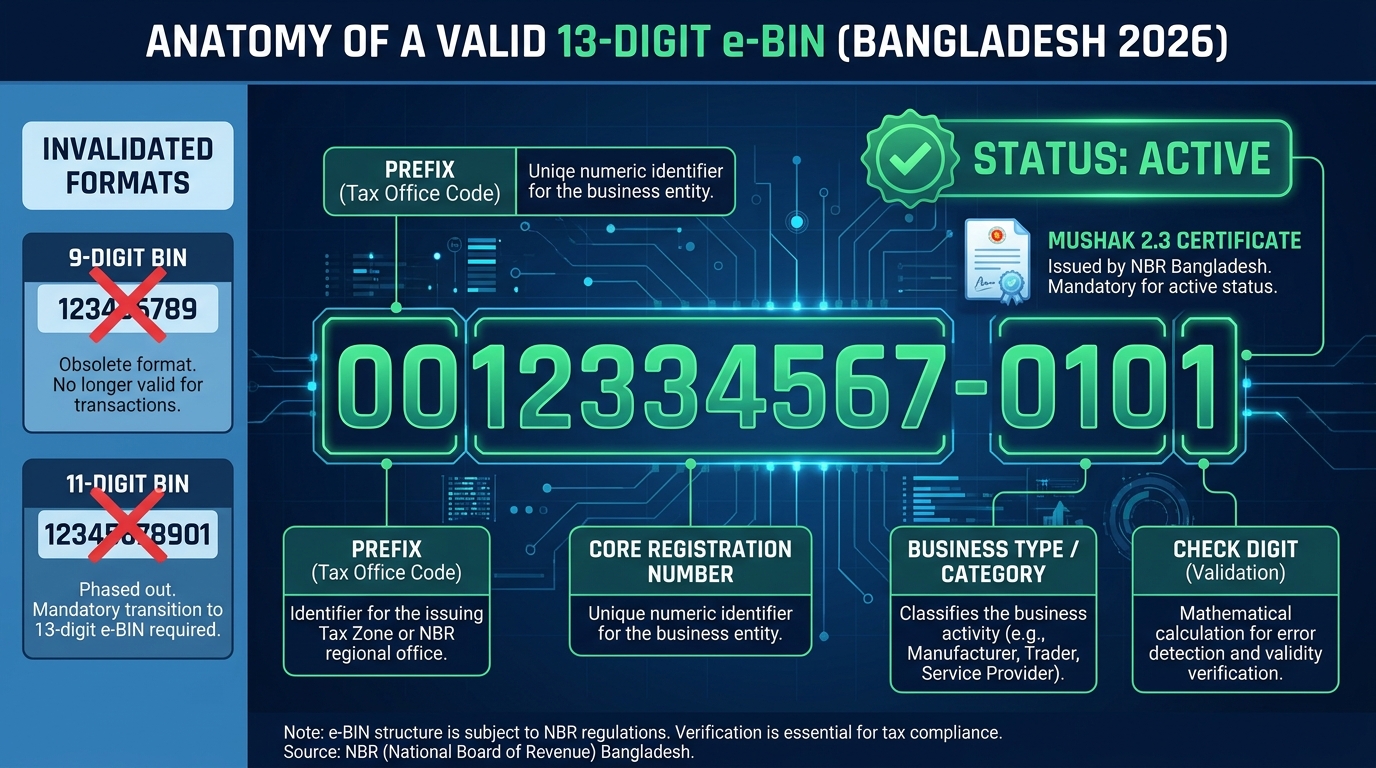
A BIN (Business Identification Number) is a unique identifier issued by the National Board of Revenue (NBR) to every business registered for Value Added Tax (VAT) in Bangladesh. It is the VAT equivalent of the TIN (Tax Identification Number) for income tax — your business’s official identity within the vat online bd system.
Key BIN facts:
- Format: Currently a 13-digit number (the previous 9-digit and 11-digit formats were formally invalidated by the NBR on 30 November 2019 — only the 13-digit e-BIN is legally valid for all business activities)
- Issued by: NBR through the Integrated VAT Administration System (IVAS) at vat.gov.bd
- Also called: e-BIN (Electronic Business Identification Number); VAT Registration Certificate number
- Certificate form: Mushak 2.3 — the official VAT Registration Certificate issued upon approval
- Fee: Free — no government fee for BIN registration
- Validity: Permanent — a BIN does not expire as long as monthly Mushak 9.1 returns are filed consistently
Without a valid BIN, a business in Bangladesh cannot legally:
- Issue Mushak 6.3 tax invoices to VAT-registered customers
- Claim Input Tax Credit on purchases
- Import goods through customs
- Export goods under zero-rating
- Participate in government or private sector tenders
- Operate a corporate bank account (many banks require BIN)
BIN registration thresholds:
- Standard VAT Registration (BIN at 15%): Annual turnover exceeds BDT 80 lakh (BDT 8 million)
- Turnover Tax Enlistment (BIN at 3%): Annual turnover between BDT 30 lakh and BDT 80 lakh
- Mandatory registration regardless of turnover: All companies (private and public limited), importers, exporters, and any entity participating in tenders
BIN Verification: Why It Is Not Optional
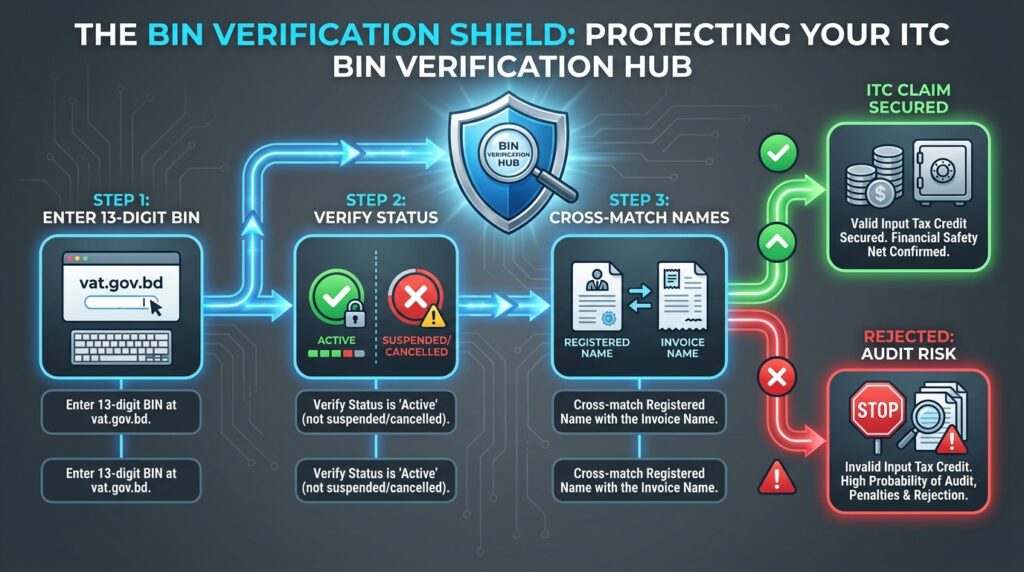
BIN verification is the process of confirming, before accepting or processing a supplier’s invoice, that:
- The BIN number cited on the Mushak 6.3 invoice actually exists in the NBR’s IVAS database
- The BIN is active and currently registered (not suspended, cancelled, or surrendered)
- The business name on the invoice matches the entity registered under that BIN
From my professional experience working with NBR VAT audits, the single most common cause of rejected Input Tax Credit claims — and the cascading penalty assessments that follow — is the failure to perform BIN verification before processing purchase invoices.
Here is why this matters financially: if you claim ITC on BDT 10,00,000 of purchases at 15% VAT, you claim BDT 1,50,000 in input credit. If those invoices cannot withstand BIN verification — because the supplier’s BIN is invalid, suspended, or does not match the invoice — the NBR disallows the entire BDT 1,50,000 claim, adds it back to your VAT payable, and imposes interest and penalty on the shortfall. A BDT 1,50,000 disallowance can generate BDT 50,000 to 80,000 in penalties and interest before the dispute is resolved.
BIN verification costs nothing and takes under two minutes. The financial risk of skipping it is potentially enormous.
How to Perform BIN Verification in Bangladesh: Step-by-Step
The primary, authoritative tool for BIN verification in Bangladesh is the NBR’s VAT Online portal at vat.gov.bd. Here is the complete process:
Method 1: BIN Verification Through vat.gov.bd (Primary Method)
- Visit vat.gov.bd — the official NBR VAT portal
- Look for the “BIN Verification” or “Taxpayer Search” option on the portal’s public-facing page (accessible without login)
- Enter the 13-digit BIN number from the supplier’s Mushak 6.3 invoice
- The system displays:
- The registered business name associated with that BIN
- The registered office address
- The registration status (active/suspended/cancelled)
- The type of registration (standard 15% or turnover 3%)
- Cross-reference the returned business name with the name on the invoice
What constitutes a successful BIN verification:
- The BIN exists in the IVAS database ✅
- Status shows “Active” ✅
- The registered business name matches the supplier name on the invoice ✅
Red flags requiring investigation before accepting the invoice:
- BIN not found in the database ❌
- BIN found but status is “Suspended” or “Cancelled” ❌
- BIN belongs to a different business name than the invoice ❌
Method 2: Old BIN Search (For Pre-2019 Registrations)
The NBR’s IVAS database primarily holds data updated from October 2019 for 13-digit BINs. Some businesses registered before the 9-to-13-digit transition may not appear immediately in the standard search. For these cases, use the alternative old-BIN search at nbr.gov.bd/old-bin-search/eng or contact the relevant VAT Commissionerate directly.
Important: Since 30 November 2019, the NBR formally invalidated all 9-digit and 11-digit BINs. If a supplier presents an invoice with a 9-digit or 11-digit BIN number, that invoice is non-compliant — do not claim ITC on it, and notify the supplier to update their registration.
Method 3: BIN Verification Through NBR.gov.bd
The NBR’s main website at nbr.gov.bd also provides VAT-related search tools and may list BIN information in certain categories of its public database. Cross-referencing with vat.gov.bd remains the definitive source.
BIN Verification Best Practices for Businesses
Based on my experience advising VAT-registered businesses in Bangladesh, here are the professional practices that eliminate BIN-related audit risk:
Verify every new supplier’s BIN before the first invoice. Do not wait until a supplier has issued multiple invoices before checking their BIN status. Verify on first engagement and record the verification result with a screenshot or printout dated to the day of verification.
Re-verify periodically for high-value suppliers. A supplier whose BIN was active when you first verified it may have had their BIN suspended subsequently — due to their own compliance failures. For suppliers representing more than 5% of your monthly input VAT claims, re-verify quarterly.
Keep BIN verification records. During NBR VAT audits, auditors may ask for evidence that you performed BIN verification before claiming ITC. A simple log file — BIN number, business name, verification date, status recorded — provides defensible documentation.
Train your accounts payable team on BIN verification. The accounts payable staff processing supplier invoices are the frontline of your ITC protection. Ensure they understand how to perform BIN verification and that no invoice proceeds to payment — or ITC claiming — without a completed check.
Never accept photocopied or verbally communicated BIN numbers. Require the actual BIN certificate (Mushak 2.3) from any new supplier, and verify the number independently on vat.gov.bd. A supplier reluctant to share their BIN certificate is a compliance red flag.
VAT Tax Calculator: Understanding the Mathematics
The VAT tax calculator — whether you use an online tool, a spreadsheet, or manual calculation — is built on straightforward mathematical formulas. Understanding these formulas is essential for every accountant, business owner, and finance professional operating in the vat bd system.
The Core VAT Formulas (Bangladesh)
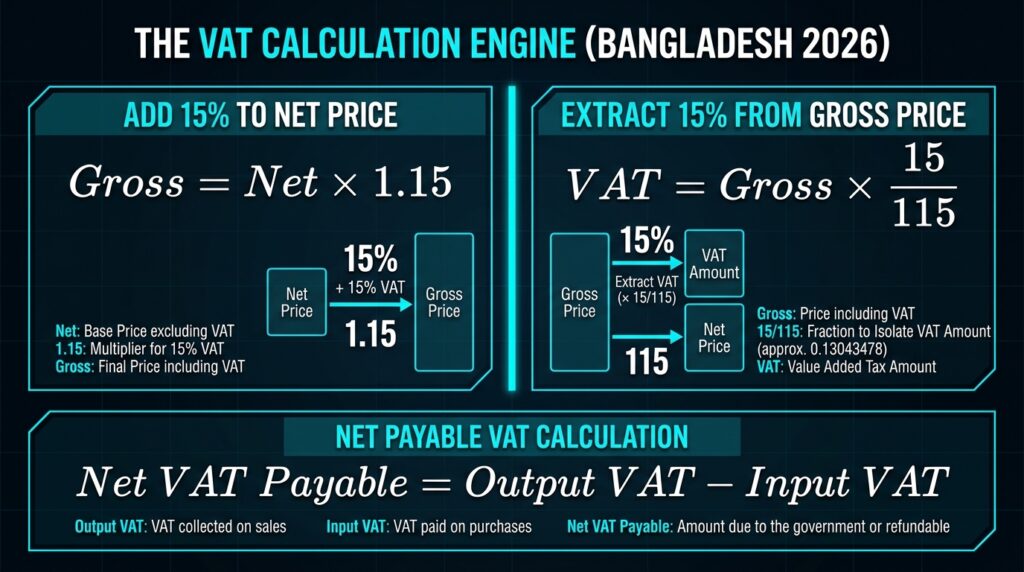
Adding VAT to a net price (calculating the gross invoice amount):
VAT Amount = Net Price × VAT Rate ÷ 100 Gross Price = Net Price + VAT Amount Or: Gross Price = Net Price × (1 + VAT Rate ÷ 100)
At 15% standard rate:
Gross Price = Net Price × 1.15
Example: Your service costs BDT 10,000 (net). Adding 15% VAT:
- VAT Amount = 10,000 × 15 ÷ 100 = BDT 1,500
- Gross Invoice Amount = 10,000 + 1,500 = BDT 11,500
Extracting VAT from a VAT-inclusive price (reverse calculation):
VAT Amount = Gross Price × VAT Rate ÷ (100 + VAT Rate) Net Price = Gross Price − VAT Amount Or: Net Price = Gross Price × 100 ÷ (100 + VAT Rate)
At 15% standard rate:
Net Price = Gross Price ÷ 1.15 VAT Amount = Gross Price − Net Price
Example (from the official NBR formula): You purchase goods at BDT 1,000 (VAT-inclusive at 15%). Extracting the VAT:
- VAT Amount = 1,000 × 15 ÷ 115 = BDT 130.43
- Net Price = 1,000 − 130.43 = BDT 869.57
Calculating net VAT payable for a VAT return:
Net VAT Payable = Output VAT − Input VAT
If Output VAT > Input VAT → Pay the difference to the NBR If Input VAT > Output VAT → Carry forward credit (or apply for refund if exporting)
VAT Tax Calculator: Worked Examples at Multiple Rates
Example 1 — Standard Rate (15%)
A trading company purchases goods worth BDT 5,00,000 (net) and sells them for BDT 8,00,000 (net):
| Net Amount | VAT @ 15% | |
|---|---|---|
| Purchases (Input) | 5,00,000 | 75,000 |
| Sales (Output) | 8,00,000 | 1,20,000 |
| Net VAT Payable | 45,000 |
Example 2 — Service at 7.5% Reduced Rate
A consulting firm bills BDT 2,00,000 for audit services:
- VAT = 2,00,000 × 7.5 ÷ 100 = BDT 15,000
- Invoice total = BDT 2,00,000 + 15,000 = BDT 2,15,000
Example 3 — Construction Services at 5%
A contractor bills BDT 10,00,000 for building construction:
- VAT = 10,00,000 × 5 ÷ 100 = BDT 50,000
- Invoice total = BDT 10,00,000 + 50,000 = BDT 10,50,000
Example 4 — Extracting VAT from a VAT-Inclusive Price (NBR Official Method)
A manufacturer buys raw materials for BDT 1,000 (VAT-inclusive at 15%) and sells finished goods for BDT 1,500 (VAT-inclusive at 15%):
- Input VAT = 1,000 × 15 ÷ 115 = BDT 130.43
- Output VAT = 1,500 × 15 ÷ 115 = BDT 195.65
- Net VAT Payable = 195.65 − 130.43 = BDT 65.22
This is the core Value Added Tax mechanism — the manufacturer only pays VAT on the BDT 500 value they added (BDT 1,500 − BDT 1,000), not on the full sale price.
Bangladesh VAT Rates Reference Table (2025–26)
Use this reference table with your VAT tax calculator to apply the correct rate:
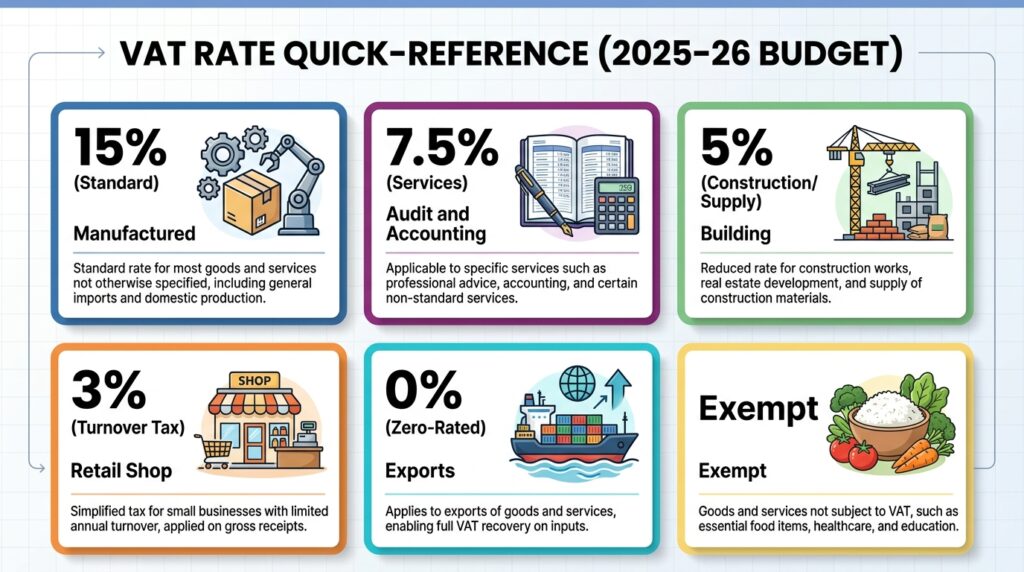
| Goods / Service Category | VAT Rate |
|---|---|
| Most manufactured goods | 15% |
| Most imported goods | 15% |
| Most professional services | 15% |
| Audit, accounting, and tax services | 7.5% (SRO-specified) |
| Construction of residential/commercial buildings | 5–7.5% |
| Restaurant services | 5% |
| Transportation (certain categories) | 5–7.5% |
| Electricity supply | 5% |
| Exports (all categories) | 0% (zero-rated) |
| Essential food items (rice, vegetables, fish, meat) | Exempt |
| Basic healthcare services | Exempt |
| Educational services | Exempt |
| Agricultural inputs | Exempt |
| Turnover tax (small businesses BDT 30L–80L) | 3% |
Note: Sector-specific VAT rates are subject to annual SRO (Statutory Rules and Orders) amendments. Always verify the applicable rate for your specific goods or services against current NBR notifications at nbr.gov.bd before issuing Mushak 6.3 invoices.
Using the Online VAT Tax Calculator
Several online VAT tax calculator tools are available for Bangladesh. The official NBR VAT tax calculator is accessible at nbr.gov.bd/e-services/vatcalculator/en. Third-party VAT calculators are also widely used by businesses and accountants.
When using any VAT tax calculator, input these parameters:
- Gross Amount or Net Amount — depending on whether you are adding VAT or extracting it
- VAT Rate — select the correct percentage from Bangladesh’s rate schedule (15%, 7.5%, 5%, etc.)
- Calculation direction — “Add VAT” or “Remove VAT”
To add VAT (calculate the VAT-inclusive invoice amount):
- Input: Net (pre-VAT) price + applicable VAT rate
- Output: VAT amount + Gross (VAT-inclusive) invoice total
To remove VAT (extract the net price from a VAT-inclusive amount):
- Input: Gross (VAT-inclusive) price + applicable VAT rate
- Output: Net amount + VAT component
The NBR also provides a dedicated VAT calculator built into the vat online bd system, accessible to registered users through their BIN account dashboard. This embedded VAT tax calculator uses current rate schedules directly from the IVAS database, reducing the risk of applying outdated rates.
BIN Verification and VAT Calculator: How They Connect in Practice
Understanding how BIN verification and the VAT tax calculator interact in daily business operations is critical. Here is a practical workflow:
Before issuing a Mushak 6.3 to a customer:
- Confirm your own BIN is active and correctly displayed on the invoice
- Use the VAT tax calculator to calculate the correct VAT amount at the applicable rate
- Ensure the invoice format is compliant with Mushak 6.3 requirements
Before accepting a supplier’s Mushak 6.3:
- Perform BIN verification on the supplier’s BIN using vat.gov.bd
- Confirm the BIN is active and the business name matches
- Use the VAT tax calculator to verify the VAT amount on the invoice is mathematically correct at the stated rate
- Only then process the invoice for payment and record the Input VAT for your monthly VAT return
This workflow eliminates the two most common ITC disallowance scenarios: invalid supplier BINs and incorrect VAT calculations.
Frequently Asked Questions
How do I verify a BIN number in Bangladesh? Visit vat.gov.bd and use the BIN Verification or Taxpayer Search tool. Enter the 13-digit BIN number. The system confirms the registered business name, address, and active/suspended status. Only 13-digit e-BINs have been valid since 30 November 2019.
What happens if I claim Input Tax Credit from a supplier with an invalid BIN? The NBR will disallow the entire ITC claim for those invoices. You will owe the full VAT amount plus interest (2% per month) and potential penalties. This is why BIN verification before processing any supplier invoice is non-negotiable.
What is the standard VAT rate in Bangladesh? The standard VAT rate in Bangladesh is 15%, applicable to most goods and services. Reduced rates (5%, 7.5%, etc.) apply to specified categories. Exports are zero-rated (0%). Some essential goods and services are exempt.
How do I calculate VAT at 15% on a net price in Bangladesh? Multiply the net price by 0.15 to get the VAT amount, then add it to the net price for the gross total. Example: Net price BDT 10,000 × 0.15 = BDT 1,500 VAT. Gross invoice = BDT 11,500.
How do I extract the VAT component from a VAT-inclusive price? Multiply the gross (VAT-inclusive) price by the VAT rate and divide by (100 + VAT rate). At 15%: VAT = Gross × 15 ÷ 115. Example: BDT 11,500 × 15 ÷ 115 = BDT 1,500 VAT.
Where is the official NBR VAT tax calculator? The NBR provides an official VAT tax calculator at nbr.gov.bd/e-services/vatcalculator/en. Registered users also have access to embedded calculation tools through their BIN account at vat.gov.bd.
Can a BIN expire in Bangladesh? A BIN does not automatically expire. However, it can be suspended or cancelled by the NBR if a business fails to file monthly Mushak 9.1 returns for consecutive periods. BIN verification reveals suspension status, which is why it must be performed at the time of each transaction — not just at initial supplier onboarding.
Is BIN verification required before every transaction? For new suppliers, always verify before the first invoice. For established suppliers, periodic re-verification (quarterly or more frequently for high-value relationships) is professional best practice. A supplier’s BIN status can change between your initial verification and subsequent transactions.
Final Thoughts: Build BIN Verification Into Every Purchase Workflow
BIN verification is the cheapest insurance policy available to any VAT-registered business in Bangladesh. It takes two minutes and protects potentially hundreds of thousands of taka in Input Tax Credit claims that could otherwise be disallowed during an NBR audit.
The VAT tax calculator formulas — whether used manually, through a spreadsheet, or through online tools — are straightforward. The standard formula of multiplying by 0.15 to add VAT, or multiplying by 15÷115 to extract it, is all you need for 90% of Bangladesh’s transactions at the standard rate. For reduced-rate categories, the same formula applies with the relevant percentage.
Together, BIN verification and accurate VAT tax calculator usage form the foundation of VAT compliance that withstands NBR scrutiny. Master both, build them into your monthly accounting workflow, and the complexity of Bangladesh’s vat bd system becomes a manageable routine rather than a compliance liability.
Need help with BIN verification procedures, VAT registration, monthly VAT return preparation, or NBR audit defence in Bangladesh? As a tax practitioner with direct NBR experience across VAT and income tax, I provide professional VAT compliance support for businesses of all sizes. Get in touch.
Tags: bin verification, vat tax calculator, bin verification bangladesh, vat rate bangladesh, BIN number bangladesh, e-bin, mushak 6.3, input tax credit bangladesh, vat calculation formula, vat.gov.bd, NBR VAT bangladesh 2026Share
Leave a Reply
You must be logged in to post a comment.