Written by Md Rakib Hassan — Income Tax Practitioner with 10+ years of tax compliance and audit experience across Bangladesh and the UK. Former Accounts Manager at a UK chartered accounting firm managing 1,000+ clients, with direct experience resolving multi-year tax audit disputes with HMRC and the NBR. Currently Finance Controller at a UK-based multinational tech group.
Introduction
If you run a business in Bangladesh, the BIN — Business Identification Number — is your company’s legal identity in the Value Added Tax (VAT) system. Just as an individual taxpayer needs a 12-digit TIN to file income tax, your business needs a BIN to collect VAT, issue legal invoices, import goods, participate in tenders, and open commercial bank accounts.
In 2026, the only valid BIN format in Bangladesh is the 13-digit e-BIN, issued exclusively through the NBR’s VAT online portal at vat.gov.bd. Old 9-digit and 11-digit BINs were formally invalidated by the NBR on 30 November 2019. If your business is still using an old-format BIN, you are operating illegally — and this guide tells you exactly what to do about it.
What Is a BIN in Bangladesh?
A BIN (Business Identification Number) is a unique identifier issued by the National Board of Revenue (NBR) to every business that registers for Value Added Tax (VAT) in Bangladesh. It is also sometimes called the VAT Registration Number.
The BIN confirms that your business is legally registered in Bangladesh’s VAT system and authorises you to:
- Charge VAT on your taxable supplies
- Issue Mushak 6.3 tax invoices to customers
- Claim Input Tax Credit (ITC) on your business purchases
- File monthly VAT returns (Mushak 9.1)
- Import goods through Bangladesh Customs
- Participate in government tenders and procurement
- Open commercial bank accounts and apply for letters of credit
The BIN is not the same as the TIN (Taxpayer Identification Number). A TIN is issued for income tax purposes; a BIN is issued specifically for VAT purposes. However, a business must have a valid TIN before applying for a BIN.
The 13-Digit BIN: Format and Structure
Since the VAT and Supplementary Duty Act 2012 came fully into force in July 2019, the legally mandated BIN format is a 13-digit e-BIN. Here is how the structure works:
The 13-digit BIN is structured as a combination of digits that encode the taxpayer’s registration type, VAT commissionerate, circle, and sequence number. Every 13-digit BIN is unique across Bangladesh’s entire VAT registry.
Important legacy note: Old BIN formats included:
- 9-digit BINs (pre-2019 format)
- 11-digit BINs (transitional format)
Both were formally invalidated by the NBR on 30 November 2019. Under the VAT and Supplementary Duty Act 2012, only the 13-digit e-BIN is now a legally accepted format for all business activities — including import and export, tender participation, bank loans, and VAT invoicing.
Any business that presents an old-format BIN on a Mushak 6.3 invoice exposes both buyer and seller to compliance penalties. The buyer also loses the right to claim input tax credit on that transaction.
Who Needs a BIN in Bangladesh?
BIN registration is mandatory for any person or entity conducting economic activities in Bangladesh in the following circumstances:
Threshold-Based Registration: Under revised thresholds (updated by ordinance in January 2025):
- Annual turnover above BDT 50 lakh (5 million) → Full VAT registration required → Standard 15% VAT applies
- Annual turnover between BDT 30 lakh and BDT 50 lakh → Turnover tax enlistment → 4% rate applies
Mandatory Registration Regardless of Turnover (Section 4(b) and General Order 17): The following business types must obtain a BIN even if they earn as little as one taka:
- All private and public limited companies
- Importers (required for customs clearance and Bill of Entry)
- Exporters (required for ERC/IRC)
- Hotels, restaurants, and catering services
- Telecommunications companies
- IT and software firms (including fintech)
- Consulting and professional service firms
- Retailers in shopping malls or city corporation areas
- Branch and liaison offices of foreign companies
- Any business participating in government tenders
Registration must be obtained within 15 days of crossing the applicable threshold or commencing a mandatorily registrable activity.
How to Register for a BIN Online in Bangladesh
The BIN registration process is fully digital and free of charge. Here is the complete step-by-step guide:
Step 1 — Visit the VAT Online Portal Go to www.vat.gov.bd. Create a taxpayer user account using your mobile number and email address. Verify via OTP.
Step 2 — Log In and Select BIN Registration After logging in, access the iVAS dashboard. Click on “BIN Registration” or “VAT Registration.”
Step 3 — Complete Form Mushak 2.1 Mushak 2.1 is the standard application form for VAT registration or turnover tax enlistment. You will need to enter:
- Business name and nature (manufacturer, trader, service provider, importer, exporter, etc.)
- Business postal address and all sales outlets or branches
- Estimated annual turnover
- Type of registration required (standard VAT at 15% or turnover tax at 4%)
- TIN number (required before applying for a BIN)
Step 4 — Upload Required Documents Documents required may include (vary by business type):
- Copy of TIN certificate
- Trade licence
- NID of proprietor/authorised signatory
- Memorandum and Articles of Association (for companies)
- Certificate of Incorporation (for limited companies)
- Import Registration Certificate (IRC) or Export Registration Certificate (ERC) — if applicable
- List of all business premises and addresses (for central registration with multiple outlets)
- Bank account details
- Passport-size photograph of authorised person
For foreign entities, additional VAT agent appointment documents may be required.
Step 5 — Submit and Await Verification After submitting the application electronically, it is forwarded to your local VAT Circle Office. An officer may conduct a physical inspection of your business premises. If everything is in order, your BIN certificate is typically issued within 3 to 7 working days.
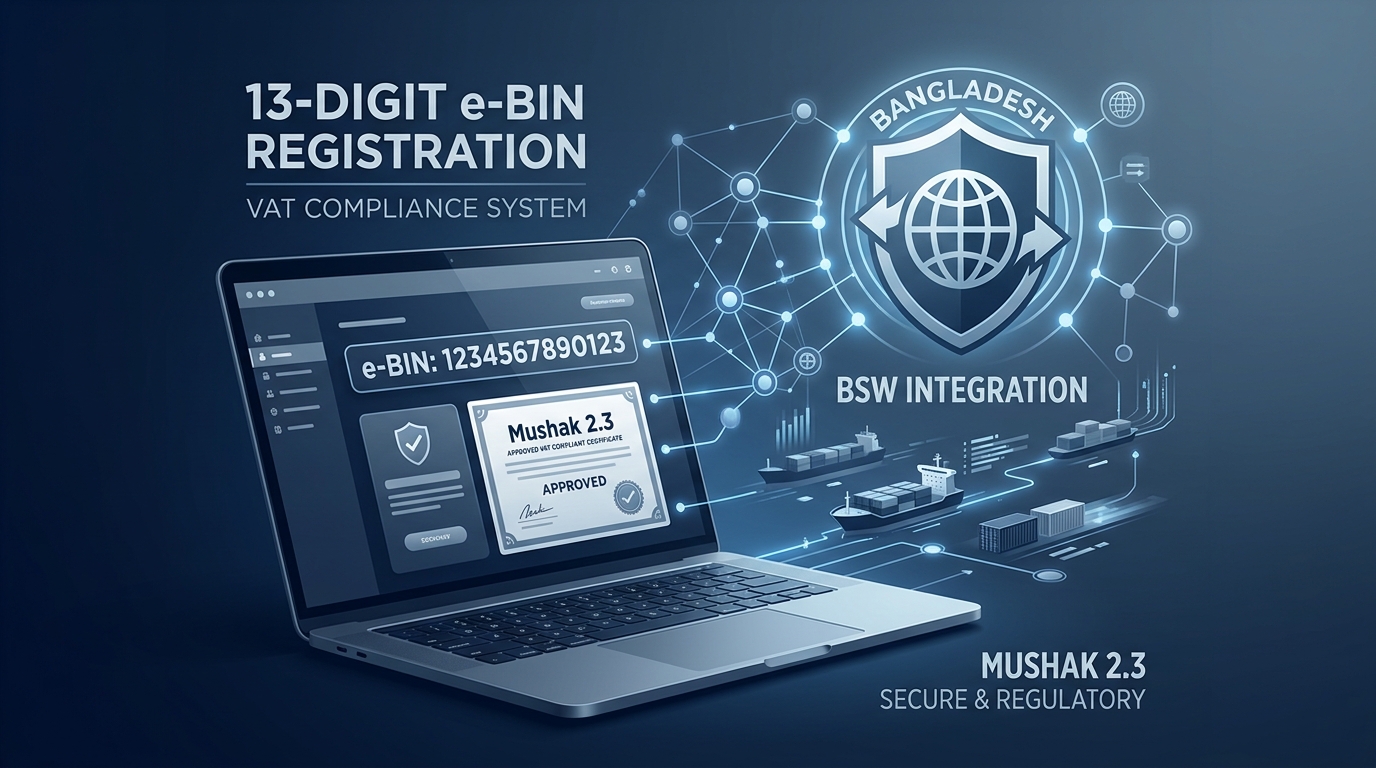
Step 6 — Download Your BIN Certificate (Mushak 2.3) Upon approval, the NBR issues your VAT Registration Certificate — formally known as Mushak 2.3 — electronically. This is your official BIN certificate and can be downloaded from the vat.gov.bd portal.
Expert Note — Md Rakib Hassan: The most common reason for BIN application rejection in my experience is address mismatch — the address in the application does not match the trade licence or NID details. Cross-check every address field against your supporting documents before submitting. A rejected application adds days or weeks of delay, and if your business is already operating, every day without a BIN is a day of potential VAT non-compliance.
How to Download Your BIN Certificate
To download your BIN certificate (Mushak 2.3) after registration:
- Log in to vat.gov.bd with your credentials
- Go to your dashboard
- Navigate to “BIN” or “VAT Registration” section
- Click “Download BIN Certificate” or “Mushak 2.3”
- Save the PDF file
You must display your BIN certificate prominently at your principal place of business and at all branches. You must also quote your BIN on all Mushak 6.3 tax invoices issued to customers and on all business correspondence related to VAT.
How to Verify a BIN in Bangladesh
BIN verification is critical for businesses before they process purchases from suppliers. Under Bangladesh’s VAT and Supplementary Duty Act 2012, a valid Mushak 6.3 invoice must contain the name, address, and BIN of both buyer and seller. If you claim input tax credit against an invoice with an invalid BIN, that claim is disallowed — and NBR can impose a penalty of BDT 10,000 for irregular invoicing.
To verify a 13-digit BIN: The NBR provides a BIN search/verification tool. You can access it through the NBR website at nbr.gov.bd. Search by company name or BIN number to verify registration status.
To verify an old 13/14-digit legacy BIN: The NBR maintains a legacy database for BINs registered prior to the 2019 migration. Access the old-BIN search at nbr.gov.bd/fourteen-digit-bin-search/eng or nbr.gov.bd/old-bin-search/eng. Note that this database only holds data as of its last update (October 2019) — companies that registered after that date or were migrated may not appear in the legacy tool.
If BIN search returns no result: Contact the relevant VAT Commissionerate directly. It is possible the company is registered but not yet in the indexed database.
What Is the Difference Between a 9-Digit, 11-Digit, and 13-Digit BIN?
| BIN Format | Era | Status |
|---|---|---|
| 9-digit BIN | Pre-2012 | INVALID since 30 November 2019 |
| 11-digit BIN | Transitional | INVALID since 30 November 2019 |
| 13-digit e-BIN | 2019–present | ONLY VALID FORMAT |
Many businesses — particularly those that have been operating for years and never updated their registration — are still using old-format BINs in transactions. The NBR has issued instructions to all field-level VAT offices to take action against businesses using invalid BINs. If your business has not yet migrated to the 13-digit e-BIN, do this immediately via vat.gov.bd. Migration is free of charge.
BIN and the BSW System (Effective July 2025)
From 1 July 2025, Bangladesh launched the Bangladesh Single Window (BSW) system — an online platform for importers and exporters to submit all certificates, licences, and permits required for goods clearance. The BSW system is directly integrated with the NBR’s BIN database.
To use BSW system services, users must register their BIN on the BSW platform at bswnbr.gov.bd. From July 2025, certificates, licences, and permits issued by 19 government organisations (including DGDA, EPB, BEZA, BEPZA, BTRC, BSTI, BAERA, and others) are mandatory through the BSW system for import and export customs clearance.
This means that from 2025 onwards, a valid 13-digit BIN is not just a VAT requirement — it is a prerequisite for functioning within Bangladesh’s entire import-export ecosystem.
Keeping Your BIN Active: Ongoing Compliance Obligations
Once registered, your BIN does not expire — as long as you continue filing your monthly VAT returns. However, if you fail to file returns for consecutive periods, the NBR may lock or suspend your BIN. A suspended BIN halts all banking, import-export, and invoicing activities.
To keep your BIN active, you must:
File Monthly Mushak 9.1 Returns By the 15th of every following month, even for months with zero transactions (nil return).
Issue Mushak 6.3 Tax Invoices For every sale to customers — including the buyer’s BIN on the invoice.
Maintain VAT Records Keep Mushak 6.1 (Purchase Book) and Mushak 6.2 (Sales Book) for all transactions. Records must be preserved for 5 years.
Update Business Details If your business address, ownership structure, or product/service scope changes, update your registration on the vat.gov.bd portal through a Mushak 2.1 amendment.
Display BIN Certificate Display prominently at all places of business.
BIN Registration Fees
There is no government fee for obtaining a BIN in Bangladesh. The entire BIN registration process through vat.gov.bd is free of charge. Be cautious of agents who charge service fees — while professional assistance is legitimate, the underlying registration itself costs nothing.
Penalties Related to BIN Non-Compliance
| Violation | Penalty |
|---|---|
| Failure to register when required | Up to BDT 50,000 |
| Using old/invalid BIN in transactions | VAT non-compliance — penalties apply |
| Issuing invoice without buyer/seller BIN | BDT 10,000 + loss of input tax credit |
| Late VAT return filing | BDT 10,000/month + interest |
| Non-payment of VAT | 2% interest per month |
| Filing false returns | Up to BDT 100,000 + criminal prosecution |
Frequently Asked Questions
Q1. What is the difference between a TIN and a BIN in Bangladesh? A TIN (12-digit) is your income tax identification number. A BIN (13-digit) is your VAT registration number. Most businesses need both. TIN is required before applying for a BIN.
Q2. How long does BIN registration take? After submitting your online application and documents, the process typically takes 3 to 7 working days, pending physical verification of premises by the VAT Circle Office.
Q3. Can I have one BIN for multiple business branches? Yes. A central registration with one BIN can cover multiple sales outlets and branches, provided all locations are listed in the Mushak 2.1 application.
Q4. My BIN is locked. What should I do? File all overdue Mushak 9.1 returns through the vat.gov.bd portal and contact your local VAT Circle Office to request BIN reactivation.
Q5. Do I need a BIN to participate in government tenders? Yes. A valid 13-digit BIN is mandatory for participation in government tenders and procurement processes in Bangladesh.
Q6. Is there a deadline for migrating from an old BIN to a 13-digit e-BIN? Old BINs were officially invalidated on 30 November 2019. There is no grace period — if you are still using an old BIN, you are operating in non-compliance. Migrate immediately at vat.gov.bd.
Final Thoughts
The BIN is the cornerstone of VAT compliance in Bangladesh. Whether you are a startup applying for your first registration or an established company that has been overlooking an old BIN migration, the stakes in 2026 are clear: without a valid 13-digit BIN, your business cannot legally import goods, issue compliant invoices, participate in tenders, or claim input tax credits.
The registration process through vat.gov.bd is free, increasingly efficient, and well-supported by the NBR’s field offices. Take the time to get it right the first time — correct address matching, complete documentation, and accurate business classification — and your BIN will serve as a durable foundation for every commercial activity your business conducts.
This article is informational and reflects VAT and BIN regulations as understood in 2026. Regulations may change. Consult the NBR website or a registered VAT practitioner for advice specific to your business.
Leave a Reply
You must be logged in to post a comment.